

Published :
Updated :
 For all latest news, follow The Financial Express Google News channel.
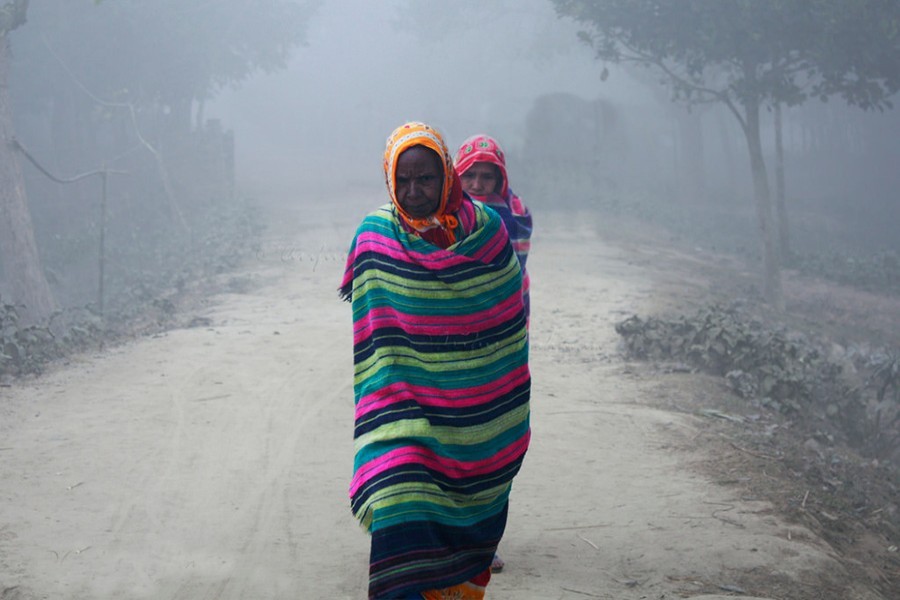
A biting cold wave swept across large parts of Bangladesh on Tuesday, pushing temperatures down to the season's lowest and disrupting daily life in at least 10 districts.
According to the Bangladesh Meteorological Department (BMD), the country's lowest temperature was recorded at 7.0°C in Rajshahi, as a mild to moderate cold wave continued to affect the region.
"The current situation will prevail across the country till January 11, and from January 12 the temperature may rise," said Omar Faruk, a meteorologist at BMD.
In its regular bulletin, BMD said a mild to moderate cold wave is sweeping over Rajshahi, Pabna, Bogura, Dinajpur, Nilphamari, Panchagarh, Rangamati, Jashore, Chuadanga and Kushtia, and it may continue.
The weather office also warned of moderate to thick fog over the country from midnight to morning, which may linger until noon in some areas. Such conditions could temporarily disrupt air navigation, inland river transport and road communication, it said.
While both night and day temperatures may rise slightly, BMD noted that cold feelings are likely to persist due to foggy conditions.
Meanwhile, a well-marked low-pressure area formed over the southeast Bay of Bengal and the adjoining East Equatorial Indian Ocean remains over the same area, with its associated trough extending up to the North Bay.
At the same time, the ridge of the sub-continental high extends up to West Bengal and the adjoining western parts of Bangladesh.
Life slowed in Chuadanga
In Chuadanga, the cold wave has taken a heavy toll on daily life.
Correspondents report that normal activities in the southwestern border district have been thrown out of gear as dense fog and piercing cold continue to grip the area.
The season's lowest temperature of 7.5°C was recorded at 9 am on Tuesday, according to the district's first-class meteorological observatory.
This is the lowest temperature recorded in Chuadanga during the current winter season.
Meteorological officials said a mild to moderate cold wave is sweeping over the district and may persist until January 11 or 12.
"Cold conditions are likely to continue for a few more days," said Md Jaminur Rahman, acting officer-in-charge of the Chuadanga first-class meteorological observatory.
Despite the freezing weather, low-income people were seen lighting fires early in the morning at street corners, bus terminals and tea stalls to keep themselves warm. Most residents preferred to stay indoors, venturing out only when necessary.
For daily wage earners, the cold has made life particularly difficult. Many said going out for work in the early hours has become extremely challenging.
A farmer said his hands and feet go numb due to the cold, yet he is forced to leave home every morning in search of work-often returning without finding any.
Health concerns rise
The cold wave has also led to a rise in cold-related illnesses.
At Chuadanga Sadar Hospital and other health facilities, doctors reported an increase in patients suffering from respiratory problems.
Medical professionals said children and the elderly are especially vulnerable, with cases of pneumonia, coughs and colds on the rise.
Business activities in the district have slowed as well, with traders reporting very few customers before noon, as thick fog and cold conditions keep people off the streets.
As the cold wave continues to blanket much of the country, authorities have urged people-especially the poor, children and the elderly-to take precautionary measures to stay warm and avoid health risks.