

Published :
Updated :
 For all latest news, follow The Financial Express Google News channel.
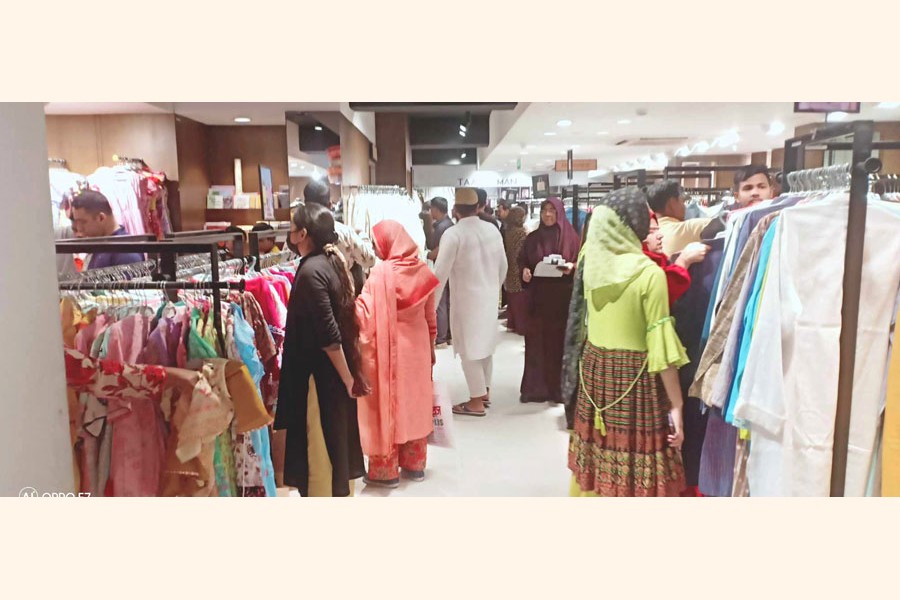
As customers throng shopping malls ahead of Eid, Bogura traders estimate sales would fall compared to last year; severe competition from foreign garments almost push out local handloom and cotton apparel in Cumilla; while families of low-income buyers in Rangpur suffer due to exorbitant clothing prices.
Our correspondent from Bogura writes, shopping ahead of Eid-ul-Fitr has gathered pace in the city markets although traders expect overall sales to fall about 11 per cent from a year earlier due to high inflation eroding consumers' purchasing power.
Business leaders and shop owners say weaker rural incomes and the growing spread of small local shops offering credit sales have dampened demand in the city's traditional retail hubs.
Traders estimate that total Eid sales in Bogura may struggle to reach Tk4.0 billion this year, down from roughly Tk4.5 billion last year.
Bogura, often referred to as the commercial hub of northern Bangladesh, has around 15 major shopping markets within an area of about 20 square kilometres.
During the Eid shopping season, pavements as well as formal markets blend into one large retail zone as hundreds of thousands of shoppers crowd the city.
Visits to major shopping centres including New Market, Al-Amin Complex, Sharif Uddin Market, Ranar Plaza, Police Plaza, Churi Patti, Jaleshwaritala and the Hawkers Market showed large crowds of shoppers seeking garments across a wide range of prices and styles.
"Clothing prices are much higher than last year," said shopper Jebunnesa Jesi.
"A three-piece dress that cost Tk 3,000 last year is now selling for around Tk 5,000."
Pakistani and Indian garments and sarees are drawing strong interest among buyers, she added.
Shop owners say their main customer base comes from rural areas, where incomes have been hit by weak agricultural prices.
"High inflation has reduced real incomes, while farmers in rural areas have received low prices for potatoes, leaving them short of cash," said Abu Bakkar Siddiqi, joint secretary of the Bogura Bara Mosque Lane Shop Owners' Association.
He told the FE that that clothing traders in the area are expected to sell goods worth about Tk1.0 billion this Eid season, compared with Tk1.5 billion a year earlier.
Kala Chand Saha, owner of Roni Cloth Store in Samir Uddin New Market, said sales had slowed significantly compared with last year.
"Our main customers are villagers. Potato prices are low and many farmers have less cash," he said.
"Meanwhile, new shops have opened in rural areas and they often sell on credit, which we cannot offer in city markets."
A correspondent from Cumilla notes, imported apparel, especially Indian and Pakistani women's wear, appears to be crowding out locally made traditional outfits, raising questions about the future availability of domestic apparel in one of the busiest retail seasons of the year.
Retailers at Khondokar Haque Tower, Sattar Khan Shopping Complex, Planet SR and Delwar Rupayan Tower have been making brisk inquiries for Pakistani and Indian collections. Stores have stocked a wide range of sarees, three-piece and four-piece outfits to cater to anticipated demand. Shop owners acknowledge that while local cotton sarees, jamdani and katan remain available, imported brands are drawing stronger interest.
Yusuf Haque, a salesperson at Style One in Sattar Khan Shopping Complex,
said customer traffic began to increase after the first week of Ramadan. Pakistani and Indian three-piece suits account for a significant share of sales, he noted, attributing their popularity to distinctive designs and strong marketing. "Local cotton sarees still have buyers," he added, "And party sarees, jamdani and katan are selling too." He expects transactions to accelerate as Eid draws nearer.
Jakir Hossain, director of Ideal Fashion at Khondokar Haque Tower, offered a similar assessment. According to him, Pakistani Jimsu, Tawakkal and Dastak collections are leading current sales, alongside Indian Bichitra and Delhi Boutiques lines. Among domestic options, Bangladeshi Rakhi three-piece sets are available, with prices varying depending on fabric quality and embroidery work.
Our correspondents from Rangpur reports, although the solvent as well as affluent customers are able to purchase their preferred outfits, the middle- and lower- income people are struggling a lot to meet the demand of their entire family members.
Shoppers said the prices of outfits have increased notably this year compared with last year. Especially, dresses for children and women are being sold exorbitantly.
At different shopping malls, women's three- piece outfits of different kinds and designs are being sold at higher rate ranging from Tk 3,000 to Tk 20,000 each depending on designs and quality. Different varieties of women's three -piece outfits include Aarong three-piece outfits, Indian Delhi boutique, Jomjom, Hoor, Jafran, and Farsi three piece. Pakistani outfits like Sadabahar, Aghanoor, Neha, Rangoon have huge demand among the female customers.
Besides, different varieties of children's dress items are being sold at exorbitant prices starting from Tk 1,200 to Tk 10,000.
A number of sellers said the sarees that are in huge demand are katan, jamdani, silk, benarashi and georgette. The prices of sarees vary from Tk 1,500 to Tk 40,000 each depending on design and quality.
On the other hand, lower income groups are found buying sarees at Tk 600 to Tk 1200 each.
Presently, buyers are thronging to different markets in the city including Jahaz Company shopping Complex, Super Market, Mati Plaza, City Plaza, Salek Market, RAMC Shopping complex, Royalty Mega Mall, Karupannya and different clothing stores as well as makeshift clothing shops on footpaths.
A number of traders told the FE that last year, they could not earn a good profit due to political unstable situation. But this year, owing to business-friendly atmosphere, they are witnessing huge sales and are optimistic of earning a satisfactory profit, they added.
Iren Ruma, a buyer, said she came to Super Market to buy dresses for her daughter and herself.
She said, "This year, the prices of dresses for women are abnormally higher compared with previous years. Sellers are demanding Tk 4,500-5,000 for a three-piece outfit which was sold at Tk 3,000 last year," she further said.
Hafizur, a resident of Mulatol area in Rangpur city, said that customers have to spend at least Tk 4,000 to Tk 6,000 to buy a quality dress in the shopping malls, which is a huge burden for most of the shoppers.
Especially, those who have two or three children are in immense trouble, he added.
Meanwhile, lower income people are rushing to the makeshift shops on footpaths to purchase clothes for their family members.
Expressing disappointment, Md. Rashed, a farmer from Gangachara Upazila of Rangpur, said he came to the shops on footpath in the city to buy clothes for his three children. He said this year, he is facing severe financial crisis as he incurred colossal losses from potato cultivation.
He mentioned that the high cost of clothes, even at sidewalk shops, made it impossible for him to purchase outfits for his three children.
Finding no other options, he was compelled to buy one T-shirt for his four- year- old youngest son, he said.
He said that this year, he as well as other farmers suffered huge losses by cultivating potato and as a result, they do not have enough money to buy necessary clothes for their family members.
sajedurrahmanvp@gmail.com
zahidpressbd@gmail.com
sayedmofidulbabu@gmail.com