
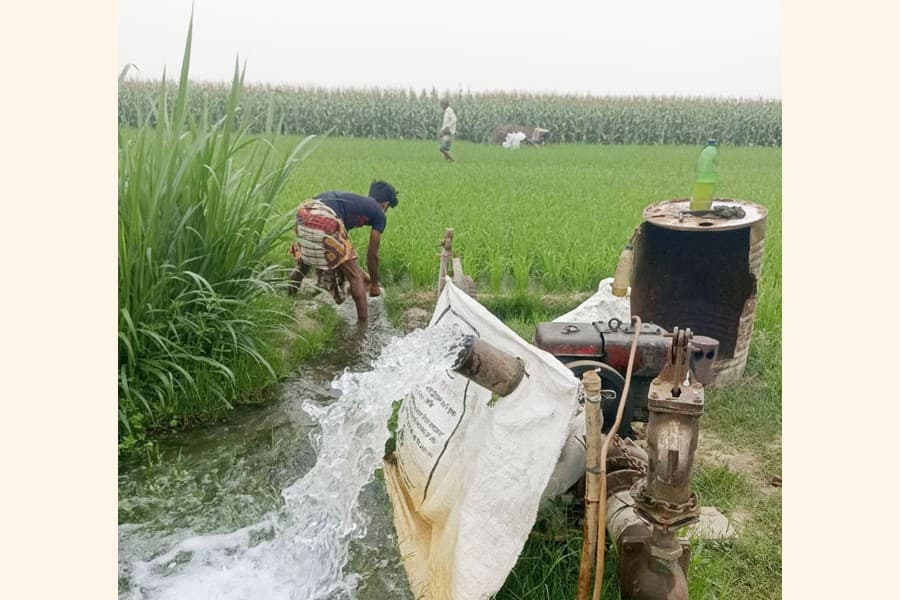
RAJSHAHI, Apr 02: Farmers across northern Bangladesh are becoming increasingly concerned about irrigating their Boro paddy fields as a severe diesel shortage disrupts irrigation activities during the peak time of the cultivation.
With limited fuel supplies at filling stations, many farmers say they are struggling to secure diesel needed to operate irrigation pumps.
Some retailers are reportedly charging Tk15-20 per litre above the government-fixed price, citing supply constraints.
Farmers fear that if the situation persists, it could significantly affect boro production, one of the country's main food crops.
Diesel-powered machinery is widely used in land preparation, irrigation and harvesting during the Boro season.
According to the Department of Agricultural Extension (DAE), the country currently has 754 diesel-run deep tube-wells, 1,039,337 shallow tube-wells and 184,384 low-lift pumps in operation. The agriculture authorities have set a target to bring about 5.053 million
hectares of land under boro paddy farming nationwide in the 2025-26 fiscal year,.
Agriculture officials said as of Thursday noon, nearly 96 per cent of the targeted land had already been transplanted with boro seedlings.
In the Rajshahi agricultural region-comprising Rajshahi, Natore, Naogaon and Chapainawabganj districts-the cultivation target for the current season stands at about 352,000 hectares. Around 21 per cent of the irrigated land in this region depends on diesel-powered pumps.
Data from the DAE's Rajshahi divisional office show that the four districts together have 11,535 deep tube-wells, including 11,220 powered by electricity and 315 by diesel.
There are also 110,449 shallow tube-wells-21,195 electric and 88,268 diesel-run. In addition, the region has 8,647 low-lift pumps, of which 1,189 are electric and 7,458 diesel-operated. Ninety-one more irrigation pumps run on solar power.
Farmers say the ongoing diesel shortage is already affecting irrigation schedules, raising fears of crop damage.
Mohammad Jahangir, a farmer from Baje Kalshipur village
in Durgapur upazila, said he had to buy diesel at Tk 120 per litre from a local retailer after failing to find fuel at several filling stations.
Another farmer from Chidro Kalshipur village, Md Moslem Uddin, said he could not manage even a litre of diesel after visiting several retail outlets in the local market on Wednesday.
"My Boro fields are drying up. I even offered to pay Tk 150 per
litre, but still could not get diesel," he said.
Abdullah Bin Safi, a farmer from the Diyar Manikchar area of Godagari upazila, said diesel prices in the char areas had risen from Tk 102 to Tk 120 per litre over the past five days, significantly increasing irrigation costs.
Pump operators said they have also been forced to raise irrigation charges, putting additional pressure on farmers.
Labu Mia, a farmer and irrigation pump owner from Natore's Singra upazila, said diesel had become difficult to obtain from local shops since the outbreak of conflict between the United States and Iran. Retailers are charging about Tk 15 more per litre, he added.
Agricultural economist and former director general of the Bangladesh Livestock Research Institute Dr Jahangir Alam Khan said the ongoing global energy crisis linked to geopolitical tensions had disrupted fuel supply chains.
He said the government's decision to introduce rationing of fuel was reasonable but stressed that priority sectors must be clearly identified.
"Boro is the country's main food crop and heavily dependent on irrigation. About 62 to 65 percent of Boro land is irrigated using diesel-powered pumps. Therefore, the agriculture sector should receive top priority in fuel distribution during this period," he said.
He also suggested introducing diesel subsidies for irrigation, similar to electricity subsidies in agriculture, and accelerating canal excavation projects to improve surface water irrigation.
However, Dr Md Azizur Rahman, additional director of the DAE's Rajshahi divisional office, said he had not received any complaints about diesel shortage or overpricing. According to him, irrigation activities across the country are continuing normally as fuel supply remains uninterrupted.
anaetru@gmail.com