

CUMILLA DISTRICT
Farmers upset as power outages expose seed potatoes to spoilage
Published :
Updated :
 For all latest news, follow The Financial Express Google News channel.
Persistent power cuts have begun to unsettle potato farmers across Cumilla, as several thousand tonnes of their stored produce, much of which is intended as seed for the next planting season, now face an uncertain fate.
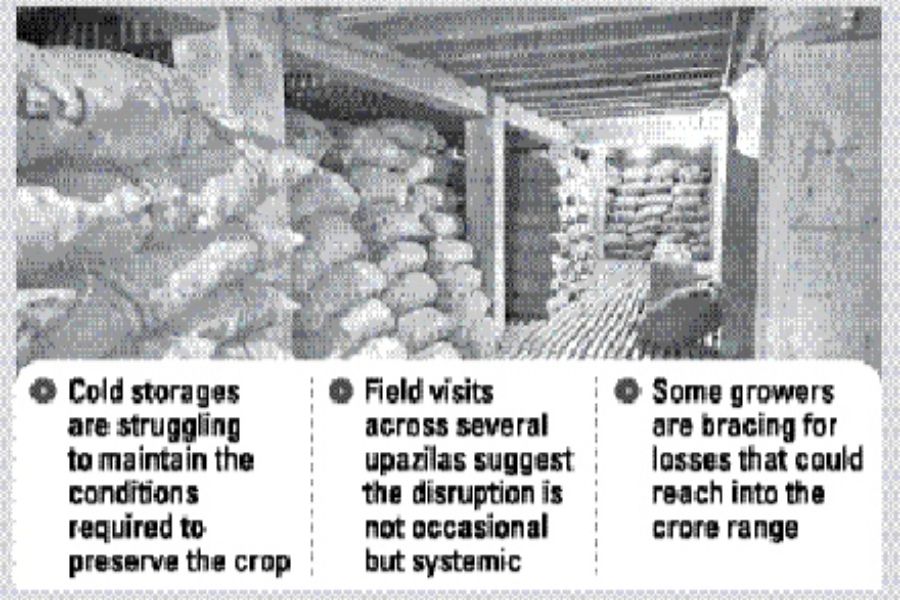
With electricity supply failing to stabilise, cold storage facilities are struggling to maintain the conditions required to preserve the crop, raising fears of spoilage and significant financial loss.
Field visits across several upazilas suggest the disruption is not occasional but systemic.
In many facilities, uninterrupted electricity lasts barely a few hours a day. At times, supply returns for as little as 15 to 20 minutes, an interval too brief to restart and run heavy refrigeration systems that typically require at least half an hour to reach operational capacity.
Operators say this stop-start pattern is particularly damaging, as it prevents temperature consistency inside storage units.
The stakes are not limited to current inventories. A substantial portion of the stored potatoes consists of seed stock, which farmers rely on for the next cultivation cycle. If these deteriorate, the impact may extend well beyond this season, potentially affecting planting decisions, yields, and local market stability.
Agricultural observers indicate that such a disruption, if prolonged, could ripple through the district's farming economy in ways that are difficult to reverse quickly.
Farmers, for their part, are doing the arithmetic with growing unease.
Storing a single sack of seed potato costs around Tk300. For those holding large quantities, the investment runs into several lakhs of taka. The uncertainty over whether that investment will hold has created palpable anxiety. Some farmers privately admit they are bracing for losses that could reach into the crore range if conditions do not improve.
The situation appears particularly strained in Daudkandi upazila. A visit on Wednesday revealed cold storage units operating under severe constraints, with large volumes of potatoes effectively in limbo.
In Gauripur, farmer Monir Hossain Miaji said he has stored around 1,000 sacks of potatoes but now questions whether they will remain intact.
Electricity, he noted, was available for only about 30 minutes between morning and noon. "If this continues," he said, "We may lose everything."
Others echo the same concern, though with a slightly different emphasis. Nabir Hossain Bepari, also from the area, pointed out that most of his stored produce is seed potato. If these fail, he fears he may not be able to cultivate potato at all next year. The concern, in his words, is not just about immediate loss but about falling into a cycle of financial strain that could be hard to escape. Both farmers urged the government to intervene quickly to stabilise power supply.
Cold storage owners are facing their own dilemma. They acknowledge the reliance farmers place on them but say the current conditions leave little room to manoeuvre. Running generators is technically possible, yet the cost is prohibitive over extended periods.
Ruhul Amin Majumder, owner of a cold storage facility in Noadda under Naiyar Bazar, said his unit has a capacity of around 180,000 sacks but is operating below that level this season. Yet maintaining the stored stock has become increasingly difficult. Electricity supply, he said, is too erratic to support continuous operation.
Officials from the power distribution side admit the problem but offer limited immediate reassurance.
Molla Abu Jihad, deputy general manager of Cumilla Palli Bidyut Samity-3, said the issue has been reported to higher authorities and efforts are underway to address it. He described the response as ongoing, though did not indicate a clear timeline for improvement.
For now, uncertainty dominates. Farmers and cold storage operators alike are calling for uninterrupted electricity supply, arguing that without it, both the stocks --for the present consumption and the next planting season-- remain exposed to risk.
If the disruption persists, the consequences may not be confined to individual losses; they could weigh on the broader agricultural economy of Cumilla in the months ahead.
zahidpressbd@gmail.com