

Stakeholder meeting on green evolution project promotes safe farming in Singair
Published :
Updated :
 For all latest news, follow The Financial Express Google News channel.
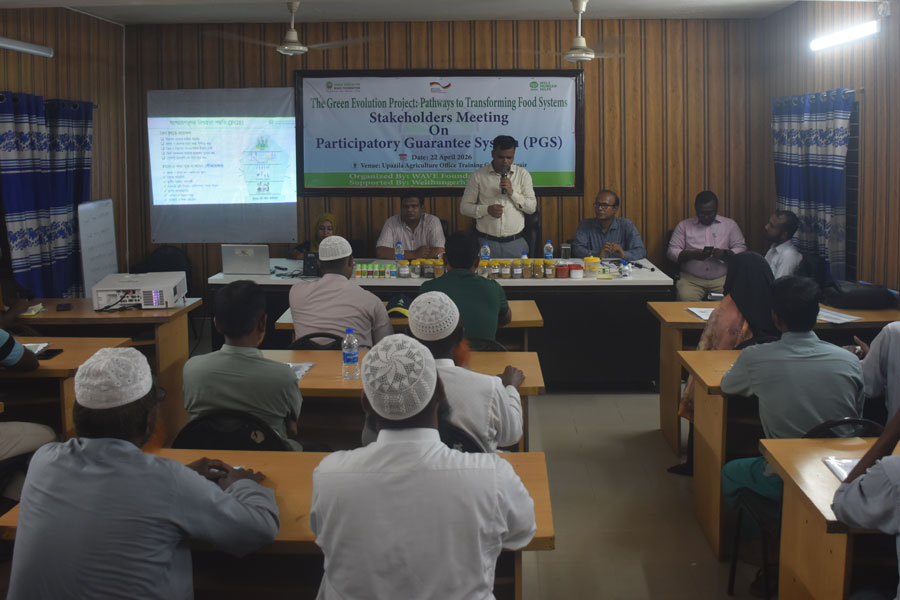
A stakeholder meeting titled “The Green Evolution Project: Pathways to Transforming Food Systems” was held in Singair Upazila of Manikganj to promote safe and environmentally friendly agricultural practices.
The seminar was organised on Wednesday noon at the Upazila Agriculture Office Training Center by Wave Foundation, with support from Welthungerhilfe Bangladesh.
At the beginning of the event, Agroecology Expert Md Istiaq Islam of Wave Foundation presented an informative overview of the project. He explained the differences between agroecological farming, chemical-based agriculture, and environmentally friendly farming, and also elaborated on the Participatory Guarantee System (PGS).
The session was moderated by Sourav Kanti Das, communication and advocacy coordinator of Wave Foundation. Among the speakers were Singair Upazila Agriculture Officer Md Habibul Bashar Chowdhury, Upazila Livestock Officer Dr Sazedul Islam, Veterinary Surgeon Dr Mahamuda Akter Sumi, and Project Coordinator Anisur Rahman.
Speakers highlighted that agroecological farming is a sustainable, nature-based approach that emphasises soil health, water conservation, biodiversity, and human well-being. In contrast, excessive use of chemical fertilisers and pesticides in conventional agriculture harms soil fertility and creates risks for the environment and public health. Environment-friendly farming, they added, provides a balanced approach that maintains productivity while reducing damage to natural resources.
Explaining the Participatory Guarantee System, the speakers said it is a locally managed certification system in which farmers, consumers, and other stakeholders jointly verify the quality of agricultural products. The system is cost-effective, farmer-friendly, and helps ensure the availability of safe food in local markets.
Under this project, a total of 100 farmers from four unions- Bayra, Dholla, Shayesta, and Joymontop - have been included. Each union will have 25 farmers who will begin cultivation using chemical-free methods and bio-pesticides.
Initially, cultivation will begin on one bigha of land in each union, for a total of four bighas. Four lead farmers will guide the participants. The farmers have already received three days of training on the PGS approach.
Through this initiative, farmers are expected to produce indigenous high-yielding vegetables, contributing to the supply of safe food in local markets.
The seminar was attended by local farmers, public representatives, imams, madrasa teachers, and sales representatives from various seed companies.