
Local NGOs in Cox’s Bazar, who have long worked on Rohingya issues, said on Tuesday that UNHCR has stopped all partnerships with Cox’s Bazar–based NGOs.
Instead, UNHCR has given the partnerships to international NGOs and organisations based outside the district.
They said this goes against UNHCR’s own “Guidelines on Localisation,” published in October 2025, which call for stronger support to local organisations.
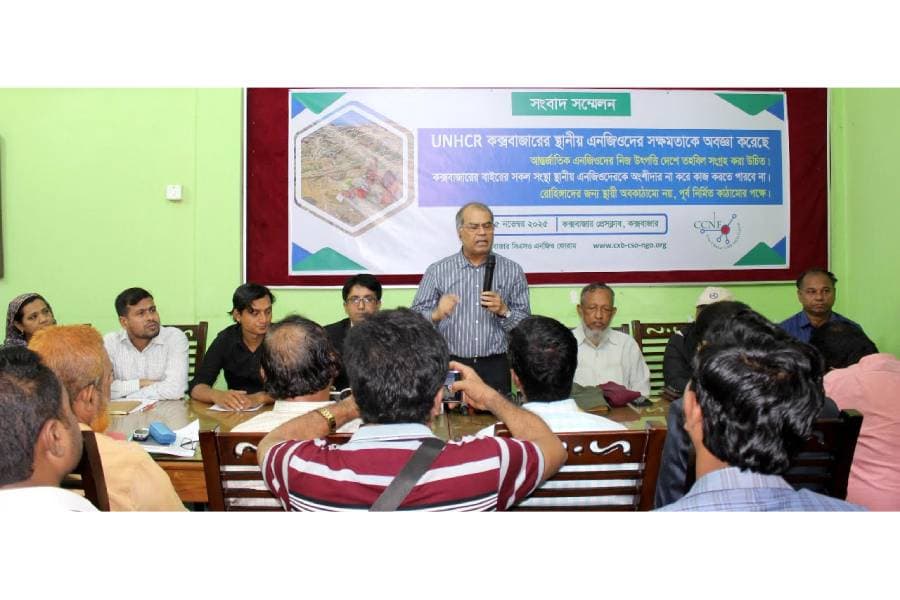
These complaints were made at a press conference organised by the Cox’s Bazar CSO NGO Forum (CCNF) at the Cox’s Bazar Press Club under the theme “UNHCR Undermines Local Organisations’ Capacity in Rohingya Response.”
The press conference was moderated by CCNF Co-Chair Rezaul Karim Chowdhury and attended by Abul Kashem (Help Cox’s Bazar), Advocate Abu Musa (ADHIKAR Cox’s Bazar), Nurul Azim (ORNAB), Md Elias Miah (CEHRDF), Nurul Amin (SBSKS), Hosne Ara Rekha (YPSA), and other CCNF members, along with journalists.
Md Shahinur Islam of COAST Foundation said UNHCR has dropped all local NGO partnerships in Cox’s Bazar for 2026–2029, even though some local groups were included in 2025.
No local organisation will receive funding during the upcoming partnership period, he said.
He said that this ignores the experience and capacity of local NGOs and goes against the idea of localisation.
Local NGOs are therefore demanding that UNHCR cancel this decision.
Advocate Abu Musa said the World Bank has approved US$700 million—loans for host communities and grants for Rohingya—to be implemented through the Government of Bangladesh and UN agencies.
But local NGOs and civil society groups have not been included in this plan.
He said this arrangement is unfair because it creates division: loans for locals and grants for Rohingya.
Rezaul Karim Chowdhury said that since 2017 both local and international NGOs have played key roles in supporting the Rohingya refugees.
He thanked INGOs for their expertise but said that international groups like ActionAid and ACTED should not compete with local NGOs for funding inside Bangladesh.
Instead, they should raise money from their own countries.
Md Elias Miah said Cox’s Bazar faces natural disasters and high pressure on natural resources because of the refugee crisis.
He said more than 25 million litres of groundwater are taken every day from Ukhia and Teknaf for the camps.
He called for an immediate stop to groundwater extraction to protect the future water supply for local communities.