

Published :
Updated :
 For all latest news, follow The Financial Express Google News channel.
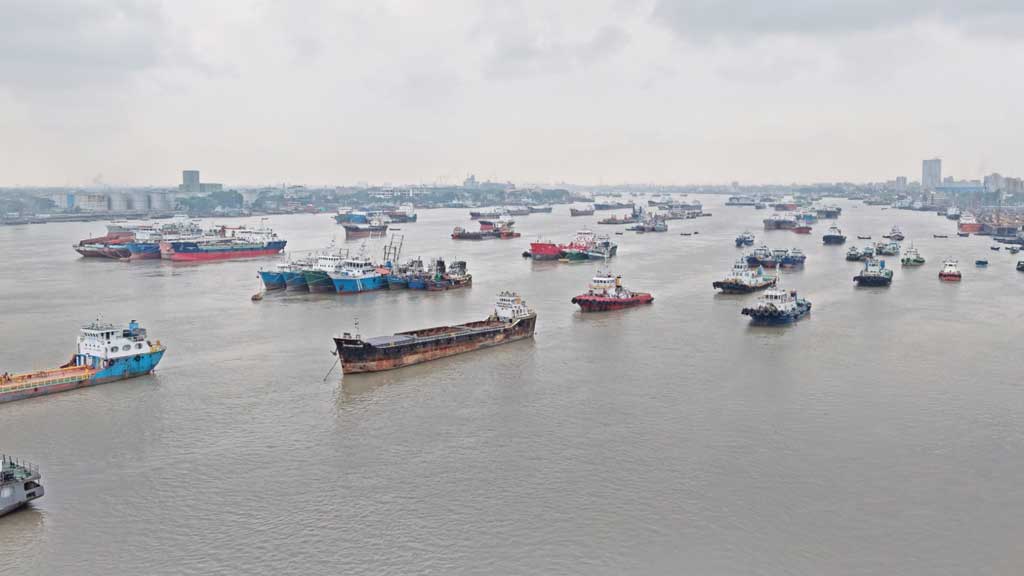
A severe fuel shortage, triggered by the continuing conflict in the Middle East, has disrupted lighterage vessel operations at Bangladesh’s premier seaport, sparking fears of price hikes.
Lighterage operators alleged that the supply of diesel from state-owned depots has plummeted to nearly a fourth of the daily demand, delaying the offloading of mother vessels at the outer anchorage and affecting the entire supply chain of industrial raw materials and imported goods.
Lightering is the lifeline of the imported goods supply chain, as shallow drafts restrict mother vessels from reaching the main jetties of Chittagong Port.
Bangladesh imports everything from sugar and LNG to industrial raw materials primarily through this maritime gateway.
According to the Bangladesh Water Transport Coordination Cell (BWTCC), which regulates around 1,200 lighterage vessels, the daily requirement for ships booked to offload cargo is approximately 250,000 litres.
Marine fuel dealers, however, are currently providing only 60,000 to 70,000 litres.
Operators said they are desperately trying to prioritise the offloading process from mother vessels to avoid heavy demurrage fines.
However, once the goods are loaded, the vessels lack sufficient fuel to reach their inland destinations or return to the port for the next shipment.
"We are managing to load goods from the mother vessels, but the ships cannot reach their destinations. Even if they do, they cannot return," said Parvez Ahmed, a director of BWTCC and owner of Mutual Shipping.
He explained that a round trip from the outer anchorage to Dhaka requires between 3,500 and 4,000 litres of diesel, but vessels are currently receiving only 700 to 800 litres.
As a result, ships are forced to wait for five to seven days mid-journey, significantly increasing the turnaround time for mother vessels, the operators said.
Haji Shafiq Ahmed, convenor of BWTCC, told bdnews24.com that state-owned oil suppliers, Padma, Jamuna, and Meghna, are failing to provide adequate stock to marine dealers.
"The entire lightering supply chain is affected. If this is not resolved immediately, the transport of goods through internal waterways will come to a halt," he said.
He noted that transporting goods by river is significantly more cost-effective, costing Tk 550 per tonne compared with Tk 2,000–2,500 by road.
"Despite being the cheapest mode of transport, the waterway is not being prioritised,” Shafiq said.
“Unlike roads, there are no petrol pumps on the river, we depend entirely on marine dealers in Chattogram," he added.
The BWTCC has sent two letters to the Ministry of Power, Energy, and Mineral Resources seeking an urgent solution, but operators say they have yet to get a response.
Port records show that approximately 80 mother vessels are currently stationed at the Chattogram outer anchorage and Kutubdia channel.
These ships carry vital supplies, including wheat, food grains, fertilisers, and industrial raw materials.