

Published :
Updated :
 For all latest news, follow The Financial Express Google News channel.
India summoned Bangladesh high commissioner to Delhi to convey "strong concerns" over security environment in Bangladesh and alleged threats to the Indian mission in Dhaka, amid diplomatic "tension".
Dhaka dispels such concerns, and also takes exception to New Delhi's uncalled-for remarks on modalities of Bangladesh polls.
India's Ministry of External Affairs (MEA) said Tuesday that the Bangladesh high commissioner, Riaz Hamidullah, was called in and informed of India's unease over the activities of what it termed as "extremist elements", some of whom have announced plans to create a security situation around the Indian mission in the Bangladeshi capital.
In a statement issued by the MEA, India said it "completely rejects the false narrative" being promoted by such groups in relation to recent events in Bangladesh.
New Delhi also voices dissatisfaction with the response of the country's interim government, saying it is "unfortunate" that no thorough investigation has been conducted and that no "meaningful evidence" shared with India concerning the incidents in question.
The summons comes at a sensitive moment in bilateral relations, as Bangladesh remains under an interim administration following political upheaval and ahead of an anticipated general election.
While India has publicly supported democratic processes in its eastern neighbour, it has also repeatedly emphasised the need for stability and security, particularly in relation to diplomatic personnel and facilities.
Reiterating their longstanding position, India says its relationship with Bangladesh is rooted in the 1971 liberation struggle and has been strengthened over decades through development cooperation and people-to-people ties.
"We are in favour of peace and stability in Bangladesh," the statement says, adding that India has consistently called for "free, fair, inclusive and credible elections, conducted in a peaceful atmosphere."
The MEA underlines that the protection of diplomatic missions is a core obligation under international law and it expects the interim government in Dhaka to ensure the safety and security of all foreign missions and posts operating in the country.
Citing the "ongoing security situation", it was announced on Wednesday that the Indian Visa Application Centre located at Jamuna Future Park in the capital would remain closed from 2:00pm onwards. The IVAC in Bangladesh disclosed this information in a notice published on its website.
On the day, an intended march on its High Commission in Dhaka by a little-known group was intercepted by police.
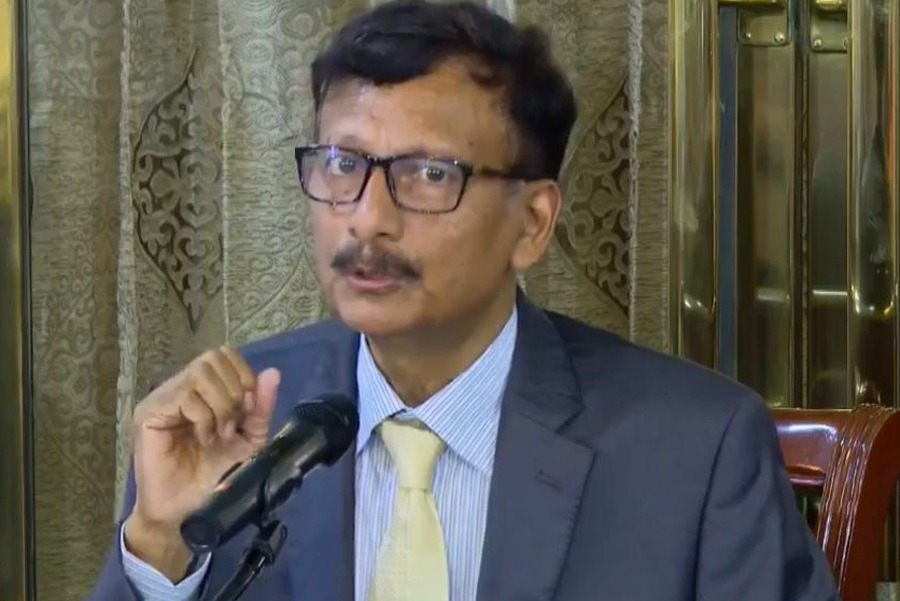
Meanwhile, in a rebuttal to India's statement involving internal affairs of Bangladesh, foreign affairs adviser Md Touhid Hossain told journalists at the foreign ministry that the latest remarks from India amounted to "advice" being offered to Bangladesh that is uncalled- for.
"I do not think there is any need for this," he said. "We did not seek advice from our neighbours on how elections in Bangladesh should be conducted."
The adviser said: "This government has been clearly stating since day one that it wants to create an environment in which people can go to polling stations and vote -- an environment that did not exist for the past 15 years.
"Now India is advising us on this issue. I find this completely unacceptable, because they know very well that during the previous 15 years, when a government with which they had extremely cordial relations was in power, and elections were farcical, they did not raise their voice even once. Now that we are moving towards a good election, there is no need for such advice at this moment."
The adviser makes it clear that they know what it takes to hold fair polls. "We will hold a good election in which people will be able to vote freely and those who receive votes will be elected -- something that did not happen over the past 15 years. This is why I find this entirely unacceptable. As for the rest, there may be areas where we say something and they may disagree -- that does not bother me."
Asked whether his comments are applicable to some other western countries who have been making statement about Bangladesh's elections, he said India's case is different from them as during the 15 years of the "fascist regime", India never talked of inclusive elections.
Asked about India's reaction to remarks made by Hasnat Abdullah concerning India, the adviser said: "The first question is whether Hasnat is part of the government. He is not. If it were a government position, either I would have spoken, or someone from the highest office of government would have done so. Therefore, this is largely irrelevant."
He mentions that discussions are ongoing regarding the Sheikh Hasina issue, as Dhaka wants the convicted deposed former prime minister back through extradition process.
About the diplomatic developments, he said, "We summoned their high commissioner and conveyed everything we had to say. They did not accept it, or they have their differences. In the same way, they have summoned our high commissioner. This is not unexpected -- it usually happens that if one side summons an envoy, the other side does the same.
"The question is whether we have now entered a different phase -- that is very difficult to say. It is better for us to accept the reality that there has been tension with India from the very beginning of this government. We have always said that we want a good working relationship. But wanting it does not mean it will automatically happen. For the relationship to move forward, efforts are required from both sides."
In his view, both sides perhaps have not been able to make sufficient progress, which is why the tension has persisted
"Recently, we too have objections on certain issues, while they have their own positions. We know that earlier, while staying in India, Sheikh Hasina used to make statements mainly on social media. But later we saw her statements appearing in the mainstream media as well, and those statements contained a great deal of provocation."
The foreign adviser makes a point here about propriety of this matter from diplomatic standpoint. "A person who has been convicted by a court here is sitting in a neighbouring country and attempting to create instability here. It is not abnormal for us to object to this, or to seek their cooperation in sending her back. But they have not taken that path."
In response to a question, the adviser said if India does not want to restrain Sheikh Hasina, Bangladesh cannot do so. "We have to understand that reality.
"We would want India to restrain her so that the environment being created for elections is not disrupted by the incendiary statements she is making. We will ask this of them, and if they do so, we will consider it a positive step. If they do not, I cannot force them."
mirmostafiz@yahoo.com