


Speakers and policy makers in a seminar on Thursday warned that Bangladesh's economic stability remains severely threatened without the immediate establishment of a credible bank resolution regime.
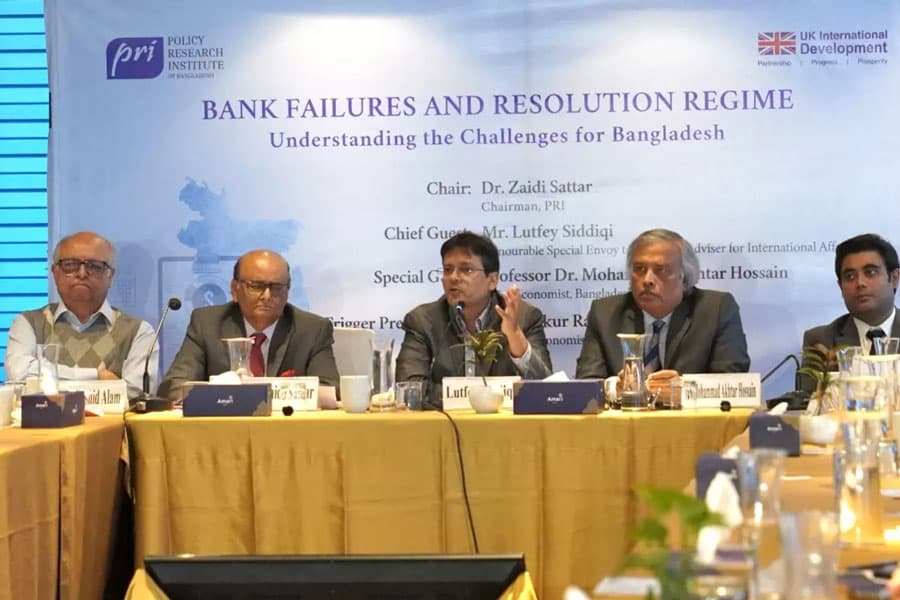
The warning was issued from a seminar hosted by the Policy Research Institute of Bangladesh (PRI), with support from the Foreign, Commonwealth & Development Office (FCDO), titled "Bank Failures and Resolution Regime: Understanding the Challenges for Bangladesh".
Lutfey Siddiqi, Special Envoy to the Chief Adviser for International Affairs, attended as the Chief Guest and stressed the critical need for change.
He stated, "If the banking sector continues with business as usual, nothing will change. Ensuring good governance regardless of which political party forms the government is essential."
Dr. Ashikur Rahman, Principal Economist at PRI, delivered a trigger presentation focusing on the necessary follow-up to legislative reform. He argued that simply "passing the Banking Resolution Ordinance is only half the job". The real challenge lies in making a serious investment in the "processes, systems, and institutional capacities" needed for the Bangladesh Bank and the financial sector to actually implement the resolution regime.
"Without the ability to execute orderly resolutions, manage failing banks efficiently, and protect depositors while minimising systemic risks, the Ordinance will remain a promise on paper," Dr. Rahman cautioned.
Dr. Zaidi Sattar, Chairman of PRI, chaired the event and highlighted the unique crisis facing the nation's financial sector. He noted that the recent rise of non-performing loans (NPLs) to nearly 35 percent is "unprecedented," exceeding levels seen even in countries affected by the global financial crisis.
Dr. Sattar described the situation where many distressed banks are "too toxic to fail," as allowing them to collapse could cause severe economic contagion.
The impact of this instability on external investment was underscored by Professor Dr. Mohammad Akhtar Hossain, Chief Economist at Bangladesh Bank.
Dr. Akhtar pointed out that the already low Foreign Direct Investment (FDI)-to-GDP ratio is being hampered by the "combination of high NPLs and ongoing political uncertainty," making it extremely difficult to attract foreign capital.
The seminar concluded with an open-floor discussion among participants—including policymakers, business leaders, and financial sector experts—who exchanged insights on priority reforms such as legislative updates, strengthened deposit protection, and enhanced crisis preparedness.