


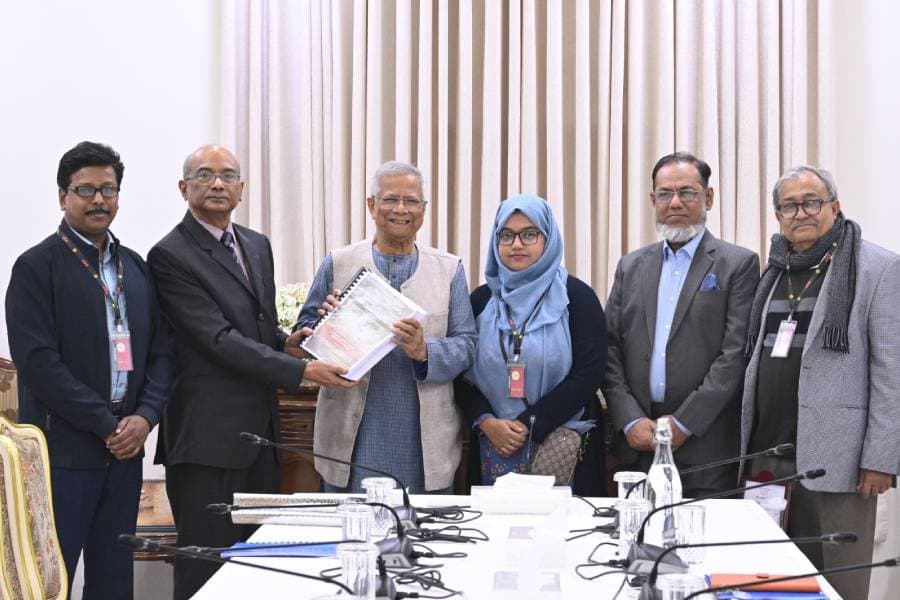
The Commission of Inquiry on Enforced Disappearances on Sunday submitted its final report to Chief Adviser Prof Muhammad Yunus, claiming that former Prime Minister Sheikh Hasina herself had issued direct orders in many cases of enforced disappearances.


Members of the Commission said the disappearances were largely politically motivated, adding that the evidence and data they gathered clearly indicated that these were crimes driven by political considerations.
The report was submitted to Chief Adviser Prof Muhammad Yunus at the State Guest House Jamuna.
Commission Chairman Justice Mainul Islam Chowdhury, along with members Justice Md Farid Ahmed Shibli, Nur Khan Liton, Nabila Idris, and Sajjad Hossain, were present at the event.
Industries Adviser Adilur Rahman Khan and Principal Secretary to the Chief Adviser Siraz Uddin Miah were also present.
According to the Commission, a total of 1,913 complaints were submitted to the Disappearance Investigation Commission.
Of these, 1,569 complaints were verified and classified as enforced disappearances based on the official definition.
Among them, 287 cases fell into the “missing and dead” category.
The report said 75 percent of the victims of enforced disappearances who later returned alive were leaders and activists of Jamaat-Shibir, while 22 percent were leaders and activists of the BNP and its affiliated organisations.
Among those who remain missing, 68 percent were leaders and activists of the BNP and its affiliated bodies, and 22 percent were associated with Jamaat-Shibir.
Evidence has been found indicating the direct involvement of then Prime Minister Sheikh Hasina, her Defence Adviser Major General (retd) Tariq Ahmed Siddique, and former Home Minister Asaduzzaman Khan in several high-profile disappearance cases, according to the Chief Adviser’s Press Wing.
The cases include BNP leaders Elias Ali, Hummam Quader Chowdhury, Salahuddin Ahmed and Chowdhury Alam, as well as Jamaat leader and former Brigadier General Abdullahil Aman Azmi, Barrister Mir Ahmed Bin Quasem and former Ambassador Maruf Zaman.
Chief Adviser Prof Yunus thanked the members of the Commission for their tireless efforts and strong moral commitment.
“This is historic work. On behalf of the nation, I thank you all,” he said. “You have witnessed these atrocities by speaking directly to the victims and their families. This task could not have been completed without strong moral courage.”
He said the report documents the extent of brutality that can be inflicted on people by manipulating state institutions under the guise of democracy.
“This is documentation of how low people can stoop, how demonic and disgusting their actions can become. Those who committed these crimes are human beings like us,” he said, adding that the nation must ensure such atrocities never recur.
“We must find a way to remedy this injustice so that it does not return.”
The Chief Adviser called for the report to be made available to the public in simple and accessible language. He also directed the Commission to submit necessary recommendations and outline future courses of action.
He instructed that locations of extrajudicial killings and enforced disappearances, in addition to the Mirror House, be identified and mapped.
Members of the Disappearance Investigation Commission expressed special gratitude to the Chief Adviser, stating that the work would not have been possible without his firm stance and support.
“You always gave us whatever support we needed and strengthened our morale,” they said.
They also urged the Chief Adviser to reconstitute the National Human Rights Commission, continue the investigative efforts, and ensure protection and justice for the victims.