
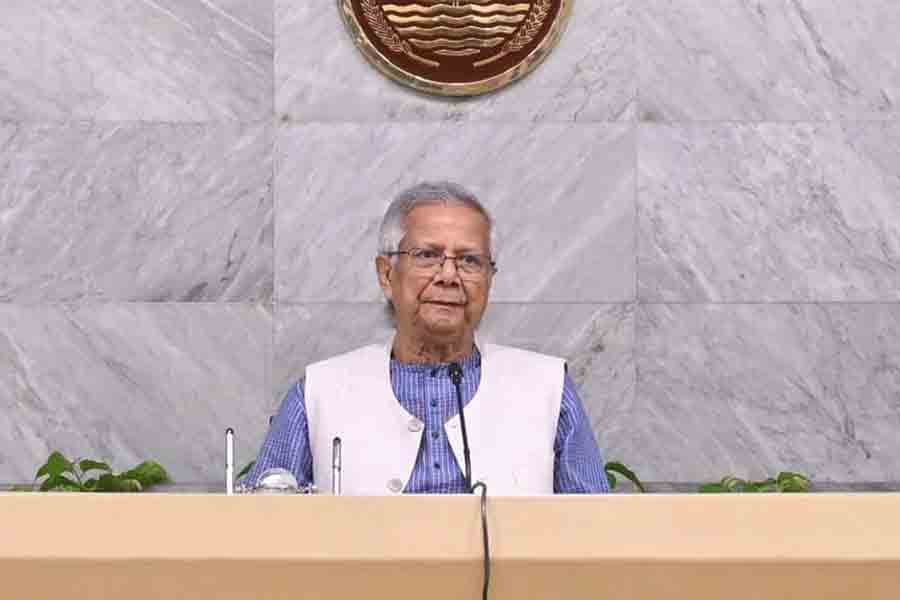
Following a series of recent tremors, Chief Advisor Muhammad Yunus has said the government will form a taskforce on earthquake preparedness.
He held an emergency meeting with experts and relevant officials on Monday.
According to a statement from the Chief Advisor’s Office, the government will quickly review written recommendations submitted by specialists and form the taskforce without delay.
The taskforce will include both public and private sector officials alongside independent experts, tasked with advising the government on immediate measures.
The emergency meeting came after four earthquakes struck Bangladesh over Friday and Saturday, causing widespread alarm.
Yunus convened top experts, researchers, and university faculty at his office, who emphasised that there is no need for panic, but precautionary measures are essential.
“I do not want us to remain idle, nor do I want any unscientific steps to be taken. Provide your recommendations in written form quickly; the government is ready to take all necessary actions,” the chief advisor said.
He added that committees of experts and one or more taskforces are already being organised, and actions will follow once expert advice is received.
The largest earthquake in decades struck early Friday morning, registering 5.7 on the Richter scale. Its epicentre was in Madhabdi, Narsingdi, just 13km from Dhaka, at a depth of 10km.
The quake claimed at least 10 lives across three districts and injured more than 600 people. Cracks emerged in numerous buildings in Dhaka, while some tilted dangerously.
“This tragedy, with lives lost and people injured, is deeply distressing. We must prepare so that it does not happen again,” Yunus said.
He urged experts to provide written guidance on the government’s course of action, including awareness campaigns and precautionary measures, to ensure the country is ready for any future incident.
Experts highlighted the need for drills and assessments, noting that coordination with Bangladeshi scientists and earthquake specialists abroad would be crucial.
The chief advisor suggested leveraging the Shubhechha mobile phone app to connect with overseas experts and to explore additional features for wider engagement.
Participants also discussed widespread misinformation circulating on social media, with unverified claims about imminent large-scale earthquakes.
Experts clarified that while historical data allows estimation of likely seismic activity, predicting exact dates and magnitudes is impossible.
Dhaka University Prof Md Zillur Rahman from the climate and disaster department stressed reviewing seismic sources and epicentres in and around Bangladesh to assess potential shaking intensities.
He noted that the likelihood of a major earthquake in Bangladesh is low, but preparation remains essential.
Geoscientist Prof Syed Humayun Akhtar highlighted the role of youth in raising public awareness, suggesting four-tiered planning at individual, institutional, indoor, and outdoor levels.
Chattogram University of Engineering and Technology’s Prof Jahangir Alam recommended special attention to critical infrastructure, including hospitals, schools, electricity, and gas networks, with earthquake awareness programmes to foster preparedness rather than panic.
Prof Zoynul Abedin of the Military Institute of Science and Technology stressed communicating clear guidance to the public, including identifying safe open spaces for drills and ensuring households and educational institutions conduct rehearsals.
Chief Engineer (Civil) of the Public Works Department Khalequezzaman Choudhury reported that a software system is already in place to collect images of buildings damaged by cracks from the recent quakes.
He added that over 200 buildings have been assessed so far, with most showing fissures in partition walls. The software enables rapid evaluation and planning of remedial measures.
Among the experts present were BUET professors Mehedi Ahmed Ansary, Tahmeed Malik Al-Hussaini, Tanvir Manzur, and Ishrat Islam; CUET’s Prof Jahangir Alam; Md Momenul Islam, acting director of Bangladesh Meteorological Department; meteorologist Md Rubaiyat Kabir; geologist Reshad Md Ekram Ali; disaster expert Md Shakhawat Hossain of Dhaka University; and Director Md Moniruzzaman Khan of the Institute of Disaster Management and Vulnerability Studies of DU.