

HC asks why July Charter order, referendum ordinance should not be declared illegal
Published :
Updated :
 For all latest news, follow The Financial Express Google News channel.
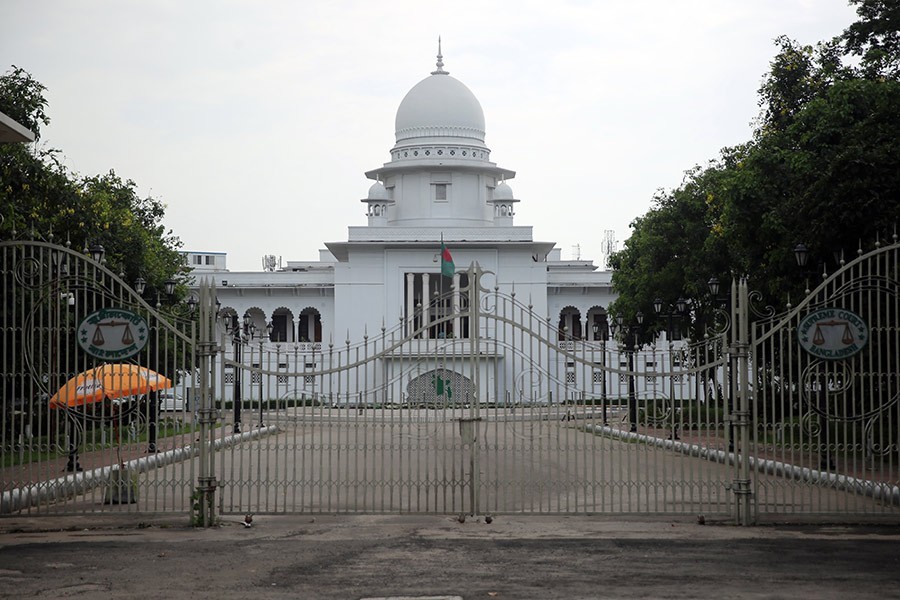
The High Court has issued a rule asking why the July National Charter Implementation Order and the Referendum Ordinance should not be declared illegal.
The panel of Justice Razik-Al-Jalil and Justice Md Anowarul Islam passed the order on Tuesday after holding a preliminary hearing on two writ petitions.
The cabinet secretary, law secretary, secretary of the Parliament Secretariat, principal secretary to the prime minister and the chief election commissioner, among others, have been asked to respond within four weeks, bdnews24.com reports.
The writ petitions were filed on Monday by Supreme Court lawyers Chowdhury Md Redwan-E-Khuda and Gazi Md Mahbub Alam, challenging the legality of the two instruments.
Lawyers Ahsanul Karim and Syed Mamun Mahbub represented the petitioners, while Mohammad Hossain Lipu, Imran Abdullah Siddiqui and Shishir Manir opposed the petitions. Acting Attorney General Arshadur Rouf and Additional Attorney General Aneek R Haque appeared for the state.
During the hearing, the petitioners’ lawyers argued that the Constitution does not permit constitutional reform through a presidential order and that amendments can only be undertaken by parliament in accordance with constitutional provisions.
Lawyers opposing the writs argued that declaring the Referendum Ordinance unconstitutional would also cast doubt on the validity of the 13th national election, which was held alongside the referendum.
The July National Charter was finalised after nearly a year of discussions and signed on October 17 last year. Disagreements later emerged among political parties over how the charter would be implemented.
On November 13, the government issued the July Charter Implementation Order, setting a referendum to be held on the same day as the February 12 general election. A separate ordinance was promulgated to facilitate the referendum.
The order stipulates that if the “Yes” vote prevailed, a Constitutional Reform Council would be formed comprising the winners of the subsequent parliamentary election. The council would be empowered to exercise authority over constitutional reforms, with elected MPs required to take a separate oath as its members.
The referendum resulted in a “Yes” vote.
However, complications arose when BNP lawmakers, who secured more than a two-thirds majority in parliament, took oath only as MPs on February 17 and declined to take oath as members of the Constitutional Reform Council.
At the time, BNP leader Salahuddin Ahmed said no one had been elected specifically as a member of the reform council and that the body had not yet been incorporated into the Constitution.
“If the Constitutional Reform Council is to be formed under the referendum verdict, it must first be incorporated into the Constitution and provisions must be made regarding who will administer the oath. There is no such provision at present,” he said.
Although elected members from the 11-party alliance, including Jamaat-e-Islami and the National Citizen Party (NCP), initially refrained from taking the reform council oath, they later took both oaths and criticised the BNP’s position.