

Published :
Updated :
 For all latest news, follow The Financial Express Google News channel.
Human rights experts, government officials and international partners have called for swift and substantive implementation of Bangladesh’s new obligations under the Optional Protocol to the Convention against Torture (OPCAT), arguing that ratification must now translate into real accountability and protection for detainees.
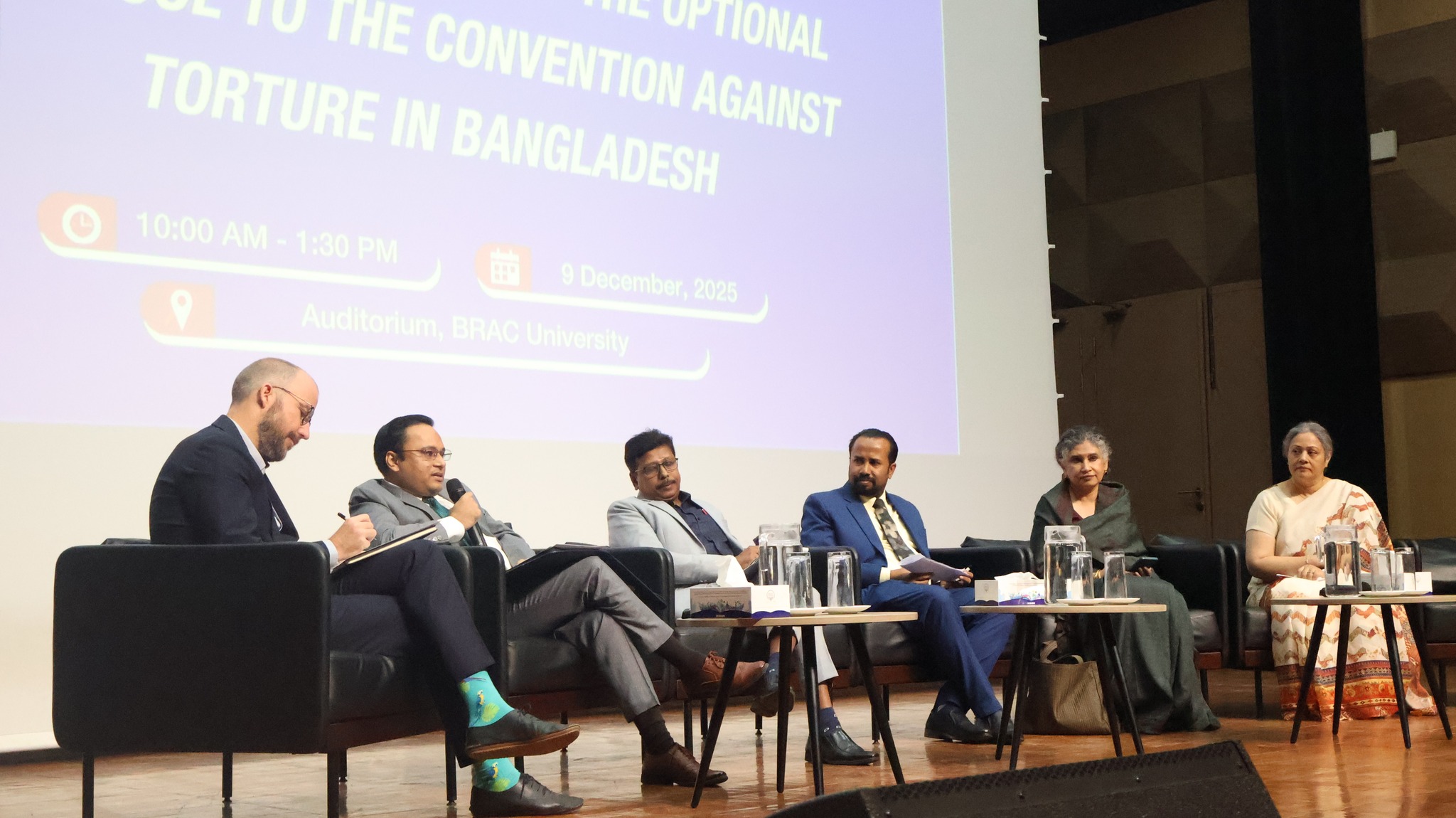
At a seminar held on Tuesday at BRAC University in Dhaka – jointly organised by the Embassy of Switzerland, the UN Human Rights Office in Bangladesh (OHCHR) and BRAC University’s School of Law – speakers discussed how Bangladesh should operationalise the protocol, ratified earlier this year, and establish an effective National Preventive Mechanism (NPM) to monitor detention facilities and prevent torture.
Professor K. Shamsuddin Mahmood, Dean of the university’s School of Law, opened the event, urging stronger safeguards, saying that the moment was an opportunity to reinforce “human rights protection and accountability mechanisms in Bangladesh.”
As chief guest, the adviser to the Ministry of Law, Justice and Parliamentary Affairs, Dr Asif Nazrul, warned that ratification was “not the end but the beginning of justice”. He noted that the National Human Rights Commission Ordinance 2025 has now been gazetted, clearing the way for the establishment of a formal torture-prevention body.
Switzerland’s ambassador to Bangladesh, Reto Renggli, welcomed Dhaka’s accession to OPCAT, describing it as a shared responsibility at a time when Switzerland joins the UN Human Rights Council while Bangladesh concludes its term. This overlap, he said, offers a chance to push for “actionable and sustainable outcomes” both in Geneva and in Dhaka.
Speakers repeatedly stressed that political will, independence and accountability will determine whether the new mechanism succeeds.
Professor Arshad Mahmud Chowdhury, Pro Vice-Chancellor of BRAC University, said that the dignity of individuals must be “protected in practice, not only in principle.” In a keynote address, Ben Buckland of the Association for the Prevention of Torture outlined regional examples where strong preventive mechanisms have reduced abuse, offering lessons for Bangladesh.
During a panel discussion, Huma Khan, OHCHR Head of Mission (a.i.), warned that without an independent, effective and accountable NPM, torture prevention would remain symbolic. Dr Saira Rahman Khan, professor at BRAC University and Secretary of rights group Odhikar, was more blunt: national bodies were “useless” unless they could act free from fear of reprisal. “Without political will, no amount of mechanisms will work,” she said.
The event also featured a video address from Victor Zaharia of the UN Subcommittee on Prevention of Torture.
The panel was moderated by Md Mostafa Hosain, followed by a Q&A session with participants, many of them students. Alberto Giovanetti of the Swiss Embassy served as master of ceremonies.