


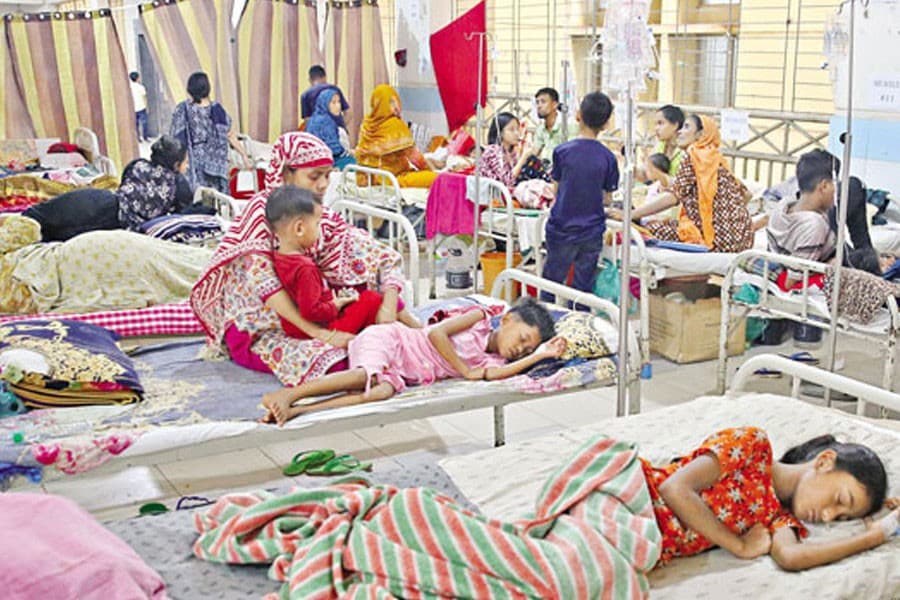
Public health specialists and epidemiologists have expressed concern over malnutrition, poor breastfeeding practices and possible immunity gaps between mothers and infants as the ongoing measles outbreak continues to claim the lives of babies across the country.


Health authorities on Saturday recorded 11 more child deaths from measles and measles-like infections, raising the total death toll to 251 since mid-March, including 42 confirmed measles deaths.
Experts told The Financial Express they were particularly alarmed that infants aged below six months -- who are usually protected by immunity passed from their mothers during pregnancy -- are also being infected and dying.
They stressed the need for urgent research to determine whether maternal immunity transfer is weakening, whether poor nutrition is affecting infant immunity, or whether any mutation in the virus is contributing to the severity of the outbreak.
Some specialists also suggested seriously considering booster vaccine doses for pregnant women.
Dr Be-Nazir Ahmed, former director of Disease Control at the DGHS, said in-depth studies were needed to assess how long immunity transferred from mothers to infants remains effective.
"Normally, immunity received from the mother starts weakening after six months of age. But now we are seeing infections even before that period, which is worrying," he told Te Financial Express.
He said herd immunity was another major concern, noting that if community immunisation coverage falls below 95 per cent, infection spreads rapidly and children become more vulnerable.
"When an outbreak occurs in a situation of low immunisation coverage, the infection spreads faster with higher infection and mortality rates," he said.
Dr Ahmed said there was no recent evidence suggesting any mutation in the measles virus or that it had become stronger.
He noted that similar outbreaks had also been reported in neighbouring countries, including India and Myanmar.
According to the World Health Organization (WHO), measles remains endemic across the South-East Asia region and the regional risk level is considered high.
The WHO also noted that Bangladesh's extensive land borders with India and Myanmar, along with frequent cross-border population movement, may facilitate continued transmission.
Prof Mozaherul Haque, former regional adviser at the WHO South-East Asia office, said maternal malnutrition was a key reason behind weak immunity among infants.
"The foetus begins receiving immunity during pregnancy. A malnourished mother cannot provide adequate nutrition, resulting in a malnourished child with weak immunity against diseases," he said.
He added that most infected children came from poor and malnourished families living in slums.
"Malnutrition and immunity are separate issues, but nutrition supports immunity. In a situation of poor vaccination coverage and low nutrition levels, the outbreak has become much more severe," he said.
According to the WHO's latest assessment released on Thursday, measles cases in Dhaka are concentrated in densely populated informal settlements, including Demra, Jatrabari, Kamrangirchar, Korail, Mirpur, and Tejgaon industrial and slum clusters.
Prof Haque said further studies were necessary to understand why infections were so high in Bangladesh and why maternal immunity appeared insufficient.
Public health specialist Prof Dr Abu Jamil Faisel said mothers' lifestyle during pregnancy and declining breastfeeding practices were also major concerns.
"The number of unnecessary caesarean sections is increasing, and many mothers are becoming reluctant to breastfeed, which is linked to weaker immunity among babies," he said.
He, along with other experts, called for immediate research involving the Institute of Epidemiology, Disease Control and Research (IEDCR) to investigate the causes behind the severe outbreak and the immunity gap between mothers and infants.
Prof Faisel also criticised delays in vaccine procurement and immunisation efforts.
"In such situations, WHO recommends forming an outbreak investigation committee to identify gaps. But we have not seen that happen yet," he said. "We urgently need such a committee to investigate why there was a delay in procuring vaccines and who was responsible."
Recently, Bangladesh Medical University Vice-Chancellor Prof Dr FM Siddiqui made a similar recommendation at a measles-related event at the university.
He said infections among babies younger than six months indicated that maternal immunity was not reaching children properly in all cases.
"In this situation, the issue of booster jabs must be considered seriously," he said.
He also recommended a large-scale study on pregnant mothers to assess immunity levels.
"Based on the findings, a policy decision can be made on providing additional vaccinations to adolescent girls if necessary, which will help protect future generations," he added.
nsrafsanju@gmail.com