

MANIKGANJ, SYLHET: Too many brick kilns put public health, environment in crisis
Published :
Updated :
 For all latest news, follow The Financial Express Google News channel.
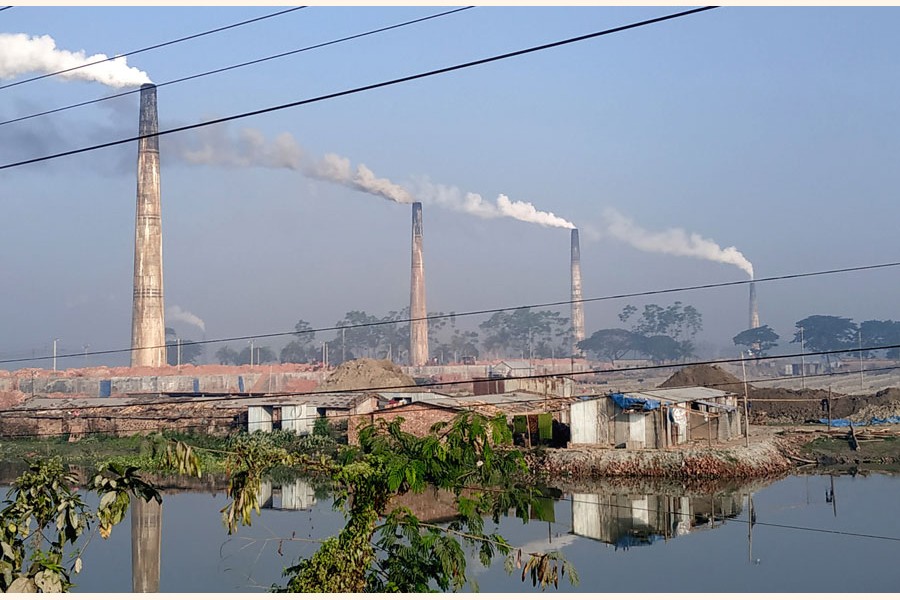
An excessive number of brick klins have been polluting the environment in a union in Manikganj, while pollution from unauthorised brick klins deteriorates public health and the environment across four districts in the Sylhet division.
Our correspondent from Manikganj writes, Singair Upazila's Baldhara Union has become a dense cluster of brick kilns, with 36 of them operating within just 30.31 square kilometers.
Home to as much as 29,085 people, the union is struggling with polluted air and declining crop yields. The unchecked expansion of brick kilns has deteriorated the health of its residents.
According to the Union Parishad sources, 26 kilns are currently active in the union. Fifteen trade licences were obtained last fiscal year and 18 this year. Locals claim the rest operate seasonally, especially during the dry months and the entire area is covered in smoke as a result.
Throughout the villages, thick fumes rise from tall chimneys all day. Residents report widespread respiratory problems, skin irritation, and eye discomfort. Children and elderly people are the worst affected.
Azgar Ali of Charamgara village said the dust has become a part of everyday life. "The tin roofs rust fast, trees do not bear fruit as they used to. There is always a smoky smell around us."
In Kholapara village, 70-year-old farmer Awlad Hossain said soil fertility has sharply declined. "We used to harvest five maunds of mustard per bigha. Now we get only two or three. Brick kiln owners cut soil from good farmland. We are poor; we cannot protest."
Local roads are also wearing out. Heavy trolley trucks carrying soil to the kilns have damaged most internal routes. "Roads used to be better," said Sona Mia. "Now they are full of potholes. Taking crops to the market is difficult. Soil and brick trucks run day and night."
However, the Singair Brick Kiln Owners Association denies the allegations. Ilias Hossain, its president, said they use zigzag chimneys that filter emissions and claim they use only single-crop land. He also said most of the land belongs to the kiln owners. But residents say these claims do not match what they experience.
Upazila Agriculture Extension Officer Habibul Bashar Chowdhury confirmed that air pollution from kilns reduce crop yields. "Farmers in Baldhara lose about one-fourth of their production due to the impact of brick kiln smoke. Continuous soil cutting is damaging land structure, which affects paddy and vegetables alike."
Public health specialists warn of long-term risks. Medicine expert Dr. Manobendra Sarker Manob said the smoke contains carbon monoxide, sulfur dioxide, and fine particulate matter that irritate the respiratory system.
"These pollutants increase coughing, throat pain, breathing difficulty, and asthma. Children's lung development is affected. The elderly face higher risks of pneumonia, bronchitis, and allergies. Long exposure can lead to chronic lung damage and heart disease."
Manikganj District Department of Environment Deputy Director Muhammad Abdullah Al Mamun said the kilns were built over many years. "There is no fixed limit for the number of kilns in a union. We issue clearance based on existing rules. But fewer kilns would certainly mean a healthier environment. More kilns will naturally increase pollution."
Baldhara now stands as a clear example of how a small area can undergo dramatic environmental change when too many brick kilns operate without tight control. Locals fear that if monitoring does not improve, farmland, nature, and public health will deteriorate further. While authorities say operations are within rules, it is the residents and farmers who continue to bear the real cost.
Our correspondent from Sylhet reports, as much as 165 brick kilns have been operating
unauthorised production units in the division's four districts, with some of them evicted by the environment department since the start of winter. Directives to curb pollution, such as installing zigzag chimneys,
were issued to others and they were warned of the consequences of non-compliance. Those evicted have also been operating at a small scale.
According to the Sylhet divisional Department of Environment, deputy director permissions were cancelled for 21 klins out of 25 kilns in Sylhet. Eleven others were evicted through mobile court.
However, the kilns have still been operating and violating environmental regulations to produce bricks.
In Sunamganj, permissions to operate have been cancelled for six out ten kilns and two were evicted.
In Habiganj, permission of two among the 90 brick kilns have been cancelled, but there had been no eviction drives in the district in the last year.
Meanwhile, in the district of Moulvibazar, out of 40 brick kilns, permission of 33 were cancelled, of which 14 were evicted. But, 26 of 40 illegal kilns were still running, while only two were shut. In the district, 34 kilns are operating legally, and two of them are shut.
The deputy director further said they can not launch regular drives due to shortage of required staff. There is only one inspector for a district, she said, "We have one magistrate for the division."
Md. Abul Kalam Azad, director, environment Sylhet division, said, "We are trying to take action on the errant brick kilns. Our district offices often launch drives on them regularly.
Shah Shaheda Akhtar, regional coordinator of Bangladesh Environmental Lawyers Association (BELA), Sylhet, said, "Most of the brick kilns run illegally. We demand the authorities take stern action against the errant brick manufacturers all
over the division as there are clear orders from the high court. The illegally run brick kilns are harmful for public health."
asadlimon@gmail.com
forsylhet@gmail.com