

METRO RAIL BEARING PAD ACCIDENT: Ridership sees little impact in absence of viable alternatives
Published :
Updated :
 For all latest news, follow The Financial Express Google News channel.
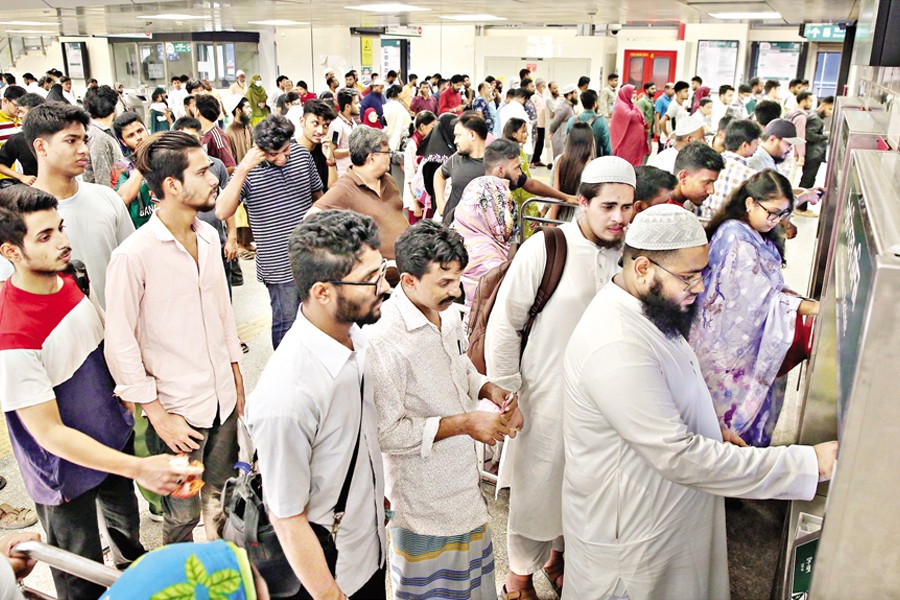
The recent Dhaka metro-rail bearing-pad accident has had little impact on overall ridership, as most passengers continue to use the service due to a lack of alternatives.
However, analysts say the incident's effects are visible in operational disruptions, resulted a temporary suspension of train services on Wednesday night.
According to official data, ridership of Dhaka's Mass Rapid Transit Line 6 (MRT-6) was nearly 450,000 before the Sunday incident. After the accident, total passengers numbered 310,000 on Monday and 386,000 on Tuesday.
MRT ridership before the accident was recorded at 448,239 and 451,366. Ridership is generally lower on Fridays and Saturdays compared with other days of the week.
Officials said the decision to suspend train operation between Bijoy Sarani and Karwan Bazar at 9:10pm on Wednesday was made after reports of unusual vibration while a train crossed from Farmgate to Bijoy Sarani around 8:45pm.
"We cannot check any problem without suspending train operation. That's why service between the three stations was stopped temporarily," said Nasir Uddin Ahmed, director of Operation and Maintenance of Dhaka Mass Transit Company (DMTCL).
He added that inspections conducted later found no issues.
Sources indicated that DMTCL remains concerned about its limited capacity to address operational problems due to a shortage of experienced personnel.
Passenger reactions to the accident were mixed. Some, like Sumaiya Minu, a student at East West University, continue to use MRT 6 despite safety concerns, citing the lack of alternatives and the daily challenges of commuting in Dhaka's traffic.
"First I was worried, but I have no other option. MRT saves time and avoids harassment I often face on other public transport," she said.
Rabiul Islam, a retired municipal official, said the metro rail has become essential for daily commuting, and sudden service suspensions, like the one on Wednesday night during rain, cause significant inconvenience. Similarly, regular commuters like Shahid Islam expressed hope that authorities will ensure safe and reliable operations.
Observations by The Financial Express also found few people avoiding MRT-6 due to concerns about operational safety and efficiency.
Currently, MRT-6 operates from Uttara to Motijheel between 6:30am and 10:10pm, accommodating an average of 400,000 passengers daily.
On some occasions, ridership exceeds 450,000, reflecting demand beyond feasibility study projections of 500,000 per day. From January to October 28, 2025, MRT-6 served a total of 99.21 million passengers, with the highest monthly ridership of 11.77 million in September.
On the day of the accident, over 250,000 passengers used the metro rail, despite partial operation limited to the Uttara-Agargaon section for about two and a half hours. Services from Motijheel to Shahbagh resumed by 8:00pm, with full corridor operations maintained for the following three days, except for a temporary suspension at three stations on Wednesday night. Passenger pressure over the last two days has remained consistent. Daily sales of Rapid Pass cards average 700, reflecting ongoing dependency on the country's first mass transit system. Since its partial launch in December 2022, around 815,000 Rapid Passes and 73,000 MRT Passes have been used.
smunima@yahoo.com