A ruckus centering the National Equipment Identity Register (NEIR) rollout has ensued and a weird revelation of umpteen devices surreptitiously connected with each NID startled mobile-phone users.
The bizarre finds stoke concerns among the users as to whether their sets were being used by frauds in criminal gangland.
"I logged in just to check my handset, and suddenly I saw 47 phones registered under my name," says Nabiul Islam, a private employee from Mirpur. "I have only used two phones in my entire life. I thought someone had stolen my identity."
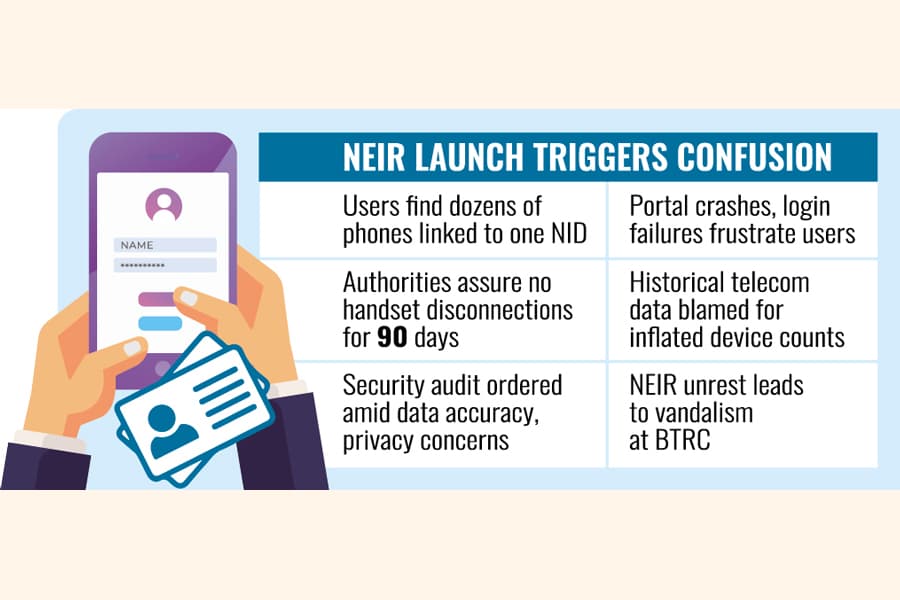
Similar experiences have been shared widely on social media since the system went live, with users reporting that 10, 50, or even hundreds of mobile handsets are showing up against a single National Identity (NID) number.
In another case, Sharmeen Akter, a university student from Mohammadpur, failed to access the portal despite trying for hours. "The website kept crashing. When it finally opened, it showed devices that I have never owned. It was frightening," she recounts.
Screenshots circulating online show large discrepancies in the number of handsets linked to individual NIDs. One user, Masum Billah Bhuiyan, claims 53 handsets having appeared under his name, with 42 registered in December alone.
He says in his facebook post that he has lived in Malaysia for four years.
Amid growing concern, Faiz Ahmad Taiyeb, special assistant to the chief adviser of the interim government for Posts, Telecommunications and Information Technology, urges the public not to panic, assuring that no mobile phone will be disconnected over the next 90 days, despite the launch of NEIR.
He says telecom operators had submitted more than three billion datasets, including historical records, which explains why many users are seeing unusually high numbers of devices linked to their NIDs.
"Since the migration date is being reflected as the current date, people are seeing inflated figures. This will gradually be corrected as historical data is archived in the background."
According to him, the Bangladesh Telecommunication Regulatory Commission (BTRC) and mobile operators are jointly working to resolve the techno conundrum.
Users have also reported repeated difficulties accessing the NEIR portal, with frequent timeouts and login failures.
Taiyeb acknowledges these problems, saying that heavy traffic following the launch caused temporary system instability.
"These technical issues are expected during the early phase of a new platform. They will be resolved soon," the post-uprising government functionary assures of correcting the flaws in the troubleshooting drive.
He says although a Vulnerability Assessment and Penetration Testing (VAPT) has been conducted earlier, a fresh security audit has now been ordered. Measures such as secure digital tokens, rate limiting and stricter API controls have also been implemented.
Explaining the unusually high handset counts, Taiyeb says Bangladesh previously allowed one person to use up to 20 SIMs, which was later reduced to 15 and is now being brought down to 10.
"As a result, historical data is showing higher numbers of devices under many NIDs."
He notes that the system would ultimately help citizens identify whether any SIMs or devices registered in their names are being misused for crimes such as mobile financial fraud or online gambling.
The NEIR rollout has also sparked unrest. A Dhaka court has sent 45 persons to jail in connection with an attack Thursday on the Bangladesh Telecommunication Regulatory Commission (BTRC) headquarters in Agargaon.
According to police, protesters vandalised the premises and a staff bus, causing damages estimated at Tk20 million. Authorities allege the violence was premeditated and aimed at creating public panic following the NEIR launch.
Law-enforcement agencies say investigations are ongoing to identify both direct participants and instigators.
While authorities insist the system will stabilise over time, many users remain anxious.
"I just want to know which phones are actually mine," says Mahmud Hasan, a small business owner from Narayanganj. "Until this is fixed, people will keep worrying."
For now, the NEIR rollout-intended to strengthen digital security-has instead left many citizens confused, frustrated and waiting for clarity.
bdsmile@gmail.com