

Nearly 5m people in BD internally displaced by disasters
IOM releases first nationwide estimate
Published :
Updated :
 For all latest news, follow The Financial Express Google News channel.
Bangladesh is home to almost five million people living in internal displacement due to natural hazards, according to the first nationwide estimate released by the International Organisation for Migration (IOM) in Dhaka on Wednesday.
The assessment marks the most comprehensive attempt to quantify how climate-driven disasters are uprooting communities across one of the world’s most climate-vulnerable nations.
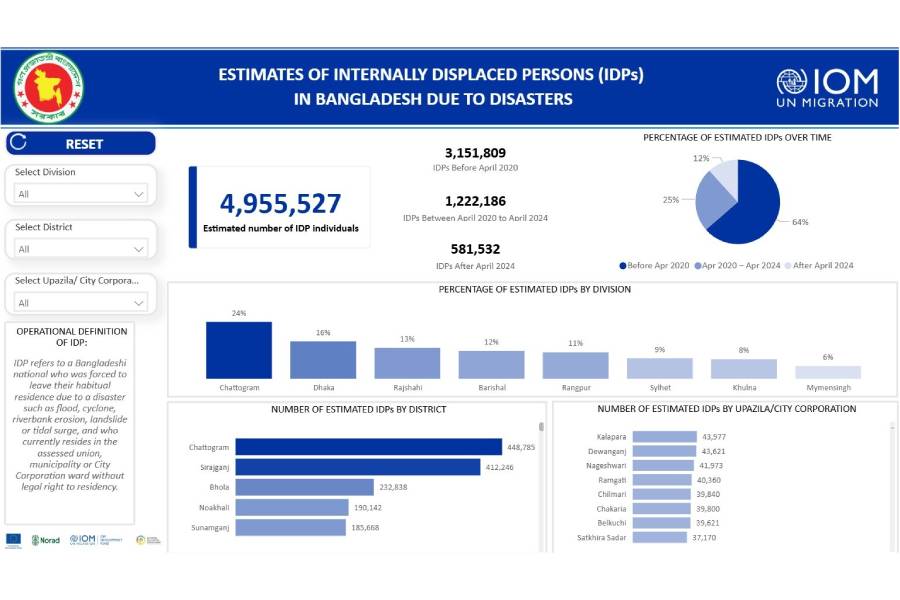
The report – developed in partnership with the Government of Bangladesh and development agencies – estimates that 4,955,527 people are currently displaced by events such as floods, cyclones, tidal surges and riverbank erosion.
Despite frequent and severe weather-related disruptions, no verified national figure existed until now.
Data was gathered between September and October 2025 across all eight divisions, 64 districts and more than 4,500 unions, drawing information from over 29,000 key informants through 5,388 field visits.
IOM officials described the scale of the research as unprecedented and a crucial step toward evidence-based policymaking.
“Understanding the scale of displacement is essential for effective disaster management and long-term planning,” said Lance Bonneau, IOM’s Chief of Mission in Bangladesh. “These findings give national authorities, local leaders and development partners a shared foundation to respond to displacement with greater clarity and coordination.”
The data reveals a pattern of prolonged and unresolved displacement. Nearly two-thirds of internally displaced people (63per cent) fled their homes prior to April 2020, indicating long-term instability for affected families, while one quarter (25 per cent) became displaced within the last four years.
The Chattogram Division hosts the largest population of displaced people – around 1.21 million – followed by Dhaka (0.79 million) and Rajshahi (0.66 million).
Four districts alone – Chattogram, Sirajganj, Bhola and Noakhali – account for a quarter of all climate-driven displacement nationally.
A large majority of IDPs, approximately 85per cent, remain in rural areas rather than relocating to major cities.
Government officials welcomed the findings, saying they would help guide the implementation of Bangladesh’s National Strategy on Internal Displacement Management, which calls for more structured and continuous data collection.
Speaking virtually as chief guest, Aleya Akter, Secretary of the Statistics and Informatics Division, said the study would play an integral role in shaping future responses to climate-induced migration.
Senior representatives from the Ministry of Disaster Management and Relief, the Ministry of Environment, Forest and Climate Change, and the European Union also addressed the event.
The launch featured a presentation on the survey’s methodology and a panel discussion on incorporating displacement data into national statistical systems, with contributions from the Department of Disaster Management, the Department of Environment and the Bangladesh Bureau of Statistics.