


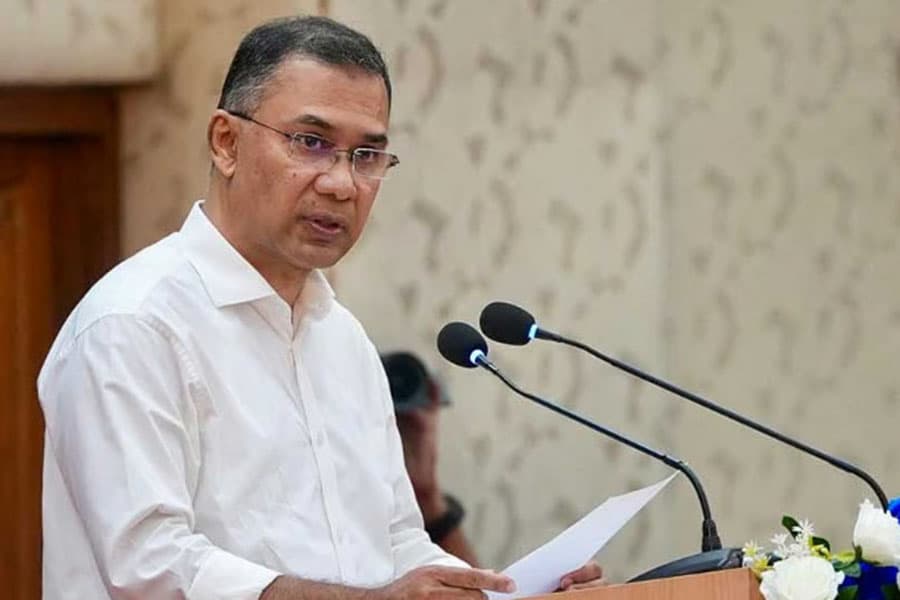
Prime Minister Tarique Rahman has called on universities to focus not only on pedagogical education, but also on research and innovation.
“The University Grants Commission has organised this day-long workshop today… I believe it is very timely. From the discussions held so far, an important question has emerged: are our universities able to maintain global standards in education and research? Sadly, the reality is that in the 21st century, our universities have still not reached the desired level in world-renowned university rankings in terms of excellence in education, research, and knowledge,” he said.
The prime minister said this while talking at the inaugural ceremony of a workshop organised by the University Grants Commission (UGC) on Tuesday morning, reports bdnews24.com.
He said, “University rankings generally place greater importance on research publications, citations, and innovation. In that case, where do we stand? Our academics will certainly need to think more deeply about these issues. If universities do not focus on research and innovation, and remain limited to traditional book-based learning, it will be difficult for us to survive in a competitive world.”
The prime minister was delivering the opening speech of the day-long workshop titled Transforming Higher Education in Bangladesh: Roadmap to Sustainable Excellence at the Nawab Nawab Ali Chowdhury Senate Building of the University of Dhaka.
The workshop includes five technical sessions. The closing ceremony will be attended by Dhaka University Vice-Chancellor Prof ABM Obaidul Islam.
Referring to the Fourth Industrial Revolution, the prime minister said: “The world has entered the Fourth Industrial Revolution. In this ongoing era, advanced technologies such as AI or Artificial Intelligence, robotics and automation, Internet of Things, genetic engineering, biotechnology, cyber security, quantum computing, industrial Internet of Things, big data, material science, nanotechnology, and fifth-generation wireless technology are influencing our thinking on one hand, and transforming workplaces and employment on the other.”
“As a result, while the use of new technologies is increasing unemployment in some traditional job sectors, it is also creating entirely new employment opportunities.”
He continued, “To face the challenges of the Fourth Industrial Revolution and enter new employment markets, we must move away from an education system dependent on rote learning and certificates. We must redesign our conventional education system according to the demands of the Fourth Industrial Revolution.”
The premier said, “Education today is not only for personal development; technology-driven education is also a key driver of national economic growth, innovation, and global competitiveness. Therefore, stronger links must be established between universities and the industrial sector. The needs of the industrial sector must be incorporated into curriculum development.”
He added, “The Fourth Industrial Revolution has made one message clear to the world: education is no longer confined within schools, colleges, or universities. Knowledge today is no longer restricted to a single discipline. We now see data science merging with biology, or engineering combining with social sciences.”
“As a result of this connection, the boundaries of knowledge are constantly expanding and becoming dynamic. It is essential for us to stay closely connected with the nature of these changes.”
Education Curriculum Must Be Overhauled
The premier said, “Every year, hundreds of thousands of students graduate from universities. Yet many remain unemployed even after receiving higher education. In fact, unemployment is higher among the highly educated. There are many opinions about why, but many agree that one major cause is the failure to acquire practical skills alongside academic education.”
He added, “The current government believes that it is now time to redesign our education curriculum from the primary level to higher education. Unemployment cannot be solved without value-based, employment-oriented education. Without a modern and relevant curriculum, it will be impossible to survive amid global competition. That is why the government has already begun updating the academic syllabus.”
He said, “To make higher education more relevant, the government has taken effective steps to expand apprenticeships, internships, and industry-academia collaboration. Initially, this programme is being launched by connecting universities in divisional cities with local educational and business institutions. As a result, students will gain hands-on learning and job skills while still studying.”
“Therefore, after completing their education, they will no longer need to remain unemployed.”
He further said, “Initiatives have been taken to provide seed funding or innovation grants through a competitive process to commercialise innovative business ideas in colleges and universities. The objective is to create entrepreneurs from campuses. These entrepreneurs will be able to implement new and creative business ideas and contribute to the national economy.”
The prime minister said, “With skills gained while studying, it is possible that a student may not wait for a job but instead become an entrepreneur and create employment opportunities for others. In addition to these initiatives, the government is planning to establish innovation and entrepreneurship development institutes and science parks in higher education institutions.”
He added that the government also plans to encourage science fairs, innovation fairs, product sourcing fairs, and similar education and skill-based events in partnership with local and international organisations.
“Not only in higher education, but from the school level as well, the government plans to make technical and practical education compulsory in the national curriculum.”