


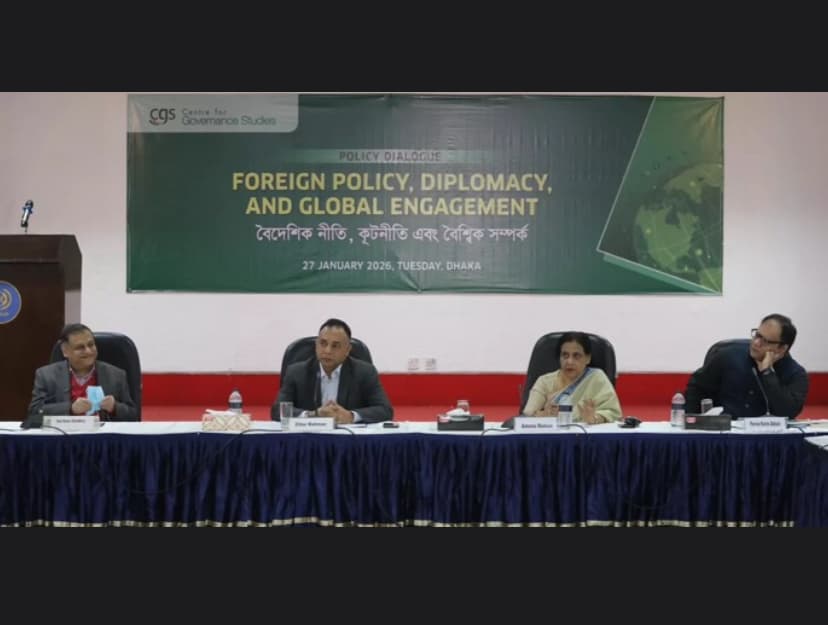


Speakers at a dialogue on media reform on Tuesday expressed concern over safety, political interference and economic vulnerability of journalists


The dialogue, titled “Media Reform in Bangladesh: Between Freedom, Responsibility and Power,” was held at the CIRDAP Auditorium to discuss key challenges and reform priorities in the mass media sector, UNB reports.
Centre for Governance Studies (CGS) in Dhaka organised the dialogue where speakers warned that the country’s media space is increasingly constrained despite its vital role in a democratic society.
Former head of the Media Reform Commission Kamal Ahmed spoke as the guest of honour.
CGS president Zillur Rahman said despite the Chief Adviser’s rhetoric of “three zeros,” he sees little substance on the ground. Referring to recent arson incidents at the offices of Prothom Alo and The Daily Star and the harassment of a senior editor critical of the government, he questioned the state of media freedom.
He also noted that a government representative at a CGS event refused to describe the incidents as “mob attacks,” claiming it would undermine the spirit of the mass uprising.
New Age Editor Nurul Kabir said mobs are generally viewed as chaotic forces, but the attacks he observed were organised and premeditated, alleging government patronage behind them.
He said although the Chief Adviser’s press secretary initially denied the allegations, a subsequent Facebook post contradicted that claim.
He added that corruption in journalism cannot be attributed solely to low pay, noting that some financially well-off journalists are also involved.
“Real journalists question power, those who don’t act as public relations officers,” he said.
Kamal Ahmed criticised the government’s last-minute rush to pass ordinances near the end of its tenure, expressing doubts about their sustainability.
He said recently introduced ordinances on the Information Broadcasting Commission and Media Commission appeared to be patchwork initiatives that lacked proper consultation.
He urged media owners to ensure fair financial benefits for journalists.
Dhaka University Professor Robaet Ferdous emphasised the need for effective accountability of both parliament and media to maintain checks and balances, warning that the absence of a culture of accountability has weakened democratic oversight.
DU Professor S M Shameem Reza said the media must engage in self-criticism and acknowledge past professional failures to ensure future independence.
He also highlighted issues related to journalists’ salaries, safety, protection laws, the effectiveness of the Press Council and repressive legislation.
Socialist Party of Bangladesh General Secretary Bazlur Rashid Firoz called for the withdrawal of harassing cases against journalists and urgent solutions to their financial crisis, warning against the culture of flattering those in power.
CPB Central Committee member Dr Sajedul Huq Rubel said media freedom often depends on the nature of the ruling political force, adding that while responsibility for provocative speech exists, little action has been taken against the spread of incitement from abroad through social media in recent months.
Executive Editor of Dhaka Tribune Reaz Ahma said the Media Reform Commission had done commendable work despite limited time and resources, but regretted that the government had taken little initiative to implement its recommendations. “Only time will tell how committed the next government will be to media reform,” he said.
Other speakers included Executive Editor of Bangladesh Protidin A K M Manjurul Islam; Head of English Web of Prothom Alo Ayesha Kabir; G-9 General Secretary Dr Sakhawat Hossain Sayantha; University of Dhaka Professor Dr S M Shameem Reza; Special Content Editor of The Daily Star Shamsuddoza Sajen; senior journalist Zahid Newaz Khan; political analyst Zahed Ur Rahman; freelance journalist Kazi Jesin; and Senior Reporter of The Daily Star Zyma Islam.