


Published :
Updated :
 For all latest news, follow The Financial Express Google News channel.
The Bangladesh Nationalist Party (BNP) on Tuesday unveiled an eight-point priority social-policy agenda, pledging sweeping reforms to rebuild the country's economy and social fabric after what it described as years of mismanagement under the Awami League government.
The party said the proposed framework aims to restore democratic accountability, promote inclusive growth and place citizens at the centre of development.
The proposals were presented at a policy dissemination event at a city hotel, attended by members of the diplomatic and development partner community, as the BNP laid out its vision ahead of the national elections scheduled for February 2026.
Speaking as chief guest, BNP Secretary-General Mirza Fakhrul accused the Awami League of turning the country into a "mafia economy" since 2009.
He alleged that banks had been systematically looted, billions of dollars siphoned abroad and ordinary citizens marginalised in a system designed to benefit a small elite.
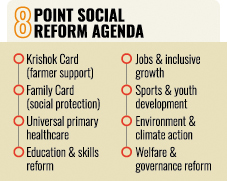
Adviser to the BNP Chairperson Dr Ziauddin Hyder presented the keynote paper titled "BNP's Eight Priority Social Policies."
BNP Joint Secretary General for International Affairs Humaiun Kabir delivered the welcome address, while the event was moderated by Election Steering Committee Member Barrister Gias Uddin Rimon.
In his keynote presentation, Dr Hyder outlined the BNP's eight-point development agenda, promising far-reaching reforms across agriculture, employment, education, healthcare, the environment, sports and social welfare.
At the centre of the plan is the proposed 'Krishok Card' (Farmer Card), a digital platform designed to provide farmers with subsidised fertiliser, seeds, pesticides, machinery support, crop insurance and fair-price procurement mechanisms, alongside improved market access for agricultural produce.
Farmers would also receive mobile-based weather information and training, with the scheme extended to fisheries and livestock producers to ensure sustainable food security.
Another flagship initiative, the 'Family Card', is intended as a social protection measure placing women at the heart of household resilience, Dr Hyder said.
Under the scheme, households would receive either a monthly allowance of Tk 2,000-2,500 or essential food commodities.
Distributed through adult women, the programme aims to reduce poverty and hunger while empowering women as household decision-makers.
In healthcare, the BNP pledged to reduce out-of-pocket expenses by recruiting around 100,000 healthcare workers, 80 per cent of them women, and establishing primary care units in every city and village.
Preventive healthcare, maternal and newborn services, affordable treatment for critical diseases and domestic vaccine production are central to the plan.
The party also promised free primary medicines, low-cost cancer drugs and year-round mosquito eradication campaigns.
Education reforms would include the 'One Teacher, One Tab' initiative, compulsory technical education at the secondary level, mid-day meals, multimedia classrooms and the introduction of a third language.
Moral and social education would begin from Class VI, while sports and cultural activities would be integrated into the curriculum. Technical and vocational education would be modernised with hands-on training and international certification.
On employment, the BNP said it would create jobs in the IT sector, expand cottage industries and small and medium-sized enterprises, and provide low-interest loans.
Skill development and career centres would be established in educational institutions, while overseas workers would receive training and financial support.
Nationwide employment initiatives would ensure that marginalised groups are not left behind, Dr Hyder said.
In sports development, the party pledged to make physical education mandatory from Class IV, supported by subject-specific sports teachers.
It also promised scholarships for talented youths, the construction of sports villages in all 64 districts and the expansion of playgrounds.
Branches of the Bangladesh Krira Shikkha Protishthan (BKSP) would be expanded nationwide to identify and nurture local talent.
On environmental protection, the BNP said it would plant around 250 million fruit and medicinal trees over five years to improve ecosystems and empower rural women.
It also plans to excavate about 20,000 kilometres of rivers and canals to restore natural water flow, upgrade the Teesta Barrage, establish a Padma Barrage project and develop nationwide waste management systems to convert waste into fuel and fertiliser.
As part of its welfare programme, the BNP pledged monthly honorariums, festival allowances and skills training for religious leaders, including khatibs, imams, muazzins and leaders of other faiths.
"The last 15 years of so-called development were marked by corruption, lack of accountability and election rigging," Mr Fakhrul said, adding that the country had been pushed into despair, with limited employment and investment opportunities.
He argued that the July uprising by students and citizens reflected growing public demand for change.
The BNP Secretary-General said the party's role since independence has been to champion reforms that put people at the centre of governance.
He emphasised that the proposed framework would democratise the economy, empower lower-income groups and ensure participatory development.
BNP Standing Committee Member Dr Abdul Moyeen Khan, Adviser to the BNP Chairperson and spokesperson for the party's election steering committee Dr Mahdi Amin, and BNP International Affairs Secretary Rashedul Haque were among those present at the event.
azizjst@yahoo.com