

Referendum on constitutional and governance reforms will also be held
Historic 13th parliamentary polls today
Published :
Updated :
 For all latest news, follow The Financial Express Google News channel.
Bangladesh heads to the Jatiya Sangsad (JS) polls Thursday amid a changed political ambience in a consequential election in its recent history as rebuilding the country's upended democratic institutions is an onerous stake.
Many see the vote--arranged against the backdrop of an uprising that banished the then-ruling government-as a test of whether the nation can restore faith in democratic institutions after years of polarisation and contested ballots.
The 13th parliamentary election, taking place in 299 of 300 constituencies, raises hope for a free, fair and credible polls after almost 16 years as the last three polls, held under the Awami League-led regime, were marred by massive rigging and state-backed manipulations.
This time around, the election is being held under an interim administration led by Nobel-laureate economist Muhammad Yunus which has been steering the country since the ouster of the Hasina regime on August 5, 2024.
Today's polls have generated an unprecedented enthusiasm among the voters, particularly among the young voters who were deprived of exercising their voting rights during last three electiookns held under the autocratic regime of Sheikh Hasina. People in their thousands left Dhaka city by roads, railway and waterways to their respective constituencies during the last couple of days. Never before such exodus for exercising voting rights happened.
Given the security arrangements in place, polls analysts expect a festive polling atmosphere and high voter turnout.
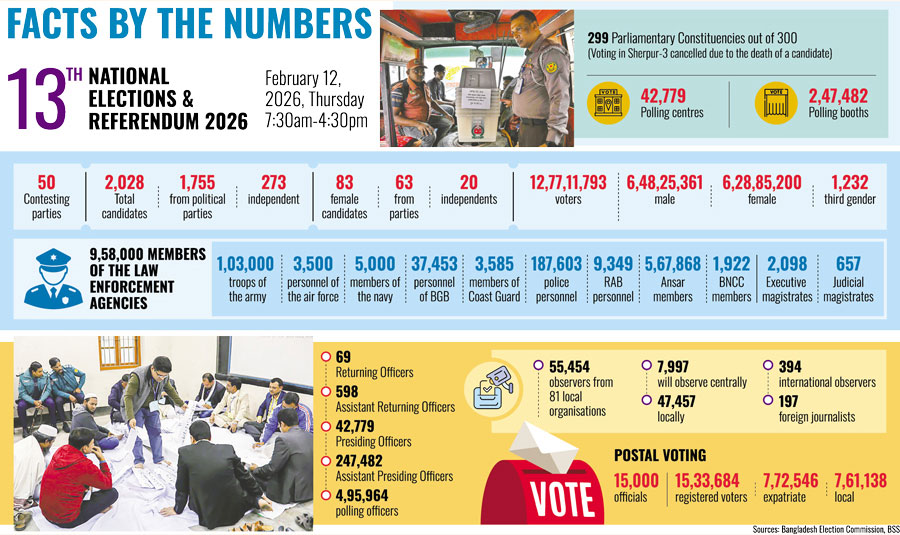
More than 127.7 million voters are eligible to cast ballot, including 62,885,200 women and 64,825,361 men. Polling will run from 7.30am to 4.30pm, with paper ballots placed in transparent boxes. Officials say voters present at polling centres before closing time will be allowed to vote.
Polling in Sherpur-3 constituency is postponed due to the death of a candidate.
The Awami League, which had ruled for 15 years in a row, has been barred from contesting over allegations of crimes against humanity during its tenure.
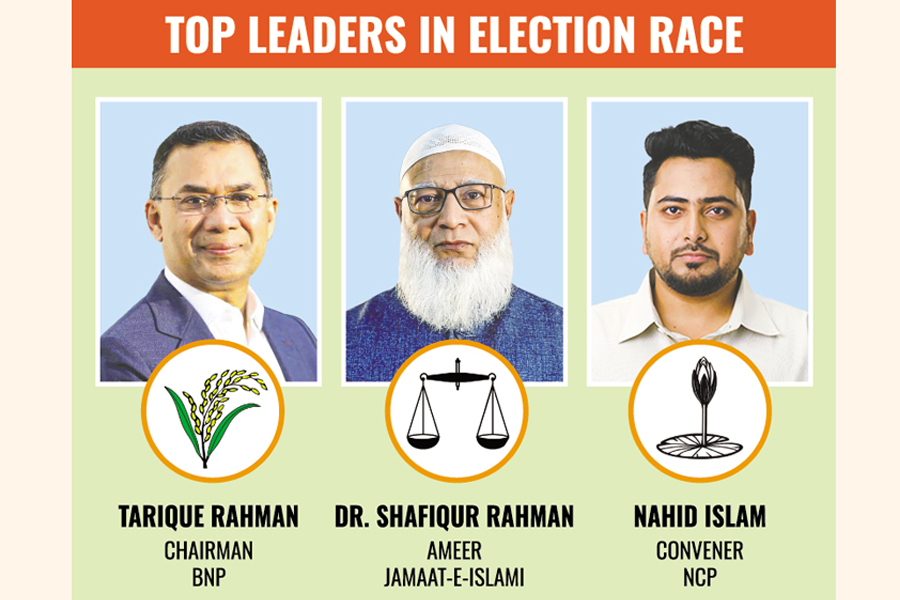
In its absence, the political landscape has shifted dramatically. The Bangladesh Nationalist Party (BNP), founded by the late president Ziaur Rahman, is widely viewed as the frontrunner, according to most opinion polls in the run-up to the polls.
The BNP chairman, Tarique Rahman - son of Ziaur Rahman and the late former prime minister Khaleda Zia, who herself served three terms - has led an energetic campaign, addressing 64 rallies in 19 days. In a recent interview, he said he was hopeful the party would be able to form the government on its own after Thursday's general election, coupled with a referendum on constitutional changes.
Jamaat-e-Islami, once banned and widely criticised for its role during 1971 the Bangladesh'd Liberation War, is also poised for what analysts suggest its strongest showing yet.
Its leader, Shafiqur Rahman, has addressed at least 62 public meetings since campaigning began on January 22, travelling by road and helicopter.
In a nationally broadcast address, he emphasised reforms in education, the judiciary, the economy and governance to restore public trust and promote inclusive development.
At several rallies, including four large gatherings in Feni, Noakhali, Laksam and Cumilla on January 30, his speeches went beyond soliciting votes and sought to frame the BNP as Jamaat's principal rival.
A total of 2,028 candidates from 50 political parties and independents are contesting the general election. Of them, 83 are women. Voting in the Sherpur-3 constituency has been postponed following the death of a candidate.
The scale of security deployment reflects both the stakes and lingering anxieties. About 958,000 law-enforcement personnel have been mobilised nationwide, including 103,000 army troops, 3,500 air-force personnel and 5,000 navy members. Police, Rapid Action Battalion officers and nearly 568,000 Ansar members will be on duty, alongside Border Guard Bangladesh and coast guard units.
More than 2,000 executive magistrates and 657 judicial magistrates have been assigned to oversee compliance and adjudicate election-related offences.
Authorities have identified 8,770 polling centres as highly vulnerable and 16,000 as moderately vulnerable. Over 90 per cent of centres have been equipped with CCTV cameras.
Inspector-general of police Baharul Alam has said a three-tier security system - static, mobile and striking forces - has been put in place.
"With the scale of security arrangements in place, no one has the capacity to disrupt the election," he said, though he acknowledged isolated incidents could not be ruled out.
Vehicle movement has been restricted nationwide in the run-up to polling, with motorcycles banned from Tuesday to Friday and most private and commercial vehicles suspended from Wednesday midnight until polling day, save emergency services and authorised personnel.
On the streets of Dhaka, the pre-election atmosphere has been subdued. A four-day holiday beginning Wednesday has prompted many residents to leave the capital for their native homes. Roads and neighbourhoods appear unusually quiet, with reduced public transport and only rickshaws and auto-rickshaws plying the streets.
Political analysts caution that the absence of the Awami League from the ballot does not mean its influence has evaporated. Even if half of its supporters turn out, they could decisively shape outcomes in tightly contested constituencies. As a result, nearly all major parties, including BNP and Jamaat, have made overtures to Awami-leaning voters.
Professor Lailufar Yasmin of Dhaka University says expectations are particularly high among younger voters. "Many expectations surround the election, as Bangladesh votes for the first time in roughly 17 years," she adds, referring to widespread doubts about the credibility of recent polls.
"About 30 per cent of young people are expected to vote for the first time. Many suspect their votes will go to rightwing, youth-led parties."
But she cautions against overstating their influence. "Young voters are distributed across different constituencies. They will not be the only deciding factor. Women's votes and those of financially marginalised groups - especially small business owners seeking stability, protection from extortion and assurance of law and order - will matter."
The varsity teacher looks out for three groups: youth voters, women voters and financially marginalised voters.
Alongside the parliamentary vote, a national referendum will also be held simultaneously, adding another layer of significance to Thursday's ballot.
Voters will be asked to give their verdict on a set of proposed reforms aimed at reshaping key constitutional and governance structures, a move the interim administration says is intended to strengthen accountability and prevent future democratic backsliding.
Supporters argue the referendum offers a rare opportunity for citizens to directly influence structural reforms, while critics warn that complex constitutional questions may not lend themselves to a simple yes-or-no vote amid an already polarised environment.
The simultaneous holding of parliamentary elections and referendum is unprecedented in recent years, and election officials say separate ballot papers and procedures have been arranged to ensure clarity and transparency in the dual process.
The final days of campaigning have also seen a surge in online disinformation. Facebook has become a battleground for fabricated quotes, doctored images and AI-generated visuals depicting staged meetings and conspiracy theories.
False statements attributed to political leaders have circulated widely, while unrelated images have been used to suggest foreign backing or geopolitical tensions.
Yunus, the interim government chief, has urged voters to participate "courageously" and called on political parties to accept the results with good grace in national interest.
In a televised address ahead of the election and the referendum, he warned that flawed or violent polls ultimately harm the country as a whole.
At least 394 international election observers and 197 foreign journalists have arrived in Bangladesh to observe the election.
Of the international observers, 80 represent various international organisations, 240 come from bilateral countries-including independent European observers-and 51 are individuals affiliated with different global institutions, officials said.
According to analysts, as Bangladesh prepares for the ballot, the vote represents more than a contest between parties. It is a referendum in both the literal and symbolic sense - on whether the country can move beyond years of acrimony and restore confidence in the democratic process, or whether its deep political divisions will once again cast a long shadow over the result.
mirmostafiz@yahoo.com