

Mustard cultivation brings high profit for Cox's Bazar's growers
Farmers earn Tk 25,000-30,000 per bigha within 2.5 months
Published :
Updated :
 For all latest news, follow The Financial Express Google News channel.
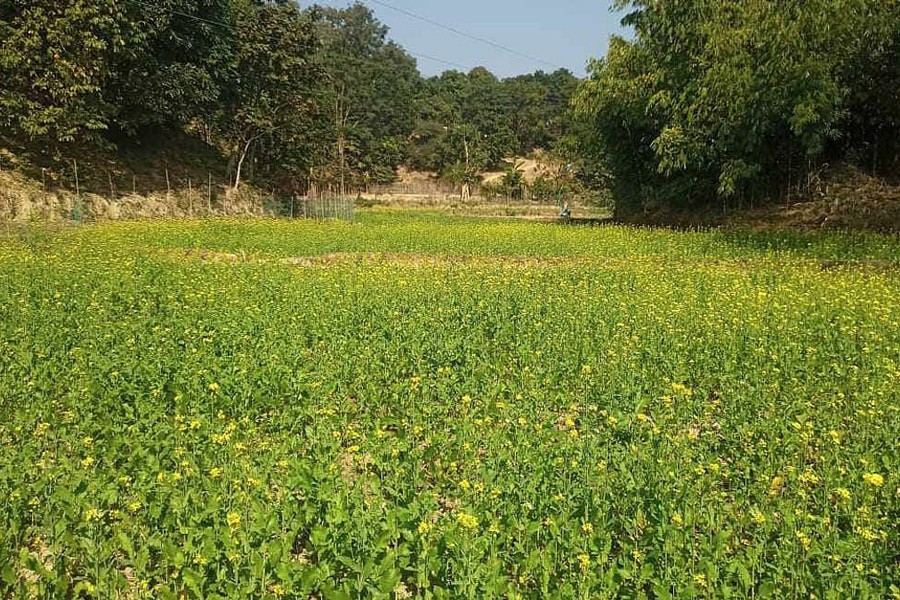
Cox's Bazar's farmers have been securing profit amounting at least five times the production cost with mustard cultivation on post-Aman-rice-harvested fallow land - in an efficient crop rotation that transformed vast fields into a sea of yellow blooms.
Department of Agricultural Extension (DAE) sources said rising edible oil prices and relatively lower input costs have fueled farmers' interest and they expanded the targeted area for cultivation. The DAE also increased production goals upward from what it was last year.
A total of 1,276 hectares (9,538 bighas approx.) were brought under mustard cultivation in the district, to be harvested within 70-75 days after plantation and projected yields in the 2025-26 season has surpassed previous years, DAE sources said. The district has set a production target of about 2,200 metric tonnes.
Field visits to Chakaria, Ramu, Pekua and Cox's Bazar Sadar upazilas reveal mustard fields flourishing under favourable weather conditions.
Farmers are optimistic about achieving higher yields this season. Of the cultivated 1,276 hectares, around 600 hectares are in Chakaria, 300 hectares in Pekua, 260 hectares in Ramu, and 116 hectares in Sadar Upazila.
Stakeholders in the sector say mustard cultivation typically costs between Tk 3,000 and Tk 5,000 per bigha, while average yields range from seven to eight maunds. With market prices currently between Tk 95 and Tk 110 per kg, farmers are earning between Tk 25,000 and Tk 30,000 per bigha.
In Purba Baraeitoli village of Dulahazara Union under Chakaria Upazila, farmer Nurul Amin has cultivated the high-yielding BARI-14 mustard variety on four acres (12.12 bighas approx) of land. "I made good profit last year, so I expanded cultivation this season. I expect around seven maunds per bigha," he said.
In Khuniapalong union of Ramu Upazila, farmer Jasim Uddin cultivated mustard on one and a half acres. He received quality seeds and fertiliser as government incentives from the local agriculture office.
"After deducting all expenses, I hope to earn nearly Tk 80,000 in profit," he said.
Abdul Hakim and his brother in Taitong Union of Pekua Upazila cultivated mustard on about one acre of land after harvesting Aman paddy. "Instead of leaving the land fallow, we planted mustard. The pods look promising. If the weather remains favorable, we expect a good yield," they said.
In Khurushkul area of Cox's Bazar Sadar, farmer Rafiqul Islam cultivated mustard on 70 decimals (2.12 bigha approx.) of land. With support from the agriculture department, he reduced production costs. "The crop can be harvested within two and a half months, and the profit margin is good," he noted.
Sadar Upazila Agriculture Officer Md. Rasel Rana said mustard is a short-duration and low- input crop. "Irrigation requirements are minimal. Government incentives have been distributed to encourage expanded cultivation," he said.
DAE Deputy Director in Cox's Bazar, Dr. Bimal Kumar Pramanik, said improved varieties are contributing to higher yields. "We expect production to exceed the target this season."
tahjibulanam18@gmail.com