

Published :
Updated :
 For all latest news, follow The Financial Express Google News channel.
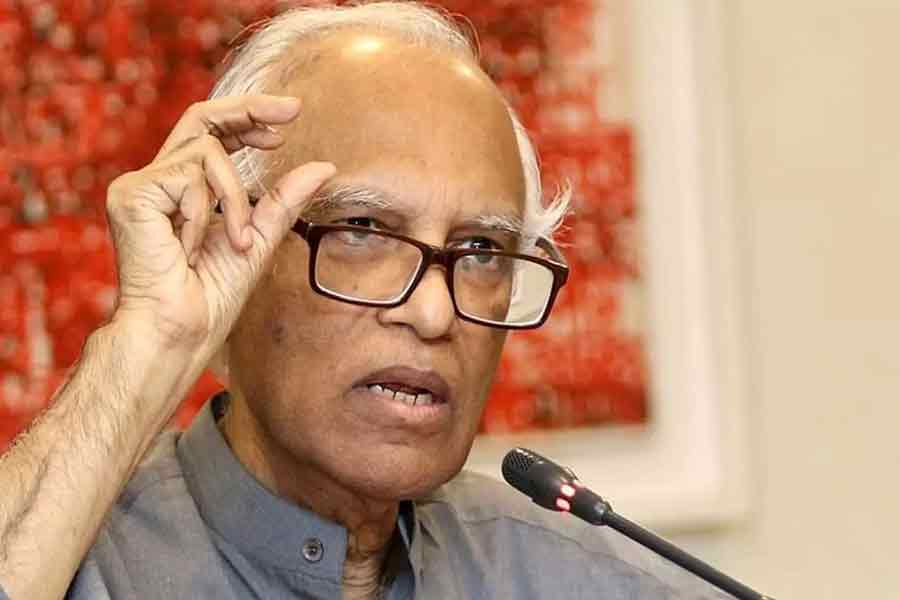
Bangladesh's long-term development prospects may face serious setbacks unless rent-seeking in politics and the collusive nexus between business and bureaucracy are dismantled, Planning Adviser Dr Wahiduddin Mahmud said on Sunday.
He said meaningful institutional reform, an efficient bureaucracy and strong political commitment are essential to create proper economic incentives, noting that regulations alone cannot deliver lasting change.
Dr Mahmud made the remarks while speaking at the opening session of the Annual BIDS Conference on Development (ABCD), organised by the Bangladesh Institute of Development Studies (BIDS) in the capital.
"The two-day conference will feature 20 research papers across six academic sessions, covering industrial development, labour markets, health systems, food systems, social protection, climate change and energy transition," BIDS Director General Prof AK Enamul Haque said at the opening.
Presenting a keynote paper titled "Democracy and Development", Dr Mahmud argued that democratic structures alone cannot guarantee progress without transparency in state institutions and a market system that rewards productive entrepreneurship instead of illicit advantage.
"New laws or administrative reforms may reduce harassment in theory, but without incentive change they risk turning into fresh channels for rent extraction," he said. "If politics remains driven by illicit income, extortion and muscle power flourish -- and development suffers."
He observed that despite various procedural reforms, Bangladesh continues to score low on global business climate indicators because informal networks often override formal rules.
Breaking these entrenched power circles, the adviser said, is more crucial than simply shortening approval processes or reducing paperwork.
"An unscrupulous business actor can distort competition and even influence policy outcomes," he said, cautioning that regulation alone cannot curb illegal rent-seeking if political appetite for it persists.
Highlighting youth unemployment and poor-quality education, he said these push many young people into patronage-based political activities, reinforcing a cycle that rewards unproductive behaviour and weakens institutions.
Dr Mahmud stressed that economic growth must be judged not only by GDP expansion but by its ability to reduce inequality and widen opportunities.
He added that social protection financing, tax reform, and redistribution require sustained political commitment -- areas often overlooked in consensus-driven policymaking.
The planning adviser said that while democratic transition after the July changes is important, Bangladesh's development future hinges on improved governance and accountability.
"No country is too poor to guarantee basic livelihood needs. The constraint is not resources -- it is goodwill and political commitment to fairness."
Calling corruption an economic burden rather than merely a moral problem, he urged clarity in institutional mandates, stronger rule-based governance and effective enforcement of anti-corruption measures to attract investment and enhance productivity. Policy consistency and predictable regulation, he said, are vital for restoring investor confidence.
"No economy can thrive where informal power outweighs formal rules," Dr Mahmud cautioned, adding that illicit political financing also affects education outcomes, contributing to poor learning quality and higher dropout rates.
He also said that the country's priority should be to establish functional democracy, foster sustained growth and address inequality. "It is unfortunate that, 50 years after independence, these remain unfinished agendas."
jahid.rn@gmail.com