

Published :
Updated :
 For all latest news, follow The Financial Express Google News channel.
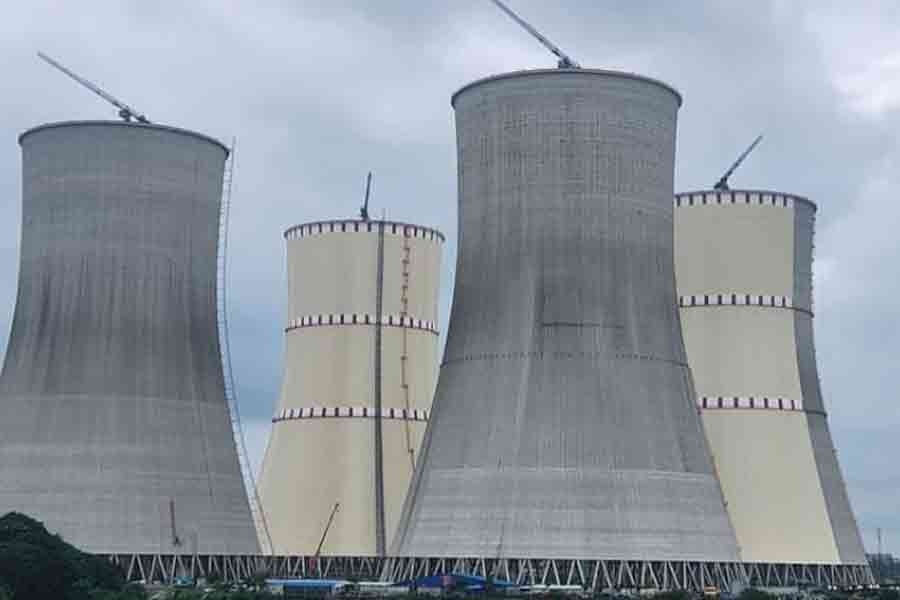
The Rooppur Nuclear Power Plant (RNPP) project, originally planned for 9.5 years with a budget of Tk 1.13 trillion, is set to reach the end of its tenure next Tuesday. So far, around 72.5 per cent of the works has been completed.
The project revision, which seeks to extend the completion date to June 2028 and increase the total cost by 23 per cent to over Tk 1.39 trillion, has hit major hurdles. The Planning Commission sent the proposal back to the Ministry of Science and Technology with more than 20 queries.
Sources at the Planning Commission said a meeting of the Project Evaluation Committee (PEC) was recently held to review the revision proposal, which includes a revised project cost of over Tk 1.39 trillion, largely backed by Russian loans worth Tk 1.17 trillion.
The meeting, chaired by Dr Md Mokhlesur Rahman, member (Senior Secretary) of the Industry and Energy Division, raised concerns over the high estimates for several components under the project.
A senior official of the Planning Commission's Programming Division told The Financial Express that, without timely approval of the revisions, disbursements against the project may have to be halted from the beginning of next year.
He explained that projects with expired tenures are usually marked with a star in the Annual Development Programme (ADP), from which funds can only be released after the approval of revisions.
The Bangladesh Atomic Energy Commission (BAEC), the implementing agency, expressed concern that this could create significant uncertainty in continuing project activities, paying staff salaries and allowances, and covering essential operational expenses.
The original DPP, approved by ECNEC in December 2016, estimated the project cost at Tk 1.13 trillion, including Tk 220.53 billion from the government exchequer and Tk 910.40 billion as project assistance under an intergovernmental loan agreement with Russia.
Under the proposed revision, project assistance would rise by 28.29 per cent, while government funding would increase by nearly 19.63 per cent.
The PEC noted that the revised proposal did not adequately justify sharp increases in several expenditure heads, particularly those with limited spending during the past nine years.
IMED representatives pointed out at the meeting that for multiple items-such as transport hiring, fuel and lubricants, motor vehicles, office equipment and security services-the proposed allocations for the remaining 2.5 years far exceed historical spending trends. In several cases, no expenditure had occurred so far, yet large new allocations were proposed.
The committee also raised serious concerns over the absence of a Subsidiary Loan Agreement (SLA) between the Economic Relations Division and the implementing agency, despite the signing of the intergovernmental loan agreement in 2016.
Given the circumstances, the PEC advised the Ministry of Science and Technology to consider a separate proposal solely for extending the implementation period, without incorporating cost revisions, to ensure uninterrupted project operations.
The committee also instructed the ministry to rationalise new revenue components, reassess residential and non-residential building costs, revise vehicle procurement plans in line with existing restrictions, and remove calculations prepared using a 5.0-percent discount rate instead of the prescribed 12 per cent.
Until these issues are addressed and a restructured revised DPP is resubmitted, officials indicated that final approval of the Rooppur project revision by ECNEC may take considerable time, adding further uncertainty to the completion timeline of the country's first nuclear power plant.
The rise in the project cost is largely attributed to the depreciation of the taka against the dollar, reveals the proposal.
While the project's budget was initially calculated at Tk 80 per US dollar, the exchange rate has surged significantly, inflating the taka value of the dollar-denominated loans, it added.
The revised proposal notes that due to exhaustion of allocations for advance payments under the contract, import duties, and value-added tax, the plan includes increasing allocations in 34 heads, reducing allocations in 40 heads, and adding 10 new heads.
Former planning secretary Mamun Al Rashid said, "Revision to such large and costly projects are never approved in haste. Every financial and technical aspect is scrutinised before a decision. If complications arise due to delays in submission, the project authorities will bear responsibility."
Commenting on the extension as a routine process, Md Anwar Hossain, secretary of the Ministry of Science and Technology, said, "The project revision is being undertaken in full compliance with rules and with complete transparency."
jahid.rn@gmail.com