

Speakers emphasize trauma-informed legal education to combat human trafficking
Published :
Updated :
 For all latest news, follow The Financial Express Google News channel.
Speakers on Wednesday emphasized the importance of fostering a victim-centered, trauma-informed, and gender-responsive approach among law students by strengthening their foundational knowledge and practical understanding. This approach aims to reinforce Bangladesh’s legal framework against human trafficking while contributing to greater access to justice and the rule of law.
In addition to legal knowledge, the speakers highlighted the practical challenges frequently encountered throughout the justice process, including investigation, evidence collection, prosecution, and institutional coordination.
They also drew attention to emerging trends, such as digital exploitation, that are reshaping the nature of human trafficking.
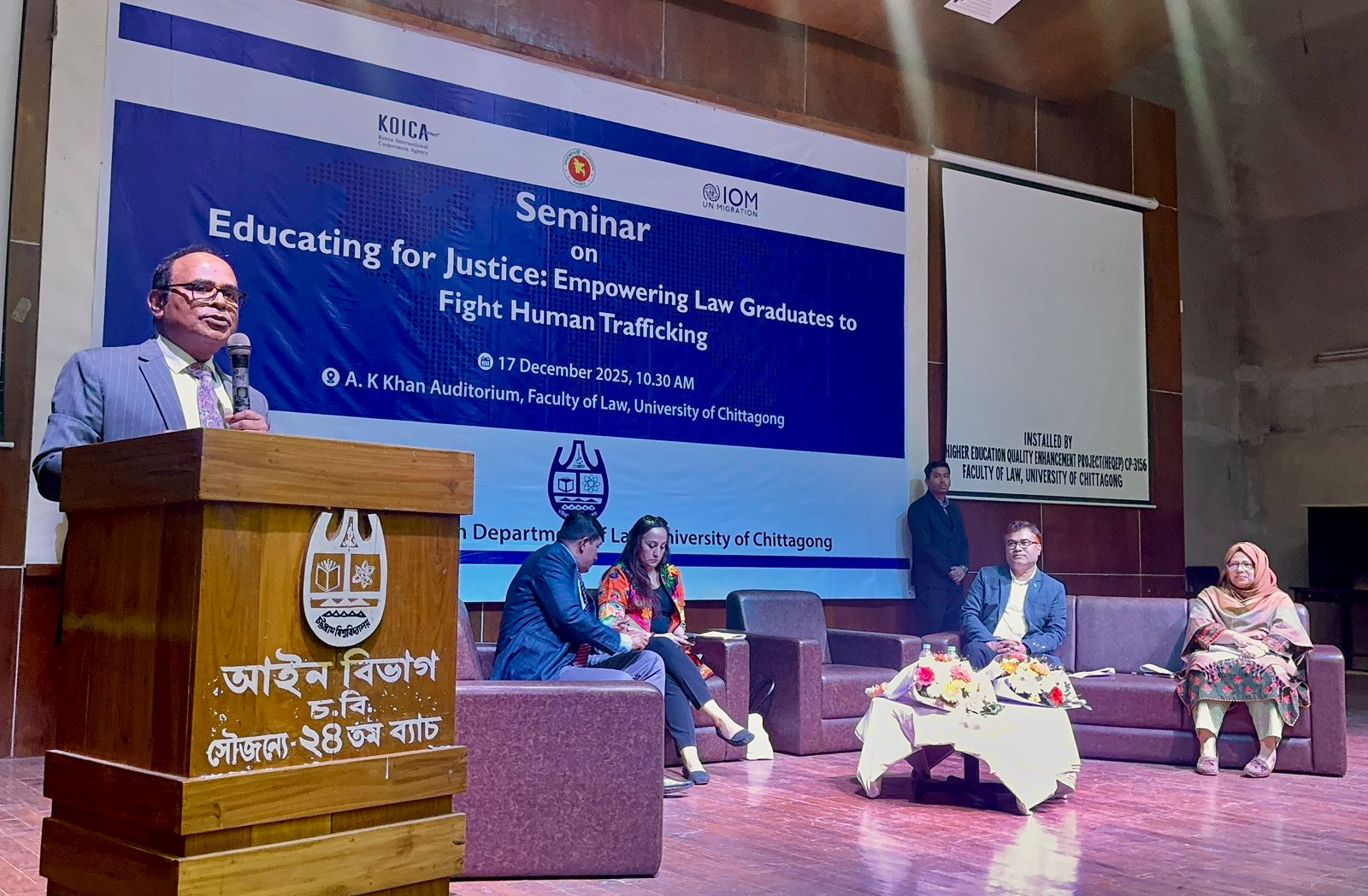
These issues were raised at the seminar titled “Educating for justice: empowering law graduates to fight human trafficking”, held at the A.K. Khan Auditorium, Faculty of Law, University of Chittagong, bringing together senior academics, government officials, and legal practitioners to discuss the gaps in legal education and practical challenges in implementing anti-trafficking laws, said a press release.
The seminar was jointly organized by the University of Chittagong (CU) and the International Organization for Migration (IOM).
The seminar also featured student engagement through a quiz competition, prize distribution, and a handover of reference books from IOM to the CU Department of Law.
The seminar is part of IOM’s approach to actively engage the youth and academics in its programming to combat human trafficking, acknowledging the critical role they can play and to provide them with a platform to do so, such as the recently concluded national level university debate tournament ‘Safeguarding Lives – Human Trafficking Prevention’.
The event concluded with the opening of a book corner with IT equipment at the Law Seminar Hall, donated by IOM with the support of Korea International Cooperation Agency (KOICA), promoting continued academic engagement on anti-human trafficking issues.
Professor Dr. M. Jafar Ullah Talukder, Dean, Faculty of Law, CU, and Pooja Bhalla, Head of Protection at IOM delivered opening remarks, highlighting the importance of collaboration between academic institutions and justice sector actors in preparing future legal professionals.
During the keynote address, Professor A.B.M. Abu Noman from CU’s Department of Law stressed the need to integrate human trafficking law into undergraduate curricula to equip students with both conceptual knowledge and practical skills for effective justice delivery.
An interactive session with Md. Aminul Islam, Deputy Secretary (Political 3), Ministry of Home Affairs, was also held, focusing on investigation, evidence collection, and institutional coordination challenges.
M. Jashim Uddin Khan, Joint Secretary (Political 1), Ministry of Home Affairs, attended as Chief Guest and underlined the ethical responsibility of future lawyers in protecting survivors’ rights. He pointed out that only knowledge of law, rules and regulations is not sufficient for a professional.
A professional must possess analytical insights, technical competence, and ethical standards. He should take a decision after a systematic assessment of relevant data, evidence, and operational context, he added.
This initiative is part of a broader seminar series across the country’s public and private universities designed to strengthen long-term engagement between universities and justice sector actors by creating academic interest and institutional readiness for integrating the Human Trafficking Law module developed by IOM, into undergraduate curricula.
Through these efforts, the seminars intend to inspire students to pursue pathways in human rights, criminal justice, and counter-trafficking work, ultimately contributing to a more capable and victim-centered national justice system.