
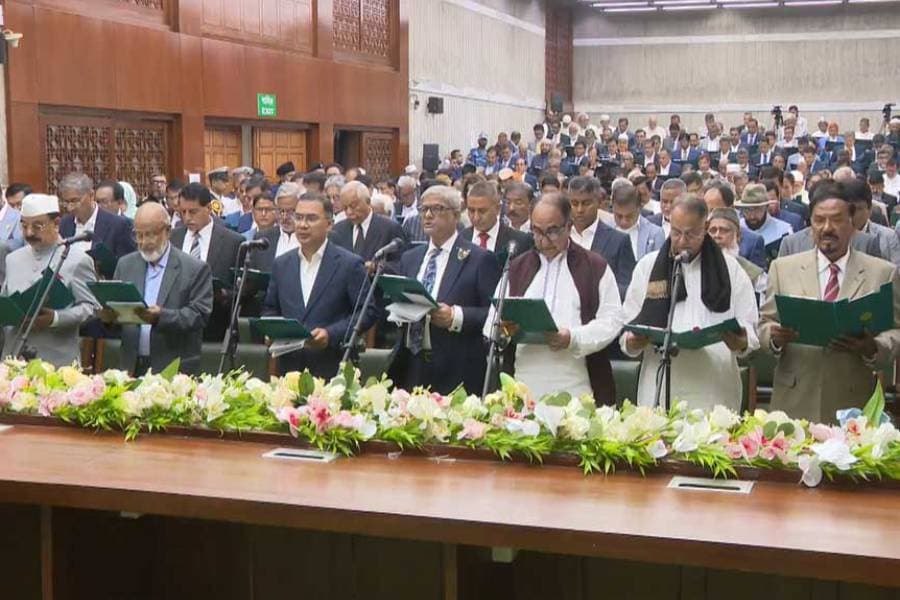
Bangladesh’s newly elected parliament has opened with an unusual split. While BNP lawmakers took the oath as members of parliament, they stopped short of pledging themselves to the proposed Constitutional Reform Council.
In contrast, the Jamaat-e-Islami and the National Citizen Party (NCP) did not.
The divergence has ignited a fierce legal debate. Senior lawyers are split: some argue that inserting a second oath into the July Charter Implementation Order is “illegal”, while others see BNP’s refusal to take the additional oath as an “unnecessary caution”.
On Tuesday, lawmakers from the BNP—the party that secured a parliamentary majority—were sworn in first. Members from Jamaat and the NCP then took their oaths in sequence.
Ahead of the ceremony, BNP Standing Committee member Salahuddin Ahmed publicly announced the party’s decision not to take the oath as members of the Constitutional Reform Council.
Holding up the oath form, he said: “None of us has been elected as a member of the Constitutional Reform Council, nor has this been incorporated into the Constitution yet.
“Once the Constitutional Reform Council is formed following the referendum verdict, it must first be incorporated into the Constitution, provisions must be made for who will administer the oath to council members, and the relevant form must be constitutionally prescribed. No such form exists in the Constitution at present.
“This form appears in the Third Schedule, in a simplified version. Only when such a form is incorporated into the Third Schedule through constitutional process, adopted by parliament, can provisions be made for members of the National Constitutional Reform Council to take an oath. Constitutionally, this is as far as we have reached.”
Salahuddin said the decision had been taken on the instructions of their leader Tarique Rahman.
He added, “BNP is acting in accordance with the Constitution and will continue to do so in the future.”
Senior lawyer Jyotirmoy Barua took a sharply critical view of the process. He said the manner in which the July Charter Implementation Order was issued by presidential decree—and the way it inserted an oath for members of the Constitutional Reform Council—was “unlawful”.
He asked, “Can you substitute the Constitution with a separate order?”
The Charter implementation order was issued on Nov 13, the same day the date was set for simultaneous elections and referendum.
After a year of prolonged discussions, dialogues and debates, the Charter on state reform initiatives was finalised and signed on Oct 17.
Voters were asked to give their consent through a “Yes” or “No” vote on four questions covering 48 constitutional reform issues outlined in the Charter.
In Thursday’s polling, the BNP won 209 seats to secure a majority and form the government. Jamaat won 68 seats, while the NCP secured six.
In the referendum, 60.06 percent of voters cast their ballots in favour of “Yes”.
Amid the debate over whether BNP lawmakers should take the second oath, Jyotirmoy said on a Jamuna Television talk show on Monday night that, at first glance, the referendum’s approval might appear to create a legal obligation for newly elected MPs to take two separate oaths.
But, he argued, a closer legal reading suggests otherwise.
“This is not something that can simply be accepted without explanation or analysis. Very illegal actions have taken place. A second oath has been added without any lawful authority.”
He explained that during the entire tenure of the interim government, several laws were enacted and implemented through presidential ordinances.
“But after the July Charter was signed, an order titled the July Charter Implementation Order was issued—a single order by the president on Nov 13, 2025. The question is whether the president had any authority at all to issue such an order.”
Citing Article 93 of the Constitution, Jyotirmoy said three specific conditions must be met for issuing ordinances.
“First, it must relate to circumstances where parliament does not exist. Second, no ordinance can be issued on matters that cannot be lawfully enacted by parliament. Third, no ordinance may alter or repeal any provision of the constitution.
“The president has no authority to issue an order that fundamentally changes the Constitution.”
He noted that Schedule I of the order added a second oath.
Referring to Article 148 of the Constitution on parliamentary oaths, Jyotirmoy said the oath must follow the formats prescribed in the Third Schedule.
“Under what law can you insert a new oath by order, making a fundamental constitutional change?”
Questioning whether two oaths were legally mandatory, he said the implementation order itself lacked legality.
“This order will not stand in law. Moreover, an elected parliament cannot be bound by dictates imposed in advance—doing so undermines the very idea of parliamentary sovereignty.”
Drawing a comparison with the 1991 referendum, he said there was no concept of dual oaths then.
“The decision was made by the people. But here, it is unclear whether most people understood that a council could amend the Constitution within 180 days. I doubt that such a mandate was clearly given.”
Another senior lawyer offered a more conciliatory view, saying the BNP wants all ordinances, including the referendum ordinance, to be formally approved first, after which its MPs would take the oath as members of the Constitutional Reform Council.
He described the BNP’s refusal to take both oaths simultaneously as “unnecessary caution”, noting that the public had clearly expressed its will in the referendum.
Still, he said he saw no fault in the party’s effort to remove any constitutional doubt.