

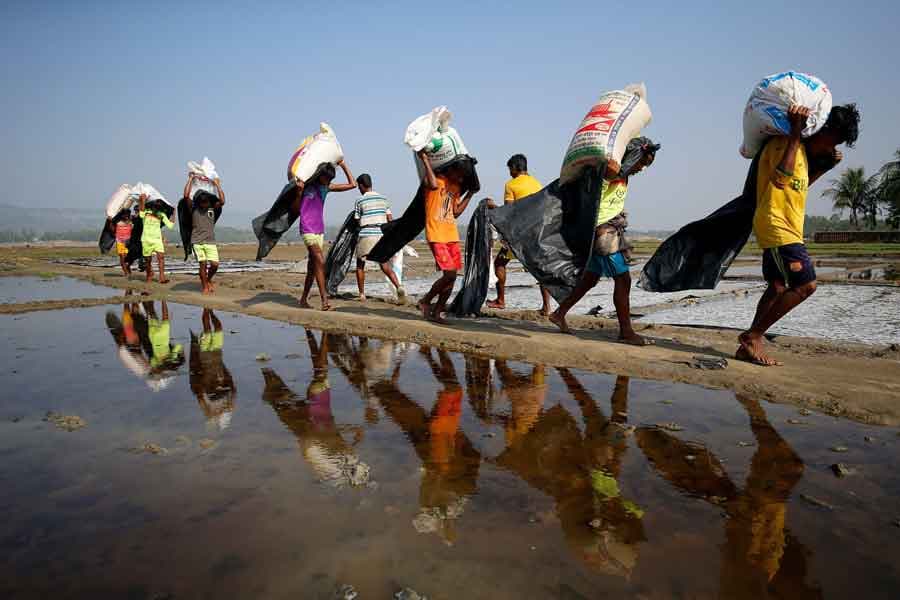
The United Nations and its humanitarian partners on Wednesday have appealed for 710 million US dollars in international assistance for the next year to sustain emergency support for Rohingya refugees in Bangladesh, warning that deepening global crises and shrinking aid budgets are threatening vital services for one of the world’s largest displaced populations.
Launching the updated 2026 Joint Response Plan, UN agencies and aid organisations called for $710.5m to provide food, shelter, healthcare, education and protection services for Rohingya refugees living in camps in Cox’s Bazar and on Bhasan Char, as well as vulnerable Bangladeshi host communities affected by the crisis.
The appeal comes nearly a decade after hundreds of thousands of Rohingya fled targeted violence and persecution in Myanmar’s Rakhine state, seeking refuge across the border in Bangladesh.
Today, around 1.2 million Rohingya refugees remain in Bangladesh, with humanitarian agencies warning that needs continue to grow as instability inside Myanmar forces more people to flee. Since early 2024, approximately 150,000 Rohingya have newly arrived in Bangladesh, increasing pressure on already overcrowded camps and overstretched humanitarian operations.
The revised response plan aims to support around 1.56 million people, including refugees and host communities. Although the appeal amount is 26 per cent lower than last year’s request, aid agencies stressed that the reduction reflects severe funding constraints rather than declining humanitarian needs.
Officials described the 2026 plan as a “hyper-prioritized” response focused only on the most critical and lifesaving interventions.
Of the requested amount, $247.3m has been allocated for food assistance, $128m for shelter support, $61.2m for water, sanitation and hygiene services, $52.7m for education and $49.9m for healthcare.
Another $35.1m has been set aside for livelihood and skills development programmes aimed at improving refugee self-reliance and reducing long-term aid dependency.
The plan also includes $36.2m in support for Bangladeshi host communities, many of which have faced growing economic, social and environmental pressure since the mass influx of refugees in 2017.
The appeal highlights mounting concerns among humanitarian agencies that the Rohingya crisis is gradually slipping from global attention as international donors divert resources toward conflicts in Ukraine, Gaza and elsewhere.
From 2017 through the end of 2025, the international community contributed approximately $5.42bn to the Rohingya humanitarian response, with the United States remaining the largest donor.
That support enabled aid agencies and Bangladeshi authorities to provide food, healthcare, education and protection services in camps that have become among the largest refugee settlements in the world.
But humanitarian officials warned that continued funding reductions could severely affect living conditions inside the camps.
“As resources become more limited, it is more important than ever to help refugees build skills and resilience, so they can gain independence, hold on to hope, and rebuild their lives,” said Kelly T. Clements, deputy high commissioner of United Nations High Commissioner for Refugees.
She said humanitarian agencies were attempting to deliver support as efficiently as possible but cautioned that operational efficiencies alone could not offset the impact of major funding cuts.
“The needs remain enormous,” she said. “Helping the refugee community become more self-reliant remains a crucial goal.”
The funding appeal was jointly presented by senior officials from UNHCR, the World Food Programme and UN Women alongside representatives of the Bangladeshi government and the wider humanitarian community.
Rania Dagash-Kamara, assistant executive director of WFP, praised Bangladesh for continuing to host the Rohingya population despite growing economic and humanitarian challenges.
“Rohingya refugees want to return home to Myanmar when they can do so safely, voluntarily, and with dignity,” she said. “We must continue to help create these conditions; we cannot let this crisis be forgotten.”
Humanitarian agencies warned that worsening economic hardship inside the camps is increasing vulnerability among refugees, particularly women, children and newly arrived families.
According to data released with the appeal, 35 per cent of camp households in 2025 depended entirely on humanitarian food assistance, while only 23 per cent earned income through aid-supported cash-for-work programmes.
Nyaradzayi Gumbonzvanda, deputy executive director of UN Women, warned that funding shortages were already affecting protection and support services for women and girls inside the camps.
“Within the broader challenges of displacement, women and girls face even more risks and barriers that require sustained attention,” she said.
The humanitarian situation has become increasingly uncertain as hopes for the early repatriation of refugees to Myanmar continue to fade.
Bangladesh and the international community have repeatedly maintained that the only sustainable solution to the crisis is the voluntary, safe and dignified return of Rohingya refugees to Myanmar. But ongoing conflict in Rakhine state and wider instability following Myanmar’s military takeover have left conditions unsuitable for large-scale returns.
As desperation grows, increasing numbers of Rohingya are attempting dangerous sea journeys to other countries across the region.
According to aid agencies, 2025 became the deadliest year on record for Rohingya sea crossings. Last month, a vessel carrying more than 270 people capsized, leaving only nine survivors.
The appeal was launched following a four-day donor mission involving representatives from Australia, Canada, the European Union, France, the Netherlands, Sweden and the United Kingdom, who visited camps and host communities in Cox’s Bazar before meeting officials and aid organisations in Dhaka.
The humanitarian community reiterated that continued international support remains essential not only to meet urgent humanitarian needs, but also to preserve regional stability and prevent one of the world’s most vulnerable refugee populations from being abandoned to worsening uncertainty and desperation.