

National
2 days ago
UNESCO and VOICE Launch “SAMATA” Project to Strengthen Media Accountability and Safety for Women Journalists
Published :
Updated :
 For all latest news, follow The Financial Express Google News channel.
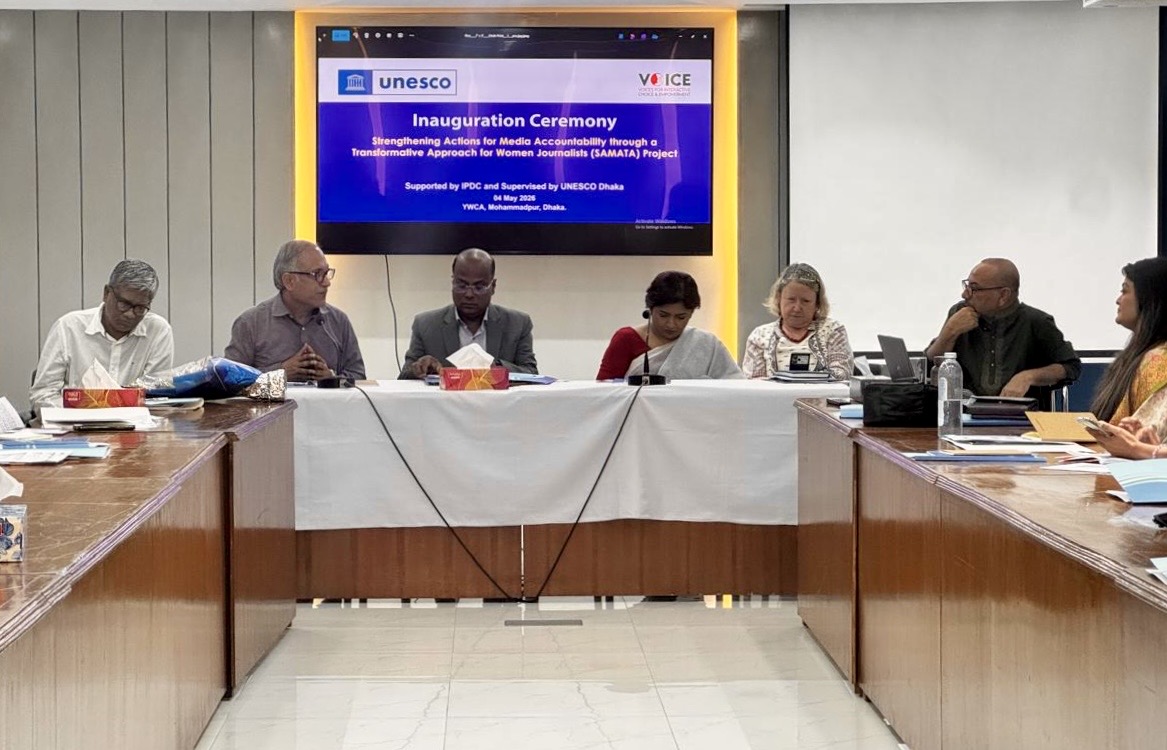
The inauguration ceremony of the project titled “Strengthening Actions for Media Accountability through a Transformative Approach for Women Journalists (SAMATA)” was held on Monday in Dhaka, marking a significant step toward addressing structural challenges and promoting gender-responsive reforms within the media sector.
The event, organized by the rights-based advocacy organization VOICE at the YWCA Auditorium on Monday, convened journalists, media professionals, rights defenders, and civil society representatives to examine the prevailing challenges and institutional realities shaping the experiences of women in Bangladesh’s media landscape.
Discussions highlighted that ensuring both digital and physical safety for women is a collective priority, requiring coordinated and sustained efforts across government institutions and civil society actors.
Muhammad Hiruzzaman ndc, Director General (Additional Secretary), National Institute of Mass Communication (NIMC), Ministry of Information and Broadcasting, attended the event as the Chief Guest and underscored the government’s collective commitment to advancing inclusive media policies, stating, “Ensuring a safe and equitable media environment for all, especially women journalists, remains a shared responsibility that requires sustained institutional support and collaboration.”
The project is supported by the International Programme for the Development of Communication (IPDC) under the supervision of UNESCO Dhaka. Dr. Susan Vize, Head of Office and UNESCO Representative to Bangladesh, formally inaugurated the project as the Special Guest.
In her remarks, Dr Susan Vize emphasized that media accountability and the safety of women journalists are fundamental to a healthy democracy, calling for a transformative approach to institutionalize gender equality.
She stated, “Ensuring the safety of women journalists is not only a matter of protection, but a prerequisite for credible and inclusive journalism. We must move beyond commitments to concrete, systemic changes that embed gender equality within media institutions and governance frameworks.”
Ahmed Swapan Mahmud, Executive Director of VOICE, highlighted the strategic necessity of the inaugurated project. He remarked, “Our objective through SAMATA project is to catalyze a structural shift within media houses. Accountability is not just a concept; it must be a practiced reality to ensure that women journalists can contribute to the democratic discourse without facing systemic barriers.”
The event featured a panel discussion titled “Advancing Gender Equality and Safety in Media,” bringing together experts from media, civil society, and academia to explore pathways for creating a safer and more inclusive media environment.
Hasibur Rahman, Executive Director of MRDI, emphasized the need for stronger institutional standards, stating, “Media accountability mechanisms must be transparent and inclusive. It is time for media houses to adopt rigorous standards that ensure women can report without fear of retaliation or discrimination.”
Miraj Ahmed Chowdhury, Executive Director of Digitally Right Limited, shed light on the practicality of the gender policy within media workplace noting, “Gender policy in media should be shaped and owned by media professionals and embedded within the workplace HR practice. A single approach doesn’t work for everyone.”
Samina Yasmin, Director of Strengthening Movements and Leadership at Bonhishikha, underscored the broader impact of the initiative, saying, “The SAMATA project aims to address structural challenges within media institutions and promote inclusive and sustainable reforms. We need to create a truly safe and supportive environment for women to excel in this profession.”
In her closing remarks, Musharrat Mahera, Deputy Director of VOICE, outlined the project’s strategic direction, stating, “With women comprising less than 10% of the journalism workforce in Bangladesh, many of their challenges remain unreported and unaddressed. Through the SAMATA project, we aim to develop a comprehensive gender policy and strengthen functional redress mechanisms to ensure safer and more accountable media workplaces.”
The event concluded with journalists, media personnel, civil society representatives, and other stakeholders jointly emphasizing the need for sustained and coordinated action to strengthen gender-responsive policies and accountability mechanisms, while reaffirming the importance of protecting both digital and physical spaces for women journalists as a foundation for a more inclusive and democratic media environment.