

Urgent, inclusive, localised action suggested to address lightning risks
Published :
Updated :
 For all latest news, follow The Financial Express Google News channel.
A new study has called for urgent, inclusive, and localised action to address lightning risks, one of the country’s fastest-growing climate-related hazards.
The study highlighted that lightning strikes claimed nearly 2,000 lives and injured more than 1,300 people between 2009 and 2024, disproportionately affecting rural farming and fishing communities, particularly in haor regions such as Sunamganj.
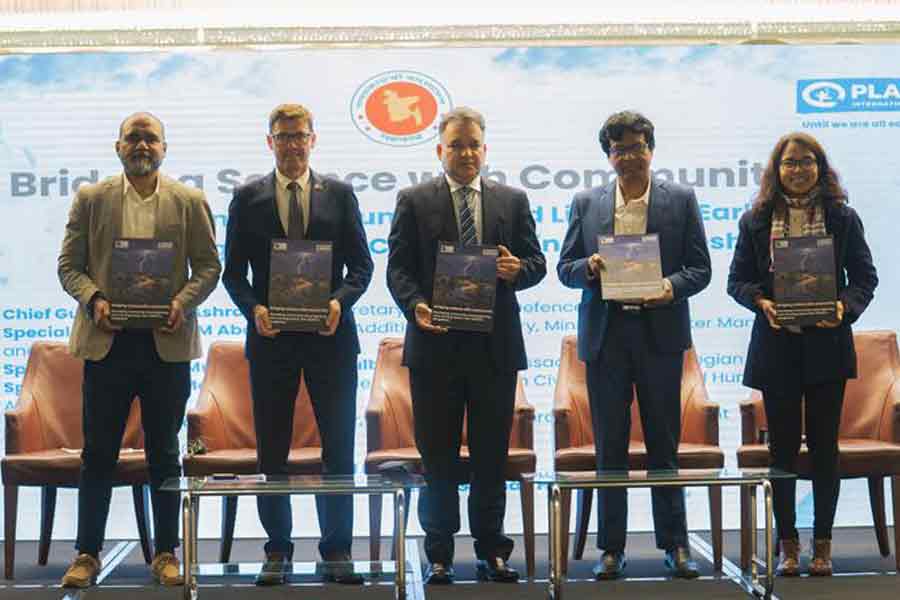
Plan International Bangladesh, in collaboration with the Bangladesh Meteorological Department (BMD), on Sunday hosted the sharing ceremony of the study titled ‘Bridging Science with Communities: Developing a Community-Based Lightning Early Warning System (CB-LiEWS) in Bangladesh’.
Mr Md Ashraf Uddin, the secretary to the Ministry of Defence, was present at the event as the chief guest. Senior government officials, development partners, researchers, and civil society representatives also joined the programme.
The programme was chaired by Mr Md Momenul Islam, Director, Bangladesh Meteorological Department (BMD) and Permanent Representative of Bangladesh to the World Meteorological Organisation (WMO).
The research, technically led by BMD with support from Plan International Bangladesh, reveals that while lightning is widely recognised as a dangerous hazard, community-level preparedness remains critically low.
More than half of the surveyed households reported direct experience of lightning-related deaths or injuries. Limited access to clear and localised forecasts further weakens response capacity, with nearly 77 per cent of respondents uncertain about warning lead times.
Preparedness efforts are minimal, as 96 per cent of respondents had never participated in lightning-specific drills, leaving communities, particularly women, youth, persons with disabilities, and low-literacy groups, highly exposed to preventable risks.
In his address as the chief guest, Mr. Md Ashraf Uddin underscored that, “Lightning claims around 300 lives every year in Bangladesh, yet it has long remained under-prioritised within our disaster risk management efforts. This study provides the evidence and direction needed to turn scientific forecasting into practical, community-based action that saves lives.”
He highlighted the need for strong inter-agency collaboration to ensure that warnings translate into timely life-saving action on the ground.
As the chair, Mr Md Momenul Islam noted, “At BMD, our scientific data identifies where lightning risks are highest, but science alone is not enough. Reducing lightning-related casualties requires more than improved forecasts; it demands accessible communication, strong coordination, and community trust. BMD is committed to advancing technologies and partnerships that make early warnings understandable and actionable for all.”
Speaking as the special guest, Norwegian Ambassador in Dhaka Håkon Arald Gulbrandsen, highlighted the value of evidence-based, community-driven approaches and international cooperation in building climate resilience. “Climate resilience is a shared responsibility that depends on strong national leadership, community participation, and international partnership. Research such as this provides the evidence needed to strengthen early warnings and reduce climate-related risks.”
Representing development partners, Mr Mokit Billah, Representative of the European Civil Protection and Humanitarian Aid Operations (ECHO), emphasised the importance of anticipatory action and sustained investment in inclusive early warning systems. “Effective early warning systems depend on sustained investment, strong institutions, and an unwavering focus on the most vulnerable. By grounding scientific forecasting in community realities, this research provides a credible foundation for scaling anticipatory action and ensuring that early warnings reach those who need them most.”
A panel discussion was held where professionals from the meteorology department, academia, development cooperation, youth and community-based initiatives discussed the key challenges and solutions for strengthening lightning awareness systems and tools in Bangladesh.