

Published :
Updated :
 For all latest news, follow The Financial Express Google News channel.
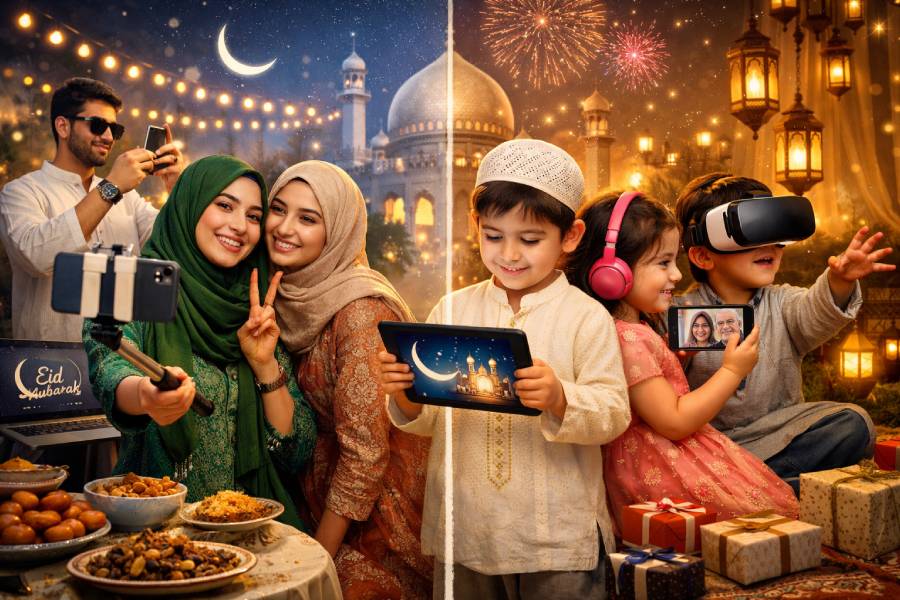
Eid, in its essence, is timeless. It arrives with the quiet certainty of the moon’s appearance, carrying centuries of devotion, communal joy, and deeply rooted traditions. Yet, like all human experiences, the way Eid is lived and expressed evolves, shaped by the hands, habits, and technologies of each generation. Today, as Generation Z and Generation Alpha stand at the forefront of cultural expression, Eid is undergoing a subtle yet profound transformation.
This transition is not merely about change; it is about reinterpretation. It is about how inherited rituals are filtered through digital consciousness, how sacred traditions coexist with social media aesthetics, and how the meaning of celebration is both preserved and redefined.
The Echoes of the Past
To understand the present, one must first listen to the echoes of the past. Eid once unfolded slowly, almost ceremonially. Preparations began days in advance. Homes were cleaned with meticulous care, new clothes were tailored with anticipation, and kitchens transformed into sanctuaries of aroma and memory. The night before Eid, Chand Raat, was electric yet intimate, filled with family chatter, last-minute shopping, and the delicate art of applying henna by hand.
Communication was personal, often physical. People visited one another, exchanging embraces that carried sincerity beyond words. Eidi, small gifts of money were given with warmth, not spectacle. Photography existed, but sparingly. Moments were lived first, documented second.
There was a certain slowness to it all. And in that slowness, depth.
GenZ: Between Tradition and Trend
Generation Z occupies a fascinating middle ground. Born into the early digital age yet raised with echoes of analog life, they are both inheritors and innovators. Their Eid is a careful balancing act, a negotiation between reverence and reinvention.
For Gen Z, Eid begins online long before the moon is sighted. Instagram feeds fill with curated outfit inspirations. Trends dictate makeup styles, and WhatsApp groups buzz with plans that are as much logistical as they are performative. The anticipation is no longer confined to neighbourhoods. It is global, instantaneous, and visually driven.
And yet, beneath this digital veneer, tradition persists. Gen Z still values family gatherings, still wakes up early for Eid prayers, still delights in the tactile pleasure of new clothes. But their experience is layered; every moment is both lived and potentially shared.
There is a subtle satire in this duality. The same person who posts a candid Eid morning photo may have taken twenty versions to perfect it. The authenticity of joy becomes, at times, a carefully edited narrative. But this does not diminish the joy itself. It merely reframes it.
Gen Z does not abandon tradition, it stylizes it.
Gen Alpha: The Native Digital Celebrators
If Gen Z is bilingual in analog and digital, Gen Alpha is fluent only in the latter. Born into a world where screens are extensions of reality, their experience of Eid is inherently different, not necessarily lesser, but undeniably transformed.
For them, Eid is immersive in ways previously unimaginable. Virtual greetings, animated stickers, and video calls replace or supplement physical visits. Eidi may arrive not as crisp currency notes but as digital transfers, sometimes accompanied by emojis that attempt to replicate the warmth of a smile.
Children of Gen Alpha may remember Eid less by the smell of sheer khurma simmering in the kitchen and more by the excitement of unboxing gifts ordered online. Their memories are shaped as much by algorithms as by family traditions.
And yet, there is something quietly poetic about this shift. The essence of Eid connection, generosity, and gratitude finds new channels of expression. A video call across continents can carry genuine emotion. A digital greeting can still hold sincerity. The form changes; the feeling adapts.
Still, one cannot ignore the gentle irony: a festival rooted in togetherness increasingly mediated by screens.
The Aesthetics of Celebration
One of the most visible transitions across these generations is the aestheticization of Eid. Where once beauty was incidental, it is now intentional, curated, and often public.
Outfits are no longer just worn. They are showcased. Meals are not merely enjoyed. They are photographed. Homes are not simply decorated. They are styled for visual impact. The language of celebration has expanded to include lighting, framing, and filters.
This shift reflects a broader cultural movement where experiences are validated through visibility. To celebrate is, in part, to share.
There is a delicate tension here. On one hand, this aesthetic awareness brings creativity and innovation. It allows individuals to express identity, experiment with tradition, and connect with a wider community. On the other hand, it risks reducing deeply personal moments to consumable content.
Eid, in this context, becomes both a lived experience and a visual performance.
Community: Physical vs Digital
Perhaps the most profound shift lies in the concept of community. Traditional Eid celebrations were deeply local, rooted in neighbourhoods, mosques, and extended families. Interaction was physical, immediate, and often unfiltered.
For Gen Z and Alpha, community extends beyond geography. Social media creates networks that transcend borders, allowing individuals to share Eid with people they may never meet in person. A greeting can travel across continents in seconds, collapsing distance in ways previous generations could only imagine.
This expansion is both liberating and complex. It fosters inclusivity and global awareness, but it can also dilute the intimacy of local connections. The neighbour next door may receive less attention than a follower thousands of miles away.
It raises an interesting question: Is connection defined by proximity or by engagement?
The Economics of Eid
Another dimension of this generational transition is economic behaviour. Eid has always involved consumption like new clothes, special foods, and gifts. But the nature of this consumption has evolved.
Gen Z and Alpha are heavily influenced by digital marketing. Brands capitalize on Eid through targeted campaigns, influencer collaborations, and limited-edition collections. Shopping shifts from bustling bazaars to online platforms, from bargaining to clicking.
There is convenience, certainly, but also a subtle shift in values. The act of buying becomes less about necessity or tradition and more about identity and expression.
Satirically speaking, Eid sales now begin before Ramadan ends, as if anticipation itself has become commodified.
Faith in a Fast-Paced World
Amid these changes, one might wonder about the spiritual core of Eid. Does it remain intact?
The answer is nuanced. While the pace of life has accelerated and distractions have multiplied, faith continues to adapt. Many young people engage with religious content online by listening to sermons, reading reflections, and participating in virtual discussions.
Spirituality becomes more individualized, less bound by physical spaces but still deeply meaningful. The challenge lies in maintaining depth in an environment that often favors speed and brevity.
Eid, at its heart, is a moment of gratitude, a pause after the discipline of Ramadan. For Generation Z and Alpha, this pause may be shorter, more fragmented, but it is not absent.
A Continuum, not a Conflict
It is tempting to view the differences between generations as a decline or a loss. But perhaps a more generous perspective is to see them as a continuum.
Each generation reshapes Eid in its own image, responding to the realities of its time. What remains constant is the underlying intention: to celebrate, to connect, to give, and to remember.
The laughter of children, whether echoing in courtyards or through video calls, carries the same essence. The act of giving, whether in cash or digital form, still reflects generosity. The greeting of Eid Mubarak, regardless of medium, still holds goodwill.
Conclusion: The Moon Remains the Same
In the end, Eid is like the moon that heralds. It is constant in presence, variable in appearance. Generations may interpret it differently, technologies may reshape its expression, and cultures may adapt its rituals, but its core remains luminous.
Gen Z and GenAlpha are not abandoning Eid. They are translating it. They are writing new verses in an ancient poem, sometimes clumsily, sometimes beautifully, but always with a sense of belonging.
And perhaps that is the true spirit of Eid; not in resisting change, but in embracing it while holding onto what matters most.
The moon rises, as it always has. The rest is up to us.