

Building stronger digital economy thru balanced telecom policy
Published :
Updated :
 For all latest news, follow The Financial Express Google News channel.
Bangladesh's ambition to become a digitally advanced economy is clear, with connectivity at the heart of financial inclusion, innovation, and sustained growth. Yet, the current policy environment points to a misalignment. The telecom sector, which enables this transformation, continues to carry a relatively high effective tax burden compared to global benchmarks. And such mismatch raises important questions about the alignment between national priorities and policy directions.
As the fiscal 2026-27 budget approaches, this gap becomes more visible. Connectivity is still treated closer to non-essential consumption than as critical national infrastructure.
Telecommunications today is not just another sector. It is the backbone of Bangladesh's digital economy, enabling e-commerce, digital payments, public service delivery, and enterprise growth.
Millions rely on mobile connectivity to participate in economic and social life. Yet, this critical enabler continues to operate under a taxation regime that limits its ability to fully contribute to national development.
Indirect taxes such as VAT, supplementary duty, and surcharge under the VAT framework raise costs for consumers, while direct taxes limit operators' ability to invest and expand. Together, they constrain both demand and supply, slowing digital growth.
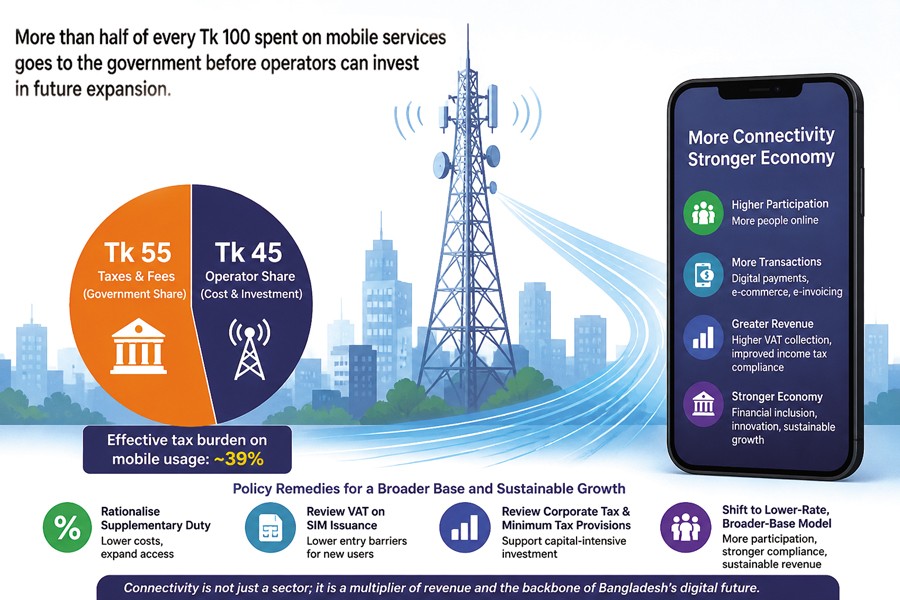
The imbalance becomes evident in the numbers. Around 55 per cent of telecom-sector revenue is absorbed through taxes and fees, more than double the global average of around 22 per cent. Consumers face an effective tax burden of nearly 39 per cent on mobile usage, driven by VAT, supplementary duty, and surcharge.
In addition, new users face upfront costs such as the Tk 300 SIM tax, along with applicable VAT, which further raises the barrier to entry. In practical terms, more than half of every Tk 100 spent on mobile services goes to the government before operators can recover costs or invest in future expansion.
At the same time, Bangladesh faces a structural challenge in revenue mobilisation. The tax-to-GDP ratio remains between 7.0 and 8.0 per cent, significantly lower than many regional and emerging economies such as Vietnam, Indonesia, and Thailand, where ratios are closer to 14 to 16 per cent. This reflects a narrow tax base rather than low tax rates.
Ongoing reforms under existing tax laws, including reforms under the Income Tax Act 2023 and VAT framework modernisation, aim to modernise VAT administration and strengthen income-tax compliance, indicating a clear policy direction toward improving revenue collection.
Despite more than 10 million registered taxpayers, only around 4.0 million actively file returns. In the VAT system, the number of registered entities remains significantly below the actual number of businesses operating in the economy. This gap underscores the need to expand the tax base, not increase pressure on already- compliant sectors.
Connectivity is key to the solution. It brings more economic activity into the formal system. As individuals adopt digital financial services, transactions become traceable. As businesses operate through digital platforms, their activities become visible and accountable. Tools such as mobile payments, e-invoicing, and online marketplaces improve transparency, reduce leakages, and strengthen compliance. Greater connectivity, therefore, enhances the government's ability to mobilise revenue by expanding participation rather than increasing tax rates. In this sense, telecom is not only a contributor to revenue but a multiplier of revenue across the economy.
A more connected economy generates more transactions, higher consumption, and greater economic visibility. This leads to increased VAT collection, improved income tax compliance, and broader participation in the formal economy. By enabling digital ecosystems, telecom creates the foundation for sustainable revenue growth.
However, this potential cannot be realised if the sector remains overburdened. The current approach reflects a high-rate, narrow-base model. What Bangladesh needs is the opposite: a lower-rate, broader-base framework. Rationalising supplementary duty under the VAT and Supplementary Duty framework can improve affordability and expand access. Reviewing the fixed VAT on SIM issuance under the Third Schedule of the VAT and SD Act 2012 can lower entry barriers for new users.
Reviewing sector-specific corporate tax and minimum tax provisions to support capital-intensive investment can support a more balanced investment environment. Together, these measures can enable a shift toward a broader-based taxation model that expands participation, strengthens compliance, and supports more sustainable revenue growth for the government.
As affordability improves, more individuals, particularly from low-income and underserved segments, will come online. This will increase digital transactions, expand economic participation, and ultimately generate higher indirect and direct tax revenues, leading to more stable and sustainable government revenue growth over time.
This is not about reducing government revenue. It is about unlocking it in the medium to long term. The upcoming budget presents a clear opportunity to align policy with national ambition. By adopting a more rational taxation approach, Bangladesh can accelerate digital adoption, strengthen financial inclusion, and expand its tax base.
The choice is straightforward: continue with a model that extracts short-term revenue from a limited base or enable a sector that can expand the base itself. Connectivity has already transformed how people live, work, and transact. With the right policy direction, it can also transform how Bangladesh generates revenue and sustains its economic growth.
The writer is the CFO of Banglalink