

How digital power is strengthening industrial resilience in Bangladesh
Published :
Updated :
 For all latest news, follow The Financial Express Google News channel.
Bangladesh's industrial sector is entering a critical phase in its energy transition. The central question is no longer whether renewable energy will be adopted, but how reliably it can support industrial operations in the long run. Rising fuel costs, grid instability, and sustainability expectations have made dependable power a strategic necessity. In this context, digital power solutions are emerging as a practical response to the evolving situation.
Industrial zones such as Gazipur, Narayanganj, and Chattogram depend on uninterrupted electricity to keep production running. For many years, diesel generators have been the primary backup during power disruptions. While effective in emergencies, diesel-based systems increase operating costs and environmental impact. They also expose factories to fuel price volatility and maintenance challenges. As a result, many industrial operators are now rethinking their long-term energy strategies.
Solar power has gained strong momentum within this shift. Rooftop solar systems are expanding across industrial facilities, supported by policy reforms that allow private investment in renewable power plants and direct electricity sales to consumers. Bangladesh has also set a target to generate 30 percent of its electricity from renewable sources by 2040. However, experience shows that solar panels alone do not ensure reliability. Power generation varies with weather conditions and daylight availability. Without storage and intelligent control, solar systems cannot deliver consistent performance.
Digital power technologies address these limitations by integrating generation, storage, and consumption into a single system. Such systems enable continuous monitoring of energy flows and equipment performance. Operators can detect faults early and reduce energy losses. Real-time data allows factories to respond quickly to grid disturbances and internal demand changes. This approach turns energy infrastructure into a controllable operational asset.
Several global and local technology providers are now active in Bangladesh's digital power ecosystem, including Huawei, Sungrow, Hithium Energy Storage Technology, Solar EPC Development Limited, Wärtsilä, and HNBC Industries Limited.
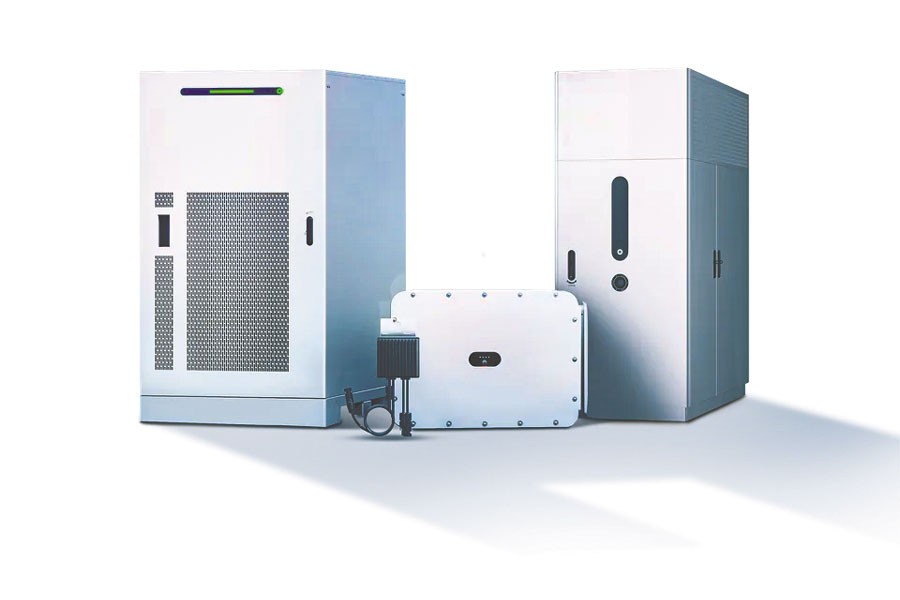
In Bangladesh, a wide range of solar inverters is currently in use, with the SUN2000 series from Huawei being widely adopted in commercial and industrial applications. The series includes models such as SUN2000-115KTL-M2, SUN2000-50KTL-M3, SUN2000-100KTL-M2, SUN2000-30/36/40KTL-M3, and SUN2000-330KTL-H1.
Among these, the SUN2000-115KTL-M2 is designed for large commercial and industrial solar installations. It delivers up to 98.8 percent energy conversion efficiency and supports ten maximum power point trackers with twenty DC inputs, allowing smart power management across multiple panel strings. The inverter integrates advanced protection features, including surge protection, leakage detection, and string-level disconnection, all supported by real-time monitoring. Surge protection shields the system from excessive voltage, while leakage detection identifies unintended current flow and can trigger alerts or automatic shutdowns. String-level disconnection isolates a faulty panel string without affecting the rest of the system.
The inverter is housed in an IP66-rated enclosure that provides strong resistance to dust and water. Its durable design and smart cooling system allow stable operation in temperatures ranging from - 25 degrees Celsius to 60 degrees Celsius. Other inverters in the SUN2000 series offer similar performance and safety features, making them suitable for demanding industrial environments.
Energy storage systems further strengthen reliability by addressing the intermittency of solar power. Huawei's LUNA2000-200KWH-2H1 and LUNA2000-215-2S10 energy storage systems are designed to meet large commercial and industrial power storage needs. Both systems support on-grid and off-grid operation and can activate instant backup during power disruptions, ensuring uninterrupted electricity supply.
The LUNA2000-200KWH-2H1 provides 193.5 kilowatt-hours of usable energy with an output capacity of 100 kilowatts. The LUNA2000-215-2S10 delivers up to 215 kilowatt-hours of energy and achieves an efficiency of 91.3 percent. Both systems feature hybrid cooling technology, advanced smart protection mechanisms, and modular designs that support easy expansion and long-term performance stability. Their IP55-rated enclosures protect against dust and water, enabling reliable operation across Bangladesh's varied climatic conditions.
Digital management platforms bring these components together into a unified operational framework. Huawei's FusionSolar platform integrates solar panels, inverters, and energy storage systems into a single energy management interface. Through mobile and web-based dashboards, users can monitor power generation and consumption in real time, detect faults, and control system operations remotely. The platform issues instant alerts when issues such as panel faults, dust accumulation, or reduced output are detected, allowing timely corrective action and improved system efficiency.
In Bangladesh, the digital power ecosystem continues to grow. Government policy support, financing from institutions such as IDCOL, and the growing capability of EPC companies are making implementation more accessible.
For the country's industrial sector, renewable energy is no longer a future aspiration. It is a present requirement. Digital power systems offer a practical pathway to combine clean energy with operational resilience. This combination will play a decisive role in supporting sustainable industrial growth in the years ahead.