

The possibilities of war games: Evaluating past or predicting future?
Published :
Updated :
 For all latest news, follow The Financial Express Google News channel.
Nowadays, hearing words like war games and artificial intelligence, people of our age instantly start attaching them to pop culture phenomena like that famous dialogue of Kyle Reese in Terminator, "Trusted to run it all. They say it got smarter, a new order of intelligence."
Or how about the 1983 classic 'WarGames' where a boy accidentally connects to a supercomputer with control over US nuclear arsenal and innocently starts World War Three between America and Russia? Sorry to disappoint you, folks. The real war games practically have not yet reached that level. But is there a possibility?
The rise of war games
Before delving into possibilities, it's better to make our definitions clear. In his book ‘The
Way of the Warrior’, military analyst James H. Dunnigan defined war games as the kind of games that measures the affectability of war strategies through a realistic simulation of an armed conflict where two or more players command opposing armed forces.
Considering the manual setup, war games date back to ancient Rome, early Iran, and also China. But, the use of boards for designing the battlefield simulation started with the then-Prussian state in their battle against France.
The use of computers for designing war games started during the Cold War when the US and NATO turned into war games to predict the impact of nuclear war, which seemed a possibility then. The presence of digital technologies accelerated after the fall of the Berlin Wall with games designed to test new ideas about the warfare of the information age.
Recreational war games
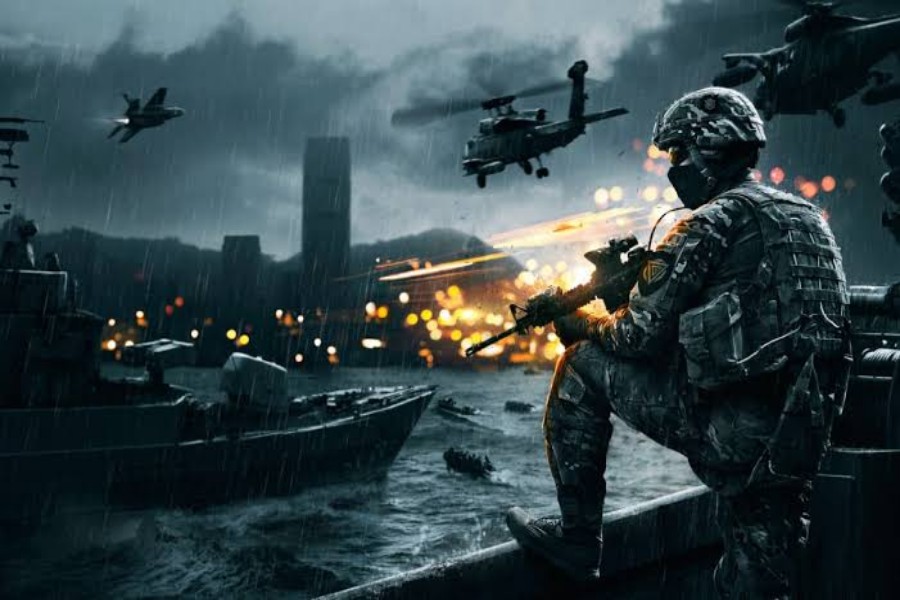
Readers might get lost in all those definitions and backgrounds for this expectation of why popular war games like Flames of War (2002), Ghost Recon (2001), Homefront (2011), and Battlefield 3 (2016) are yet absent in this discussion.
Well, we can be baffled by the predictability of some of the games mentioned here. For example, Ghost Recon, as a war game, got released in 2001 with this plot that Russia is trying to reclaim its lands which it lost at the end of the cold war.
Interestingly, the story is set in 2008, when the conflict between Russia and Georgia broke out. Or, what about 'Flames of War,' a famous war game based on the Second World War, the fourth edition of which could even predict what would happen if the Axis forces won instead of the Allied in the Second World War?
Unfortunately, there is a distinction between professional games and recreational ones. The war games which have been mentioned above fall into the second category.
Recreational war games refer to games with a stimulated reality but only to make the games realistic and more engaging to the audience. Education about different historical events is also included as one of the motifs behind recreational war games.
Point to be noted that many of these war games also predicted and evaluated different historical issues. But, if observed closely, was it unpredictable to the academia in the West that Russia, after the cold war, would want to reclaim their lost states to return to the Soviet era? Or, with the proliferation of nuclear weapons by both Russia and the USA after the 2000s, was it too tough for popular imagination to speculate about future Russia-USA conflict?
The answer is 'NO'. That is why it is easy to feed enough information to the software of different war games; thus, they depict various imaginary pictures of the past and future. These games can be recreational for common people. It may be an interesting topic to research for people in academia. But are these games capable of predicting the outcome of the real-time battlefield?
Professional war games
The only way to address the question is to describe what a professional war game is about. Professional war games work as tools for training soldiers or for research to predict the possible outcome of a particular war.
Improving the precision of military weapons depends on professional war games. For the execution of these to have desired outcomes, there are always many shortcomings in professional war games.
The loopholes above all concern the top secrecy in the case of professional games. In most cases, the designers of these games struggle to collect information about their opponents' secret weapons or military bases because, in most countries, information like this is classified.
Designing a war game with a large player base similar to a real war is also hard. So, to have the desired result, there can be models of warfare portraying conflict on land, air, sea, and space. Each of these dimensions has a different set of categorical requirements, which has to be present in the design of the game's rules.
The best way to generate data on a larger scale is to experiment on a small scale and then aggregate those results to predict the consequence on a larger scale.
The reality is, in most cases, this approach to predicting real-time war failed because there are categories in the collective or large-scale war missing in the small-scale experiment like combined arms, command and control, the role of information, morale of a collective armed force, and so many other things.
This is exactly why, in the war in Afghanistan by US military forces, professional war games helped to improve the precision of weapons, aircraft, shipments, and armed vehicles. But the failure was to change the fundamental structure of the war strategy.
Machine learning in war games
The only light of hope for war games at the age of the fourth industrial revolution is the introduction of artificial intelligence in war games.
The mystery lies in what a computer can do that humans don't. The reply was given by a team researching war games at Naval Information Warfare Center Pacific.
A computer can find the winning moves in any game with more combinations than there are particles in the observable universe. That statement may sound overwhelming. But it is also true that with the use of artificial intelligence in war games, data collection and conclusion get shortened, and thus research can have a large scale.
For example, according to US Admiral Chester Nimitz, the war games for predicting the possible outcomes of the Ukraine war have been done so many times in the US Naval War College. Thus nothing happened during the war that was not predicted before.
Still, the question remains, can computers produce fundamentally new war techniques? The answer is yes if the concept of machine learning is brought into the discussion. It is possible when computers are given certain information with the analysis of which they can produce something absolutely new.
A London-based AI company already had successfully used AI in games like chess, resulting in the superhuman ability for games. The usage of machine learning is also present in medicine, engineering, and many other fields.
So, it is predictable that with the emergence of machine learning in war games, machines can get smarter to evaluate the past, which has already been a reality, and predict the future more accurately.
ahnafshafee1234@gmail.com