


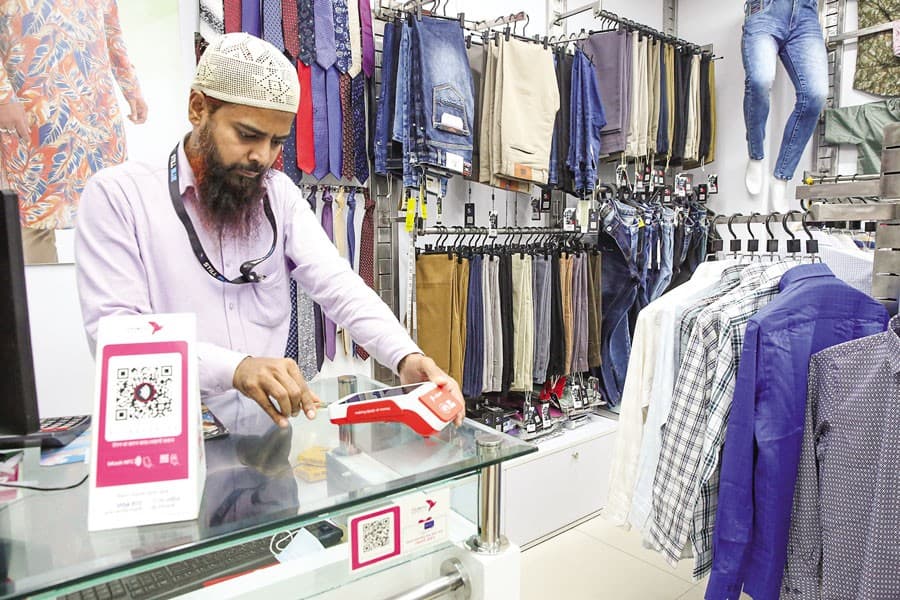
During the Eid season, commercial activity expands markedly as many people buy new clothes and other essentials in preparation for the festivity. As the holy Eid ul-Fitr is observed, preparations across Bangladesh reflect both religious devotion and a powerful economic momentum that reshapes the nation's financial landscape for the month.
Throughout this period, the people of Bangladesh remain busy with their Eid shopping. The acquisition of new clothes and other necessary items is intended to ensure an elegant and appropriate appearance during the festival. Consequently, the Eid market emerges as a crucial area of economic activity, holding importance not only for customers but also for the businessmen and entrepreneurs whose seasonal revenue is mostly tied to this festive period. Transactions during Eid are reported to increase by over 300 per cent compared to other months, underscoring its economic significance.
To manage the substantial expenditures typically associated with Eid, people now rely on a diverse portfolio of financial mechanisms. In addition to conventional banking services, a suite of modern tools has become central to the festive shopping experience. Equated Monthly Instalment (EMI) schemes, card-based payments, mobile financial services (MFS), and integrated digital banking platforms are now extensively used methods for transactions during the Eid season. Over the years, the volume of such transactions has expanded considerably, accompanied by diverse marketing tactics from financial institutions aimed at customer satisfaction and a broader shift toward technologically driven solutions.
THE RISE OF FLEXIBLE PAYMENTS: The EMI, or Equated Monthly Instalment, has become an established instrument in the contemporary financial system. By enabling users to make payments over a specified time period, rather than all at once, it considerably mitigates the pressure of immediate payment. The framework to pay in instalments provides relief from a short-term liquidity crisis, which also gives flexibility to Eid shopping. This is not limited to electronics or heavy equipment; for festive shopping, EMI gives people a dynamic scope to conduct their purchases without immediate liquidity pressure.
Bangladesh is now contending with sustained inflationary pressure that has constrained the purchasing power of many households. Rising commodity prices have rendered discretionary spending more challenging, which particularly tightens budgets for goods necessary during festivals. In this situation, the scope of EMI and the emerging trend of 'Buy Now, Pay Later' (BNPL) services lessen the financial pressure. A number of people are adopting these facilities while purchasing products, enhancing affordability. Through these options, an account holder can enjoy instalment facilities for 3 to 6 months, or even for a one-year period and more. This lessens the burden on customers and gives them comfort to manage their income distribution smoothly.
THE ENDURING APPEAL OF CARD PAYMENTS: Not only the EMI system, but also payments through debit and credit cards increase significantly during the Eid season. Carrying a large amount of money in crowded markets is often inconvenient and insecure, which encourages customers to prefer cashless transactions. In this regard, card payments provide enhanced convenience, security, and efficiency, contributing to a systematic move towards this payment system.
Md Imran Ahmed, who works at a renowned English daily in Bangladesh, shared his experience. "I look for lucrative offers, and credit card providers offer them. For example, if I have to go on a short trip, I can reduce hotel charges with credit cards, which is a big deal for me."
"Also, during the Eid season, we have some unexpected expenses that we can take as a loan using a credit card and repay within a year," he added.
This sentiment is reflected in the data. According to Bangladesh Bank (BB), the financial ecosystem has seen a monumental shift. Between May 2020 and April 2025, the total number of issued cards (debit, credit, and prepaid) grew by 140 per cent, while the transaction value through these cards surged by an impressive 228 per cent. The number of debit card users alone grew by 113 per cent, from 19.4 million to 41.51 million. The number of credit cards saw a 65 per cent increase in the same period.
CROSS-BORDER TRANSACTIONS AND REMITTANCES: During the Eid season, cross border transactions also rise. Financially affluent people sometimes go abroad for their Eid shopping, with Europe, America, and the UAE being top destinations. In April 2025, this type of transaction increased by 29.49 per cent compared to the previous year. Data shows that for cross-border transactions by Bangladeshis, credit card usage is highest in the USA, while China leads for debit card use and the UK for prepaid cards.
This trend is complemented by a massive inflow of remittances from the Bangladeshi diaspora. These funds, sent home to support family celebrations, inject significant liquidity into the economy and fuel domestic spending. Remittance inflows regularly break records around Eid; in March 2025, a new monthly high of US$3.29 billion was set, driven by the festival.
THE MFS REVOLUTION: During the Eid season, mobile banking gets extra priority for many people, as it is comparatively easier for payments and other transactions. With this mechanism, people do not need to carry an account book or any card, but just their mobile phone, while making payments for their Eid shopping or sending money to family. In fact, nowadays, many people use mobile banking to give 'Eid Salami' to their juniors.
bKash, Nagad, and Rocket are the most used mobile banking tools in Bangladesh. With a dominant market share, bKash is available in almost every corner of the country. The platform's extensive agent network allows users to withdraw money even from a local market. This wide acceptance makes it a preferred medium for transactions, from paying for shopping to settling a restaurant bill.
Crucially, the ecosystem is moving toward greater integration. Currently, bKash has established agreements with around 49 commercial banks, enabling customers to transfer funds directly from their bank account to their bKash wallet. This interoperability significantly facilitates mobile banking, allowing users to complete payments through linked bank accounts even when their wallet balance is insufficient.
During the Eid season, customers who have a temporary liquidity crisis may rely on these integrated digital payment systems to manage their expenditure efficiently. Also, people who do not have monetary constraints can make their transactions easier by using different cards or mobile banking platforms. In recent years, the number of users of these platforms has been gradually increasing, a trend that is expected to see a further jump in the upcoming years as Bangladesh progresses toward a truly digital economy.
tanjimhasan001@gmail.com