


ACI has continued expanding into new territories despite its already launched subsidiaries and associate companies weighing heavily on its business and pushing it into the red.


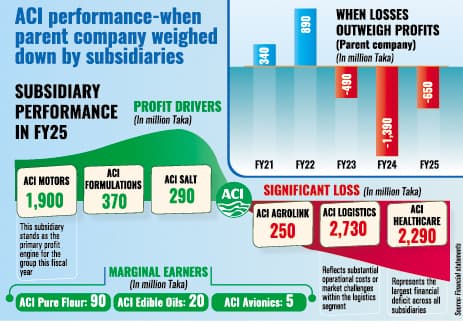
In FY25, ACI's standalone profit stood at about Tk 3.99 billion, up 19 per cent from the previous year. However, the company's consolidated income turned negative, posting a loss of Tk 650 million during the year. Losses were even higher in the previous year, amounting to Tk 1.39 billion, indicating that the profits of the parent company were eroded by losses incurred by its subsidiaries.
Despite suffering consolidated losses for three consecutive years, ACI's board of directors approved the incorporation of two more subsidiaries-ACI Semiconductor and ACI Properties.
Over the past 30 years, the conglomerate has formed 18 subsidiaries, four joint venture companies, and one associate entity. Most of these businesses have been bleeding for years.
Asked why ACI decided to enter two new sectors in such a situation, company secretary Mohammad Mostafizur Rahman said the group is advancing towards future Bangladesh and the global market.
"We have decided to establish two subsidiaries, pondering future prospects," he added.
Among the loss-making units, ACI Logistics, which operates the retail chain Shwapno, incurred a loss of Tk 2.73 billion in FY25 and had also endured heavy losses over the previous three years.
Nine other subsidiaries also posted negative earnings in FY25, ranging from Tk 4 million to Tk 2.9 billion.
As a result, ACI's consolidated income remained negative in FY25 as well as in the previous three years.
Preferring anonymity, a top ACI executive involved in the decision to set up new subsidiaries explained the rationale behind further expansion, saying the group's business is closely linked to the country's core economy.
"A company has prospects as long as it experiences growth in operating profits. It also promises future growth," he said.
The official noted that most of ACI's subsidiaries had recorded growth in operating profits, while bottom-line losses stemmed from factors such as high tax obligations.
"The companies that are now securing operating returns will earn profits, establishing a strong footing in the sectors in the days to come," he added.
Industry insiders said Shwapno alone has been eating away ACI's profits.
Responding to this, the ACI official said the retail brand also posted operating profits and holds strong future prospects in a densely populated country.
Regarding the newly formed subsidiaries, he said they would be light-asset and light-capital-based ventures.
The capital for the new companies will come from ACI's retained earnings. Each will have a paid-up capital of Tk 100 million, with the parent company holding an 85 per cent stake.
ACI Properties, according to the official, has good future potential. Initially, it will facilitate rentals of hotels, houses, and spaces for party gatherings.
Many foreigners and non-resident Bangladeshis face difficulties in booking hotels and renting houses in the capital and other divisional cities, he said.
"ACI Properties will provide solutions to them and may later enter the real estate sector, subject to viability," he added.
ACI Semiconductor will be a technology-based company focused on training young people in chip design.
"It will be a journey of at least 10 years. The future globe will be AI-based and ACI needs to keep pace with the changing reality," the official said, adding that the group's emphasis on existing subsidiaries would not diminish.
Asked whether shareholder returns are being compromised due to expansion, company secretary Rahman said returns are not measured by cash alone.
"ACI's asset base and shareholders' equity have increased significantly over the years," he said.
Commenting on the company's overall performance, Md Ashequr Rahman, managing director of Midway Securities, said ACI was once a well-valued stock, but losses incurred by ACI Logistics and ACI Healthcare largely distorted its valuation in the secondary market.
"If I were a shareholder of the company, I would ask it to define the factors behind the losses of these subsidiaries before the launch of new entities," he said.
"I would say the company should set a timeframe to turn the subsidiaries into profitable entities, alongside opening new companies," Ashequr Rahman added.
mufazzal.fe@gmail.com