

BRAC Bank aims to boost financial inclusion with technology and trust
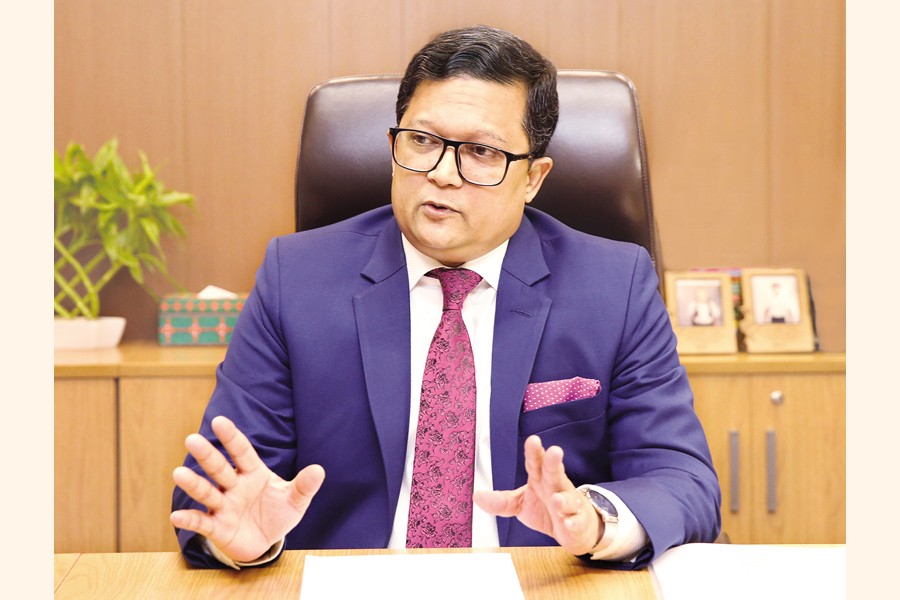
MD and CEO Tareq Refat Ullah Khan tells FE
Published :
Updated :
 For all latest news, follow The Financial Express Google News channel.
BRAC Bank aims to expand its financial inclusion footprint in the country's banking landscape by combining cutting-edge technology with institutional trust.
With a clear focus on broadening access to financial services, the leading commercial bank plans to target key areas such as school banking and agent banking, and reaching out to the unbanked rural population, particularly women.
In an exclusive interview with The Financial Express, Tareq Refat Ullah Khan, Managing Director and Chief Executive Officer of BRAC Bank, emphasised the bank's commitment to ensuring that access to finance is determined by potential rather than privilege.
"We aim to ensure that access to finance is not determined by privilege, but by potential," he said, outlining the bank's broader vision for financial inclusion in Bangladesh.
He said the bank's key priority is redefining the traditional barriers to credit. The bank plans to use consent-based data analytics to convert customers' digital transaction behaviours into a credible reputation score. This will facilitate the provision of instant, collateral-free micro-loans through the bank's Astha app, specifically targeting those who have been historically excluded from formal credit systems.
Reflecting on the bank's founding, Mr Khan shared insights into the bank's core mission.
He said the bank's founder Sir Fazle Hasan Abed recognised that while small entrepreneurs were emerging with ambition and resilience, the formal banking sector was largely absent at the critical next stage of their journey -- the SME segment. BRAC Bank was established to serve the "missing middle".
Since its inception, financial inclusion has been integral to BRAC Bank's purpose. As a Bangladeshi bank, they firmly believe that their long-term success is inseparable from the economic advancement of the people, the seasoned banker said.
"When we bring the unbanked into the formal financial ecosystem, we do far more than open accounts - we unlock access to capital, opportunity, and sustainable growth," he said.
"This conviction underpins our strategy, making financial inclusion not merely a business priority, but a defining pillar of BRAC Bank's identity."
When his attention was drawn to school banking, Mr. Khan said student banking is fundamental to building a sustainable and inclusive financial ecosystem. At BRAC Bank, it is not treated as a transactional offering, but as a long-term strategic investment.
Through their 'Agami Student Banking' proposition, he said, they provide an end-to-end financial solution that supports students from school to university and even into overseas education.
He explained that Agami empowers young people to develop responsible financial behaviours through a comprehensive suite of services, including savings accounts, education loans, credit cards, and student file facilities -- all designed to evolve with their needs.
Equally important is early exposure to digital banking and the creation of a transaction history. This significantly enhances students' ability to access credit, launch enterprises, or pursue professional ambitions after graduation, he added.
"Our focus goes beyond account opening -- we are laying the financial groundwork for the future leaders of Bangladesh."
BRAC Bank now holds the leading market share in student file services, supported by an exceptional 86 per cent year-on-year growth. By facilitating their education -- both at home and abroad -- the bank is investing directly in the long-term human capital and economic resilience of Bangladesh, said Mr Khan.
Regarding the unbanked women, the bank's top executive said that through the bank's dedicated women's banking segment, called TARA, they have brought over 350,000 women into the formal financial system by redesigning access around their realities.
By leveraging e-KYC, he said, the bank has removed physical and procedural barriers. In 2025 alone, 95 per cent of their 61,000 new female customers were onboarded digitally, without ever visiting a branch.
"Our approach is anchored in what we call 'lending with a purpose.' To date, we have disbursed Tk 16 billion to women-led enterprises, enabling them to formalise, expand and sustain their businesses," he informed.
Regarding the role of digital transformation in accelerating financial inclusion, he said that digital banking has emerged as the most powerful accelerator of financial inclusion. As banks evolve into fintech-enabled institutions, high smartphone penetration has removed the complexity of banking and placed access, awareness and financial literacy directly in the hands of customers through digital platforms.
At BRAC Bank, this vision is delivered through the Astha App, which the bank designed as a unified digital ecosystem -- bringing accounts, wallets and transactions onto a single, seamless platform.
"Today, customers can open accounts, move funds and manage their finances entirely digitally. With over 1.2 million users and monthly transactions exceeding Tk 200 billion, Astha now handles a substantial share of our total transaction volume," said Mr Khan.
For decades, the collateral barrier has excluded marginalised entrepreneurs from formal finance, forcing them into costly informal lending. BRAC Bank is here to break that cycle by extending responsible credit where others hesitate, enabling sustainable livelihoods and long-term banking relationships, he explained.
The bank's inclusion agenda is anchored in SME financing. With over 800,000 SME customers, an outstanding portfolio of Tk 360 billion and 446 SME unit offices nationwide, the bank leads the industry at the grassroots level.
Regarding the bank's primary goals for financial inclusion over the next five years, Mr Khan said the goal is to broaden BRAC Bank's financial inclusion footprint by combining advanced technology with institutional trust.
He explained that their next strategic horizon is embedded finance, integrating financial wellbeing directly into everyday economic activity -- whether through micro-insurance for farmers or micro-investments for small traders -- delivered seamlessly within the bank's digital platforms and tailored to individual needs.
"This approach will allow us to build a more inclusive, resilient and future-ready financial ecosystem for Bangladesh," he added.
jubairfe1980@gmail.com