

Emerging market status could boost foreign capital inflows: How to achieve it
Published :
Updated :
 For all latest news, follow The Financial Express Google News channel.
If Bangladesh can attain the status of an emerging market, elevated from its current position as a frontier market, it will increase the inflow of foreign investment, but achieving this success involves a reshaping of the overall economy.Bangladesh market analysis
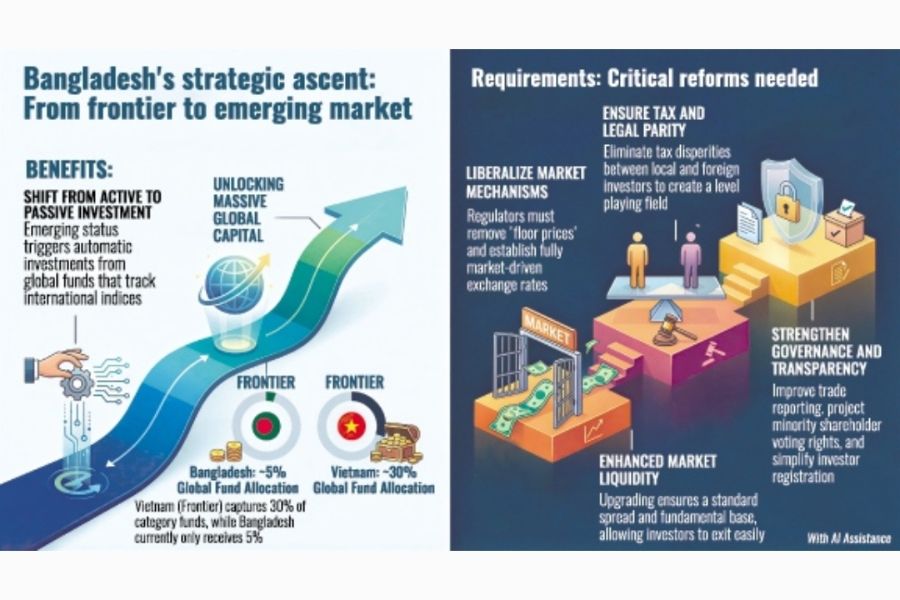
Foreign index providers, such as MSCI Inc., FTSE Russell, and S&P Dow Jones Indices, set the requirements for market upgrades. These include removing stock price caps, establishing market-driven exchange rates, eliminating tax disparities between local and foreign investors, and ensuring easy account access for foreigners.
On the website of FTSE Russell, the preconditions for Bangladesh to be upgraded are currently marked as 'not met,' while others are labeled 'restricted,' 'speculative,' or 'lower middle.'
According to officials of the Dhaka Stock Exchange (DSE), some prerequisites are not entirely clear to the bourse and the market regulator. The prime bourse is set to meet representatives of FTSE Russell this week to gain a clearer idea about the market upgrade criteria.
L
Experts and market operators say upgrading the stock market will not be possible unless the government treats the task as a national priority for the sake of both the market and the broader economy.
The bourses cannot achieve the target alone; they need to collaborate with the Bangladesh Bank and the National Board of Revenue.
"From DSE, we are going to engage with appropriate authorities to move this agenda ahead," said Nuzhat Anwar, managing director of the DSE.
Foreign portfolio investors are often less attracted to frontier markets due to factors including barriers to fund repatriation.
Global index providers classify markets based on accessibility, liquidity, and regulatory standards, said Ms Anwar.
Accessibility refers to foreigners' access to a market by opening BO (beneficiary owner's) accounts. The opening of BO accounts sometimes becomes cumbersome due to strict compliance requirements.
Foreign investors also prefer a highly liquid market so that they can sell shares at any time. They seek a standard spread between buyers and sellers. If the spread widens, it often becomes difficult to sell shares and exit the market due to a much smaller number of buyers than sellers.
A highly liquid market has a strong fundamental base.
Regulatory standards include stable policies, proper market monitoring, and corporate governance.
"Moving Bangladesh from a frontier market to an emerging market is a strategic objective that can significantly increase foreign portfolio investment, improve liquidity, and strengthen the country's financial reputation," said the DSE chief.Bangladesh market analysis
Clarity and ambiguity over upgrade conditions
FTSE Russell has flagged several 'not met' requirements, including a developed foreign exchange market, permission for short selling and stock lending, free delivery of settlement, and transparent trade reporting.
Additionally, the dissemination of market information and investor tax policies need improvement.
The premier bourse has stopped publishing data on foreign portfolio investments. Despite consistent requests from newsmen, the DSE has continued withholding the information since the departure of former managing director Dr Swapan Kumar Bala following a period of foreign capital withdrawal.
However, a DSE executive, wishing not to be named, said they plan to resume sharing foreign investment data, noting that hiding information ultimately provided no value to the market.
As foreign investors are also minority shareholders, under the criterion 'fair and non-prejudicial treatment of minority shareholders', the FTSE wants to know whether the rights of foreign investors are protected here, said Ahsanur Rahman, chief executive officer of BRAC EPL Stock Brokerage.
Their rights refer to voting rights at a company's AGM (annual general meeting) and in the company's ownership structure, he added.
Other factors, such as simplified registration for foreign investors, are currently categorized as 'restricted.' The few criteria that have passed the benchmark include having a central securities depository, a central counterparty clearing house, and high-quality custodian services.
The DSE authority believes some criteria have already been met despite the global market-mapping entities flagging them as 'unmet.'
"We need an explanation from the market mapping entity to be clear about those criteria," said a DSE official.
For instance, FTSE Russell considers the exchange rate criterion unmet, although the central bank announced a shift toward market-driven exchange rates in FY25.
To prevent price crashes during the pandemic, regulators introduced 'floor prices' in 2020. This price-controlling mechanism still applies to the stocks of two companies - Islami Bank Bangladesh PLC and Beximco Ltd.Bangladesh market analysis
This price restriction must go for the market's status elevation. Moreover, local and foreign portfolio investors should receive comparable tax benefits on a level playing field.
Under current laws, foreign individuals and institutional investors pay a 15 per cent tax on capital gains and 30 per cent on cash dividends.
Local investors, however, only pay capital gains tax on profits exceeding Tk 2.5 million, using standard individual tax brackets.
Foreign investors do not receive tax rebates on dividends and pay flat rates of 30 per cent for individuals and 15 per cent for institutions. Meanwhile, local investors enjoy a tax exemption on dividend income up to Tk 50,000.
Following the meeting with FTSE Russell, the DSE will consult the central bank and other regulatory bodies to decide the next course of action.
Benefits of becoming emerging market
According to BRAC EPL Stock Brokerage, which manages a significant amount of foreign funds, Bangladesh receives roughly 5 per cent of global funds allocated for frontier markets.
Ahsanur Rahman, CEO of BRAC EPL, said current investments are 'active', meaning they depend heavily on specific investor choices.
"If the market is upgraded to emerging status, it will receive passive investments that are made automatically by funds tracking the index," he said.
Vietnam - also currently a frontier market - captures up to 30 per cent of the funds meant for the same category.
It has already fulfilled the requirements for an upgrade to emerging status. The declaration of Vietnam's upgrade is likely next September, after which the country's market is expected to see higher foreign fund flows.
Foreign fund managers hold massive pools of capital for emerging markets. If Bangladesh secures this status, it will gain access to substantial investments.Bangladesh market analysis
"The authorities should realize the economic benefits of upgrading our equity market," a DSE official stated, requesting anonymity.
mufazzal.fe@gmail.com