


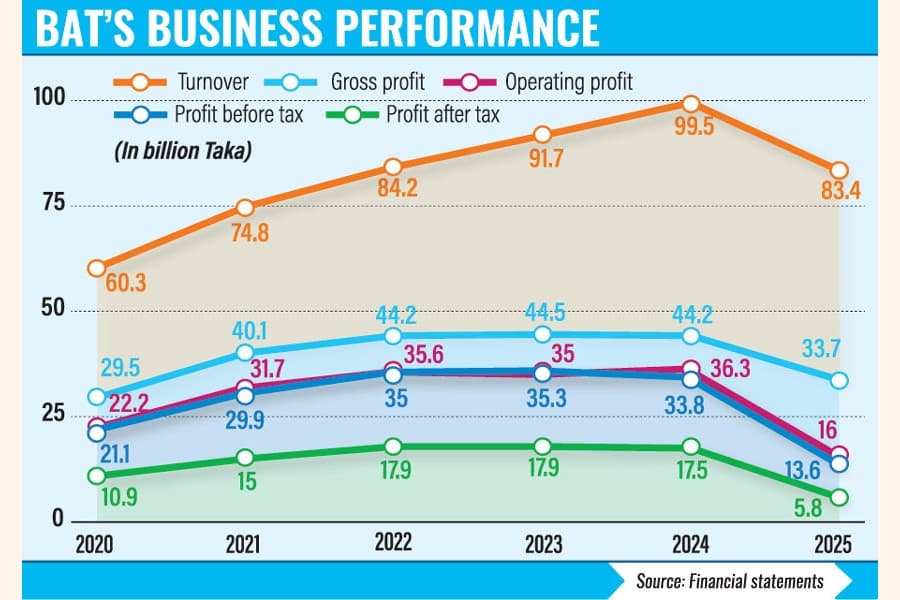
British American Tobacco Bangladesh Company (BATBC) posted a steep 67 per cent year-on-year decline in profit after tax in 2025, hit by a mid-year excise duty hike and a forced factory relocation that drove up one-off costs.


The company's income plunged to Tk 584 crore in 2025, resulting in earnings per share of Tk 10.81 for 2025, the lowest in at least six years, down from Tk 32.42 the year before.
The downturn was primarily triggered by an interim budget announced in January 2025, outside the conventional June cycle, which imposed a substantial excise duty increase across all cigarette segments.
Supplementary duty (SD) on the low segment rose from 76 per cent to 83 per cent, while rates for other segments increased from 81.5 per cent to 83 per cent. Including VAT and the Health Development Surcharge (HDSC), the effective tax burden climbed to roughly 83-84.8 per cent of the maximum retail prices, leaving 16-17 per cent to cover operating costs before a 47.5 per cent corporate tax.
Consequently, net revenue --excluding VAT-- dropped 16 per cent, despite a nominal 7 per cent rise in gross turnover driven by price adjustments. The higher tax squeezed the company's retained earnings per unit of sale.
The duty hike also intensified down-trading, the company said, with consumers shifting to lower-priced brands or illicit alternatives.
Finance Director Nirala Singh noted in the annual report that rising competition in the lower tiers and the expansion of illicit trade further eroded legal sales volumes.
The excise shock was compounded by a major operational disruption. After more than six decades of operations, the company vacated its Dhaka factory following the non-renewal of its lease, completing the relocation in June 2025.
Operating expenses more than doubled to Tk 1,768 crore in 2025 compared with the previous year. According to the company's management, the spike was largely due to one-off restructuring and relocation costs.
Manufacturing has since been consolidated at the Savar facility. While the management described the transition - completed within 45 days - as operationally efficient, the financial impact was substantial due to relocation expenses, temporary inventory build-up, higher working capital needs, and ramp-up costs.
Cash flow tightens
Cash flow also came under pressure. Net cash from operating activities declined sharply to Tk 331 crore in 2025 from Tk 1,732 crore in 2024.
To navigate the transition, the company increased short-term borrowings, resulting in net cash from financing activities turning positive at Tk 320 crore, compared to negative Tk 1,315 crore in the previous year.
Year-end cash and cash equivalents stood at Tk 919 crore, broadly stable from Tk 897 crore a year earlier.
Dividend cut signals caution
The company's board has recommended a final cash dividend of 30 per cent (Tk 3 per share) for 2025, sharply lower than Tk 30 per share in 2024 and Tk 10 per share in 2023. No interim dividend was declared for 2025.
This represents the lowest payout in at least five years and indicates a shift toward preserving liquidity and balance sheet strength.
Management flags structural concerns
Managing Director Monisha Abraham described the tax burden as "structurally destabilising" and criticised the January policy move for being implemented without prior stakeholder consultation.
She also cautioned that repeated tax hikes have not proportionately boosted government revenue, noting that sector revenue grew by only about 5 per cent in the last fiscal year, well below historical double-digit trends, as illicit trade expands.
The company called for structured, evidence-based engagement with stakeholders ahead of future fiscal measures.
farhan.fardaus@gmail.com