


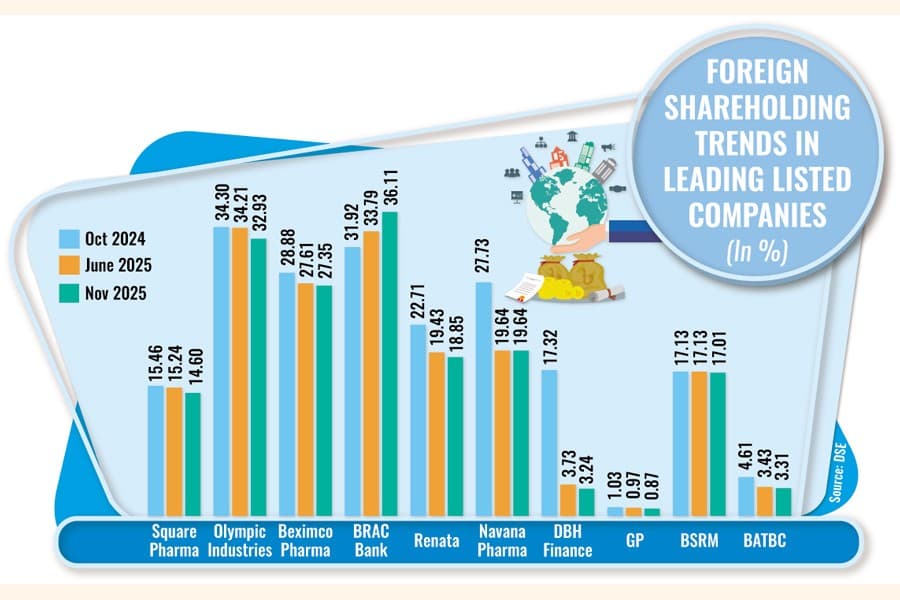
Foreign investors have continued to withdraw funds from Bangladesh's equity market over the past year through November this year amid persistent political and macroeconomic uncertainties.


Economic reform measures taken by the interim government after the political changeover had given rise to optimism about a market turnaround, which is why foreign stakes in well-performing companies jumped during the first two months through October last year.
But the hope gradually petered out as macroeconomic challenges deepened alongside intensifying political tension in the country, centering on the upcoming national election.
"Persistent political and macroeconomic challenges discouraged overseas investors from making fresh investments in stocks," said Salim Afzal Shawon, head of research at BRAC EPL Stockbrokerage.
Some overseas investors realized gains ahead of the year-end, while a lack of clear direction on the national election also intensified their sell-offs, said Mr Shawon, who deals with foreign portfolios.
Foreign investors want a stable, predictable and long-term policy environment, with particular emphasis on continuity under an elected government, so they know their capital is safe over the long term and will generate returns.
"The broader economic activities remained sluggish amid prevailing political uncertainties, and the profitability of major companies remained subdued amid high input costs," said Md Akramul Alam, head of research at Royal Capital.
Moreover, private sector credit growth fell to a historic low of 6.23 per cent in October this year, reflecting waning business confidence and tighter lending conditions, said Mr Alam.
Other factors, Mr Alam added, include a confidence crisis, elevated banking sector vulnerabilities, and record non-performing loans exposed in the banking sector after the political changeover.
Subsequently, the erosion of foreign stakes continued in November this year, with share purchases worth Tk 1.90 billion against sell-offs of Tk 3.32 billion.
This happened as the Bangladesh equity market emerged as one of the worst performers globally for two consecutive months - September and October this year.
A low number of investable securities and frequent policy changes already discourage foreigners from keeping funds in the Bangladesh equity market. Meanwhile, there has been no new listing for around two years in the country's stock market.
When it comes to investing in stocks in Bangladesh, foreigners are mostly interested in multinational companies.
But they are not interested in putting their money into these companies either, owing to lower-than-expected earnings in the nine months through September this year.
Most multinational companies saw their profits decline in the nine months through September this year compared to the same period last year, largely due to high finance costs amid political uncertainty.
Combined profits of listed multinational companies plunged 28 per cent year-on-year to Tk 45 billion, while revenue dropped 2.54 per cent to Tk 346 billion in January-September this year.
Due to massive sell-offs, shares of blue-chip and well-performing companies dropped significantly in recent weeks.
Foreign stakes in DBH Finance fell sharply from 17.32 per cent to 3.24 per cent between October last year and November this year.
Foreign shareholding in Olympic Industries also dropped from 34.30 per cent to 32.93 per cent in the year through November this year.
Grameenphone, the largest stock in terms of market capitalization, experienced a similar trend. Its foreign stake declined to 0.87 per cent in November this year from 1.03 per cent in October last year.
However, BRAC Bank saw foreign stakes rise from 31.92 per cent to 36.11 per cent in November this year, driven by record profits.
BRAC Bank's nine-month consolidated profit stood at Tk 15.36 billion for January-September this year, surpassing its previous year's record annual profit.
Along with the record profit, BRAC Bank provided capital-gain opportunities in the secondary market as its stock surged 37 per cent over the past year, which encouraged foreigners to inject funds into it, said Mr Shawon.
Akramul Alam of Royal Capital said the high value of the dollar against the local currency remained another major concern.
Although the foreign exchange market has stabilized in recent months due to higher dollar inflows, supported by strong remittance and export earnings, the taka-dollar exchange rate remains as high as before.
"When the local currency gets cheaper, foreign investors incur losses as the value of their assets falls even when share prices remain unchanged," Mr Alam said.
He also noted that many global fund managers have rebalanced their portfolios, while some have shifted to gold to secure investments instead of investing in equities.
"Foreign investors are closely watching Bangladesh and making queries. Portfolio investment is expected to pick up again if the political environment remains calm after the national election," said Mr Shawon.
babulfexpress@gmail.com