


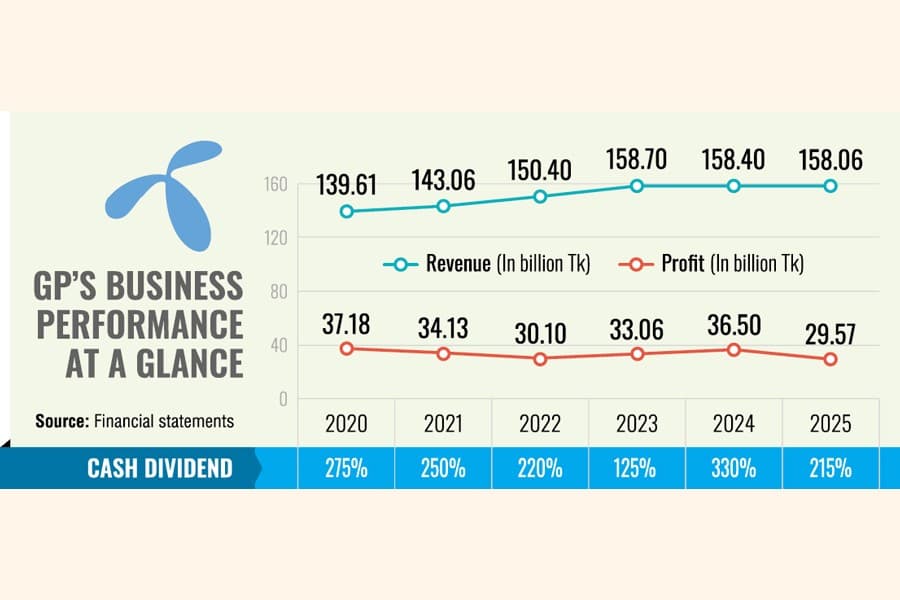
Grameenphone earned its lowest profit in eight years in 2025-Tk 29.6 billion-largely driven by cost pressure linked to recent investments in spectrum and the network, currency depreciation, and heavy taxes.


Its profit plunged 19 per cent year-on-year last year, reaching the record-low level.
Due to the significant erosion in earnings, the country's largest telecom operator declared a 105 per cent final cash dividend, resulting in a total dividend of 215 per cent for the year. With this, the company will end up distributing 98.16 per cent of its profits earned during the year.The company paid a 330 per cent cash dividend for the previous year.
"Over the past several quarters, we have faced strong macro headwinds and later saw some early signs of stabilisation in the fourth quarter of 2025," said Yasir Azman, chief executive officer of Grameenphone.
"We executed a range of strategic and commercial initiatives over the course of the year, which worked as we progressed through each quarter."
"While the environment remains tough, the fourth-quarter results show that we're moving in the right direction-growing revenue, protecting profitability, and generating strong cash flow-while continuing to build a more value-focused and resilient business for the long term," he said.
Despite challenging macroeconomic conditions, the country's largest telecom operator exhibited resilience in its topline performance.
Its revenue stood at Tk 158.06 billion for the year, registering a slight 0.21 per cent de-growth compared to the previous year, according to its audited financial statements.
"Consumer spending continues to be under pressure, purchasing power remains subdued, and hence we continue to operate with a strong focus on cost discipline," said Otto Magne Risbakk, chief financial officer of Grameenphone.
"We continued our strict cost and capital discipline, and in the fourth quarter overall costs increased only 1.5 per cent year-on-year against inflation of around 8 per cent," he said.
Although net profit was affected by higher depreciation and amortisation costs arising from capitalisation impacts, along with some cost increases from new spectrum and site deployments, GP's profit margin remains strong.
GP continued to invest to build a strong foundation for sustained growth. It carried out capital expenditure worth Tk 13 billion in 2025.
GP is set to make a further investment of Tk 22 billion for the allocation of 10 MHz spectrum in the 700 MHz band for the first time in Bangladesh.
The 10 MHz spectrum shall be effective from June this year and valid till 10 March 2039. The payment will be made in 10 equal yearly installments starting this year.
The low-band characteristics of the 700 MHz spectrum enable wider coverage per base station site for faster and more cost-effective network expansion.
"These costs do weigh on the bottom line in the short term, but they are also investments that strengthen the business and support future growth," said the CFO of the telecom operator.
Low-band spectrum plays an essential role in enhancing 4G performance, and this allocation will enable the company to prepare for future-ready technologies like 5G, AI, and IoT by supporting higher data speeds, lower latency, and a higher-quality user experience across diverse environments, he added.
"Our progress here is anchored around three core pillars: building a strong foundation, driving efficiency, and scaling real AI adoption," said the CEO of the company.
"As digital adoption accelerates, cybersecurity has become central to trust in connectivity. Grameenphone continues to differentiate itself by operating the safest network in the market, supported by advanced, multi-layer cybersecurity capabilities."
The market leader's total subscriber base stood at 83.9 million at the end of December 2025, declining by 0.4 million over the previous year. Of them, 58.1 per cent, or 48.7 million subscribers, use internet services.
Subscribers were de-registered mainly due to the Bangladesh Telecommunication Regulatory Commission's new regulation reducing the number of SIM cards allowed under a single NID card from 15 to 10.
Subscriber growth and average revenue per user (ARPU) were impacted by weaker macroeconomic growth and higher indirect taxes.
GP contributed Tk 121.56 billion to the national exchequer in 2025 in the form of taxes, VAT, duties, fees, and licence and spectrum assignments.
In a recent interview, the GP chief identified the tax burden as the biggest obstacle for the industry.
There is a 40 per cent corporate tax, 15 per cent VAT, 20 per cent supplementary duty, 1 per cent surcharge, 5.5 per cent revenue share, 1 per centsource of fund, and then licence and spectrum fees.
"Unless these issues are resolved, investors' appetite will remain extremely limited. This is not a concern unique to Grameenphone; it affects all operators," the CEO added.
babulfexpress@gmail.com