

Published :
Updated :
 For all latest news, follow The Financial Express Google News channel.
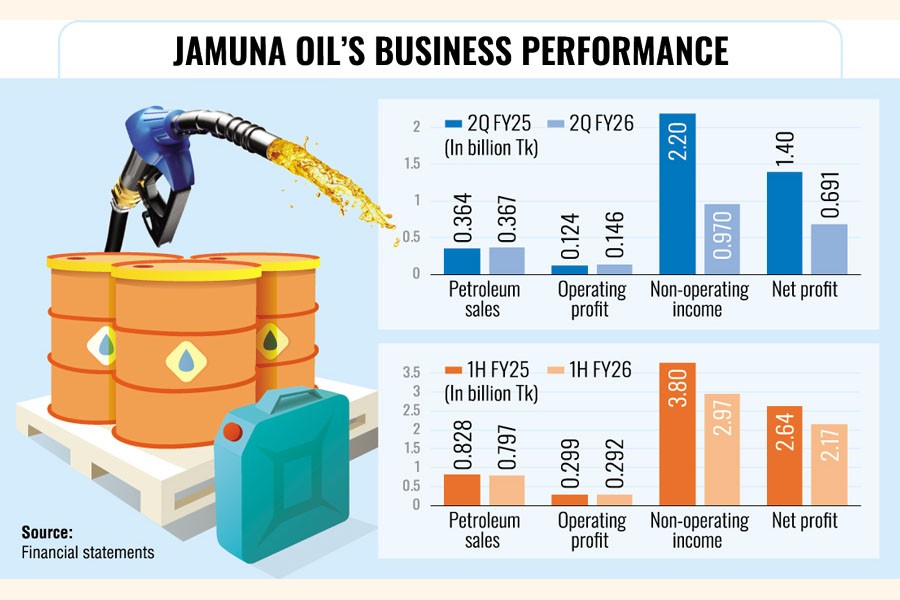
Jamuna Oil Company's profit halved year-on-year to Tk 691 million in the second quarter of FY26 as it failed to realise interest income from deposits in Islamic banks that have been merged to salvage them from a liquidity crisis.
The state-run company holds fixed deposit receipts (FDRs) amounting to Tk 10.66 billion in four cash-strapped banks-First Security Islami Bank, Global Islami Bank, Union Bank, and Social Islami Bank-out of the five recently merged into Sammilito Islami Bank.
Due to the liquidity crisis, the newly formed Sammilito Islami Bank has been unable to pay interest on deposits, which hit Jamuna Oil's bottom line.
"Jamuna Oil's profit plunged as interest on bank deposits with Sammilito Islami Bank for the second quarter of FY26 has not been accrued, and interest accrued for the first quarter earlier has been written back," said the company in its earnings note.
This happened as the recovery of interest income became uncertain.
As a result, Jamuna Oil's net profit plunged 51 per cent year-on-year in the October-December quarter of 2025.
The company's earnings from the sale of petroleum products remained almost static in the quarter compared to the same period a year earlier. However, non-operating income-on which the company had been relying to secure profit growth-tumbled 56 per cent year-on-year to Tk 970 million in the quarter through December last year.
Its dependence on non-operating income was evident in its FY25 results. Jamuna Oil posted a record profit of Tk 6.48 billion in FY25, of which Tk 5.27 billion came from interest on bank deposits amid rising interest rates.
Like other state-run fuel marketing companies, Jamuna Oil generated significant income beyond its core business, largely driven by interest income from bank deposits. In FY25, 81 per cent of the company's profit was derived from bank deposits
The company's half-yearly profit also dropped 18 per cent year-on-year to Tk 2.17 billion for the July-December period last year, again due to the erosion of interest income.
Akramul Alam, head of research at Royal Capital, said income from bank deposits may decline further in the future due to credit risk as well as blocked interest in the merged bank.
Jamuna Oil held FDRs worth Tk 3.26 billion in First Security Islami Bank, Tk 4.32 billion in Global Islami Bank, Tk 2.89 billion in Union Bank, and Tk 186 million in Social Islami Bank.
These investments were made to earn interest at rates ranging from 10 per cent to 12.5 per cent-a lucrative stream of non-operating income that now faces the risk of becoming irrecoverable.
Moreover, the company holds FDRs worth Tk 70 million in National Bank and Tk 740 million in Bangladesh Commerce Bank. These banks are also grappling with high default loans, which have weakened their financial health.Personal finance advice
Meanwhile, Jamuna Oil has written to the four merged banks seeking encashment of its investments, but the banks have yet to provide a positive response due to liquidity shortages, according to the auditor's qualified report for FY25.
"This exposed the company's weak corporate governance. The management should have conducted proper risk analysis well before the banks' collapse," said Alam.
The company's liquidity position may be squeezed further due to counterparty credit losses from these blocked funds, he added.
Meanwhile, the company's stock shed 1.64 per cent to Tk 167.5 per share on Monday on the Dhaka Stock Exchange.
Net operating cash flow per share-a measure of a company's ability to generate cash from operations-fell sharply to negative Tk 131.21 in July-December 2025 from positive Tk 74.13 in the same period a year earlier.
The company, however, explained that the cash flow deterioration was caused by an increase in inventories and a decline in credit and accruals during the period.
babulfexpress@gmail.com