

Published :
Updated :
 For all latest news, follow The Financial Express Google News channel.
The wobbling equity market has experienced heightened volatility over the past three weeks, driven primarily by significant price erosion among market leaders, including Grameenphone.
A combination of factors, including a decline in foreign portfolio investments, concerns over the viability of several financial institutions, and fresh political unrest, has led to increased caution among investors.
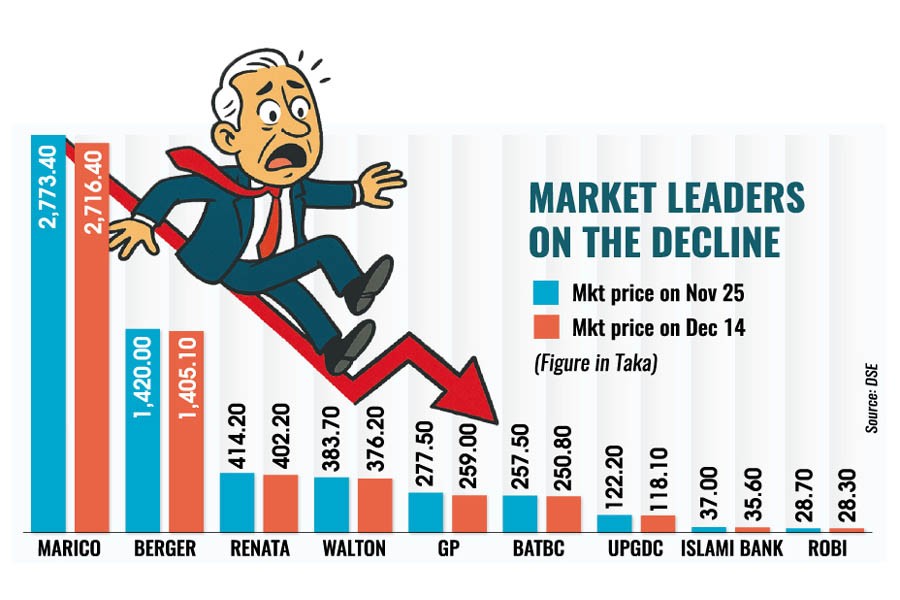
These elements have manifested in noticeable fluctuations in the Dhaka Stock Exchange (DSE) indices, reflecting the underlying uncertainties in the market. Since November 25, the majority of market leaders in terms of capitalisation have seen substantial declines.
For example, Grameenphone's stock price, which closed at Tk 280.10 on December 3, came down to Tk 259 on Sunday, marking a loss of 7.53 per cent or 21.10 points.
This company having the highest market capitalisation of over Tk 349 billion alone holds owns 2.7 per cent share of the DSE's free float cap.
According to BRAC EPL Stock Brokerage, a 10 per cent change in Grameenphone's stock price impacts the DSE index by 0.27 per cent.
So, the impact of erosion in Grameenphone's price by one taka is much higher than many other small- or mid-cap companies, given its sizable share in the DSE.
A similar trend is observed with other large-cap stocks. Square Pharmaceuticals, another market leader, holds the largest share of 7.3 per cent in the DSE's free float market, meaning its price decline also exerts a significant negative impact on the broader index.
Beyond Grameenphone and Square Pharmaceuticals, several other top market leaders have experienced price erosion between November 25 and December 14, further intensifying market volatility.
On the other hand, 'junk' stocks, such as Zeal Bangla Sugar Mills, experienced upward rally during this period, but their small market capitalisation failed to prop up the benchmark DSEX index.
From November 25 to December 14, the DSEX dropped 1.71 per cent or 86 points, closing at 4,932 points, as several negative factors weighed on investor sentiment.
To support the market, the state-run Investment Corporation of Bangladesh (ICB) has received Tk 10 billion from the government.
When asked, ICB Managing Director Niranjan Chandra Debnath said that they were unable to predict the market's movements. "We are injecting funds into the market. But whatever stock we purchase has faced erosion," he said.
The ICB received the funds at a 5 per cent interest rate, meaning the corporation needs at least a 5 per cent return from any stock it invests in.
Mr Debnath expressed concern about the potential for losses in fresh investments. "We are apprehensive of incurring losses in new investments," he said.
Meanwhile, market sentiment showed some signs of recovery following the announcement of the national election schedule, according to Md. Ashequr Rahman, Managing Director of Midway Securities.
However, he pointed to a recent gun attack in the capital as a factor that had heightened investor anxiety. "Such incidents affect the market movements," Mr Rahman noted.
Grameenphone, one of the largest market leaders, also saw heavy selling pressure, which Rahman speculated may have come from a portfolio investor whose investment period had likely expired.
"Such issues also affect the market movements," he remarked.
Adding to market concerns, the Bangladesh Securities and Exchange Commission (BSEC) recently expressed concern over auditors' opinions in the financial statements of 31 listed banks and financial institutions.
The auditors identified anomalies and raised doubts about the 'going concern' status of these companies.
In response, the BSEC sent a letter seeking intervention from to Bangladesh Bank (BB) to take action against these institutions.
The central bank is also in the process of liquidating nine non-banking financial institutions.
Insiders believe regulatory measures are crucial for stabilising the market, but these factors have had an immediate and negative impact.
On Sunday, the Dhaka bourse experienced a moderate correction. The DSEX fell 0.62 per cent or 30.86 points, closing at 4,932 points, mainly due to price erosion in the majority of blue-chip stocks.
Of the 30 blue-chip stocks, 25, including Square Pharmaceuticals and Grameenphone, ended in the red. Out of the 391 issues traded on the DSE, 79 advanced, 249 declined, and 63 remained unchanged. The turnover for the day stood at Tk 4.57 billion, down 1.35 per cent from the previous session.
mufazzal.fe@gmail.com