

Lub-rref gets nod to redeploy IPO funds, but bank crisis clouds prospects
Published :
Updated :
 For all latest news, follow The Financial Express Google News channel.
Lub-rref received regulatory approval to revise its plan for utilising residual IPO proceeds, but the funds are currently held with Social Islami Bank - an institution grappling with acute liquidity shortages and an ongoing merger - raising serious questions about the viability of the revised plan.
The company's board of directors approved a proposal to utilise Tk 200 million in unused IPO proceeds for settling liabilities, restructuring loans and supporting working capital, citing prolonged financial stress stemming from global and domestic economic shocks.
M
The purposes have deviated from what was originally earmarked in the IPO prospectus.
The proposal will require further approval from shareholders at an extraordinary general meeting (EGM) scheduled for July 9 for implementation, according to a stock exchange filing on Wednesday.
However, the funds had been kept in a short notice deposit (SND) account with Social Islami Bank after a planned syndicated loan for a balancing, modernisation, rehabilitation and expansion (BMRE) project failed to materialise.
The company's auditor even expressed uncertainty in its FY25 financial statements over the recovery of the deposits because of the bank's liquidity crisis and merger-related developments
The company secretary, Kabir Hossain, while talking to the FE, however, expressed confidence that the company would be able to access the funds.
"The Agrabad branch authorities of the bank have assured us that the funds will be released," he said over the phone.
Under the proposed revision, the Chattogram-based lubricant manufacturer plans to use approximately Tk 45.6 million to settle outstanding letter of credit (LC) liabilities. It also intends to allocate Tk 43.3 million to make a down payment for rescheduling long-term and short-term loans. The remaining balance, the company said, would be utilised as working capital to support business operations.
"The board considered it prudent to seek an alternative use of the idle funds in the interest of shareholders," said Mr Hossain, adding that the Bangladesh Securities and Exchange Commission (BSEC) had already approved the plan.
He noted that the company's working capital base had significantly eroded due to the Covid-19 pandemic, the Russia-Ukraine war and the political upheaval of 2024, prompting the board to seek an alternative use of the idle funds.
Market analysts said the proposed reallocation could help ease the company's financial pressure but might disappoint investors who subscribed to the IPO expecting business expansion.
Akramul Alam, head of research at Royal Capital, said that using the funds to repay liabilities and strengthen working capital could improve liquidity and support operational sustainability.
However, it represents a deviation from the original IPO utilisation plan, potentially raising concerns among investors who had expected the funds to be used for expansion and capacity enhancement, he added.
Lub-rref raised Tk 1.50 billion through its IPO in 2021 to support a large-scale expansion project at Julda Industrial Park in Chattogram. The Tk 15 billion project was expected to be financed through syndicated loans led by Social Islami Bank alongside IPO proceeds.
But the company failed to secure the syndicated financing, leaving key components of the project unimplemented despite acquiring and developing 40 acres of land.
As a result, the investments already made did not translate into income but increased finance expenses. The woes were further intensified by a working capital shortage and high procurement costs.
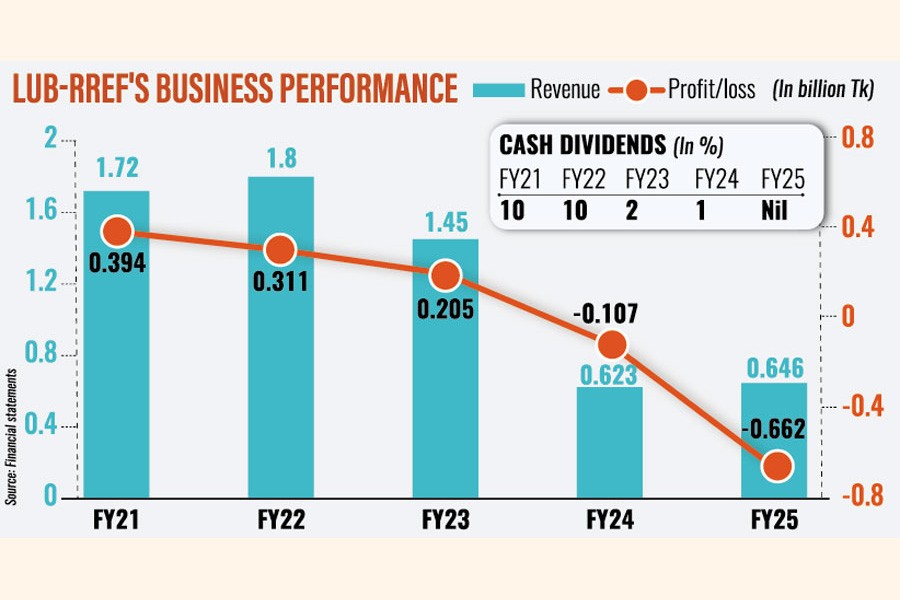
Subsequently, Lub-rref has sunk deeper into the red within five years of listing. The lubricant producer reported a loss of Tk 622 million for the year ended June 2025, up from a loss of Tk 107 million a year earlier. It also suffered a loss of Tk 322 million in the nine months through March this year.
"Our planned Tk 15 billion project cost has ballooned to Tk 22 billion. As a result, our loan burden and interest expenses soared, and raw material costs increased significantly due to import dependency," the company secretary said earlier.
Constrained letter of credit facilities severely impacted the company's ability to import raw materials, leading to reduced production capacity and an inability to meet market demand.
As corrective measures, the company is considering addressing the L/C problem and working capital shortage through other banks instead of Social Islami Bank, he added.
babulfexpress@gmail.com