

Published :
Updated :
 For all latest news, follow The Financial Express Google News channel.
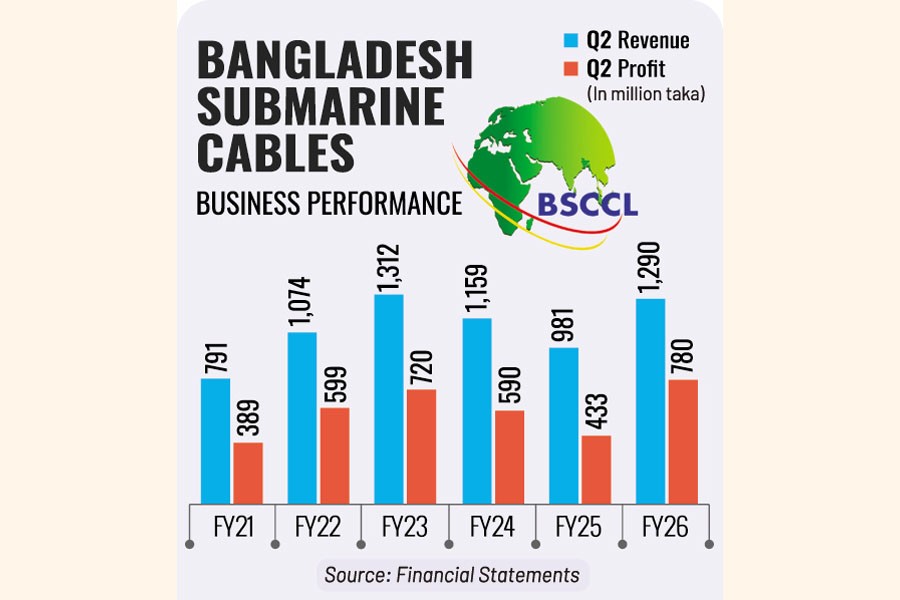
Bangladesh Submarine Cables recorded a remarkable 80 per cent rise in profit to Tk 780.85 million in the second quarter of FY26, as revenue surged by more than 30 per cent compared with the same quarter a year earlier.
According to the company, the strong earnings growth was driven by a policy shift that enabled it to capture a larger share of business.
"We used to provide the connectivity part, while the content or entertainment part was imported by companies such as Summit Communication or Fiber@Home from India. The government later imposed restrictions on the operations of private companies to save foreign currency," said Md Ariful Huq, deputy general manager (marketing and sales) of Bangladesh Submarine Cables.
"As a result, traffic was diverted to Submarine Cables, boosting our revenue," he added.
However, the additional business opportunity may not persist in the coming quarters, as private firms have filed a writ petition against the government's decision, Mr Huq said.
The state-owned company, which manages the country's international submarine connectivity, currently provides more than 7,220 Gbps of bandwidth. A third submarine cable is under development and is expected to be completed by 2027, which would significantly boost total capacity to over 13,200 Gbps.
At present, the company operates two submarine cables, which play a critical role in reducing reliance on terrestrial, land-based routes-mostly via India-and in ensuring high-speed and reliable internet access.
Some competitors of the state-run entity have obtained licences and are engaged in building private submarine cable networks to connect Bangladesh with international bandwidth sources. Once operational, these networks are expected to directly challenge Submarine Cables' core business.
Traditionally, Submarine Cables has supplied most international bandwidth through submarine connectivity. Summit Communication, however, now supplies a significant share of bandwidth through terrestrial international links and its international internet gateway (IIG), reducing Submarine Cables' market dominance.
Licensing and perceived unfair advantage
The regulatory framework originally envisioned a limited number of telecom licences, such as a maximum of three ITC licences. However, Summit and other firms received multiple licences across the infrastructure chain, including NTTN, ITC, IIG, and now submarine cable.
Critics argue that such clustering provides Summit with structural advantages, allowing it to import bandwidth through ITC and distribute it downstream, undercut competitors, and push smaller firms out of the market.
Private submarine cable vs state-owned capacity
Summit, along with its partners, has secured a licence to build a private submarine cable, challenging Submarine Cables' long-held role as the primary subsea carrier.
Submarine Cables has been able to meet current demand and is expanding capacity, prompting experts to question the necessity of private submarine cables.
Meanwhile, the company's share price rose 0.59 per cent to Tk 136.60 per share on Thursday on the Dhaka Stock Exchange (DSE).
farhan.fardaus@gmail.com