

Uncertainty looms over subsidiaries of NBFIs facing liquidation
Published :
Updated :
 For all latest news, follow The Financial Express Google News channel.
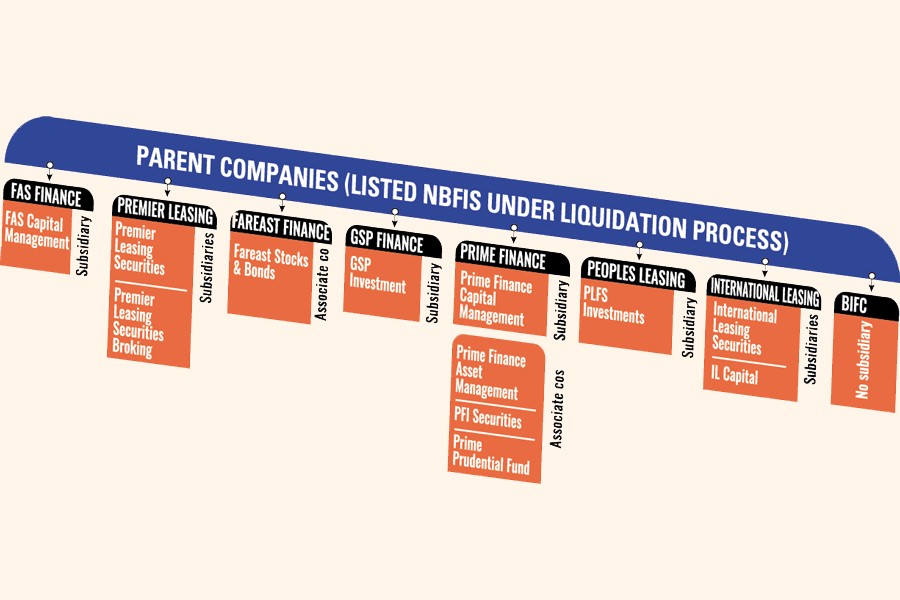
The central bank's decision to liquidate nine non-bank financial institutions (NBFIs) has raised questions about the fate of their subsidiaries and associate companies operating in the secondary market, as well as their clients who are also investors.
Eight of the NBFIs are listed on the stock market and together have seven stockbrokers or dealers, five merchant banks and an asset management firm operating under them. Thousands of investors are connected to these organisations, creating a cumulative impact on the market.
There is no clear provision in the Bank Resolution Ordinance 2025 on what happens to subsidiaries and associate companies when parent companies are liquidated, said Md Sajedul Islam, managing director of Shyamol Equity Management.
The central bank has yet to clarify whether the subsidiaries will also be dissolved.
"Liquidation means permanently closing operations and selling off assets to repay liabilities, which may include subsidiaries."
Licences of the subsidiaries and associate companies may be sold to repay liabilities as part of the liquidation of the parent companies, added the chief of Shyamol Equity Management.
Abul Kalam, director and spokesperson of the Bangladesh Securities and Exchange Commission (BSEC), said subsidiaries and associate companies are separate legal entities, but if licensed in the name of parent companies, they would be liquidated too.
Clients of such entities will be given time to transfer their securities to another brokerage firm by opening a linked beneficiary owner's (BO) account.
Mr Kalam, however, said the central bank had yet to officially notify the market regulator of the liquidation decision.
"Investors of listed firms have the right to receive price-sensitive information as per securities rules, and liquidation is a highly significant and price-sensitive decision.
"If investors of these firms face losses, the authorities concerned will bear responsibility for not disclosing the information in a timely manner."
Together, the nine NBFIs accounted for 52 per cent of total defaulted loans in the NBFI sector, estimated at around Tk 251 billion at the end of 2024.
In addition to loan frauds and unchecked irregularities, margin loans that later turned into a heavy burden of negative equity were another major factor behind the financial distress of the NBFIs, according to market stakeholders.
Lenders - brokerage firms and merchant banks - under these NBFIs aggressively disbursed margin loans, boosting market liquidity ahead of the 2010-11 stock market crash.
As a result, a large portion of NBFI funds was funnelled into margin lending. Following the market crash, many of those loans became unrecoverable. Consequently, subsidiaries of several NBFIs topped the list of companies with negative equity.
For example, International Leasing had negative equity of Tk 3.05 billion, while Prime Finance recorded negative equity of Tk 2.10 billion as of October last year, according to the securities regulator.
"The disbursement of margin loans using funds of the non-bank financial institutions is one of the major reasons behind their present moribund state," said Asif Khan, chairman of EDGE Asset Management.
Given their current financial health, shareholders of these institutions have little chance of recovering their investments due to high classified loans and negative net asset values.
"General investors have hardly anything to hope for, as they will come at the bottom of the repayment list when dues are settled," said Mr Sajedul Islam.
"There is only one option to get investors something, if the government takes the initiative to sell the personal assets of sponsor-directors," he added.
Under liquidation rules, external creditors are paid first, followed by depositors, debenture holders and preferential shareholders.
The NBFIs are to be liquidated under the Bank Resolution Ordinance 2025, the country's first comprehensive framework for resolving failing banks and non-banks.
The central bank board recently approved the liquidation of the NBFIs in what it described as the first large-scale liquidation move in the financial sector, aimed at protecting depositors and restoring stability.
babulfexpress@gmail.com