
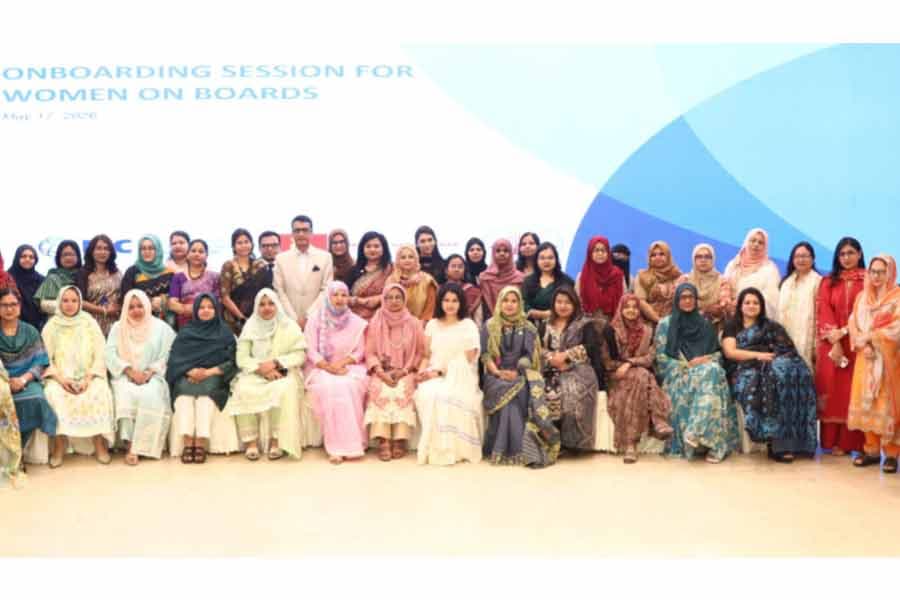
Speakers at a seminar stressed the need for building a strong network and database of qualified female professionals to help listed companies appoint competent women to board positions and strengthen corporate governance.
“The companies with diverse leadership structures are generally better positioned to ensure accountability, professionalism and effective decision-making,” said Nuzhat Anwar, managing director of Dhaka Stock Exchange.
To strengthen governance standards, transparency and long-term sustainability in the corporate sector, there is no alternative to increasing women’s participation in corporate leadership and boardrooms, said Ms Anwar.
“Women’s participation in corporate leadership is essential for building transparent and sustainable institutions,” she added, noting that Bangladesh’s capital market requires more inclusive leadership to strengthen investor confidence and governance practices.
She was speaking at a seminar titled “Women on Boards” that was jointly organised by Dhaka Stock Exchange and International Finance Corporation at the DSE Tower in Nikunja under IFC’s Integrated Environmental, Social and Governance (iESG) Project, with support from the Embassy of Denmark in Bangladesh.
The programme brought together senior female professionals from listed companies, regulators and accounting bodies to discuss the future of inclusive corporate leadership.
Representatives from Institute of Chartered Accountants of Bangladesh, Institute of Cost and Management Accountants of Bangladesh and Association of Chartered Certified Accountants also attended the session alongside senior executives and female professionals from listed companies.
Speakers observed that greater female representation at the board level is no longer only an issue of equality, but also a business necessity for improving governance, accountability and sustainable growth.
Corporate governance experts at the workshop discussed directors’ responsibilities, legal accountability, financial governance and ESG-related standards, which are becoming increasingly important for companies seeking sustainable growth and international investor confidence.
Lopa Rahman, corporate governance advisory at IFC South Asia, highlighted the evolving role of corporate boards in ensuring compliance, risk management and strategic oversight in a rapidly changing business environment.
She also discussed sustainability standards and ESG practices, saying strong board leadership is increasingly becoming a key requirement for attracting responsible investment and ensuring long-term business resilience.
Another session on financial governance was conducted by Zarin Mahmud Hossain, council member of the Institute of Chartered Accountants, and independent director of Mutual Trust Bank, who discussed the role of corporate boards in ensuring transparency, accountability and sound financial management.
DSE Chief Financial Officer Md. Abid Hossain Khan said Bangladesh’s listed companies are expanding rapidly, but sustaining that growth will require stronger governance structures and more diverse perspectives in leadership positions.
“Diverse boards often contribute to better risk assessment, improved strategic decisions and long-term corporate stability,” he said.
Referring to the success of female leaders in sectors such as garments, textiles, banking and telecommunications, the DSE CFO said Bangladesh has already demonstrated that women can play transformative roles in corporate leadership when given equal opportunities.
Meanwhile, the Bangladesh Securities and Exchange Commission (BSEC) recently warned that the listed companies without a female independent director on their boards will face legal action if they fail to appoint at least one by June this year.
Currently, 131 out of 294 listed companies have not yet complied with the mandatory provision of the corporate governance code regarding the appointment of a female independent director to their boards, according to DSE.
Under the regulatory guidelines, listed companies are required to appoint one-third independent directors from among entrepreneurs, members of business organisations, corporate leaders, university teachers, retired or current government officials, professional degree holders, or practising lawyers in the High Court Division.
babulfexpress@gmail.com