


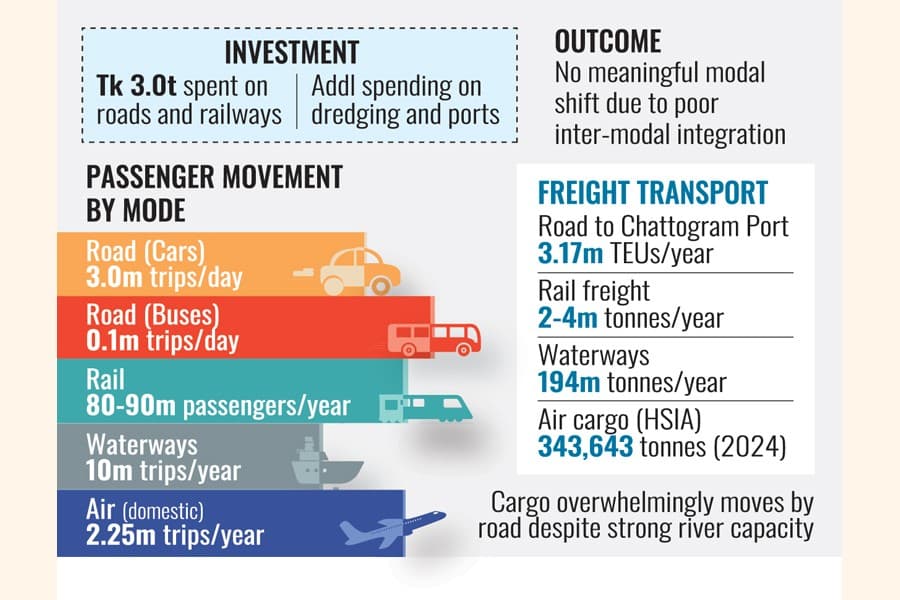
An enormous amount of money had been invested in developing Bangladesh's communications system over the past 15 years but modal transport share remained heavily skewed toward overburdened roads for no significant shift to rail, water, or air transport.
A baseline study carried out under the National Integrated Multimodal Transport Master Plan has found passenger-centric development of rail, water, and air transport could neither reduce reliance on roads nor shift cargo transportation away from jammed roadways.
Around three million trips are generated by cars and 0.1 million by buses per day while rails serve 80-90 million passengers in a year's time, the study shows. The findings state that the railway transports two to four million tonnes of cargos per year, while 3.17 million twenty-foot equivalent units (TEUs) of goods are carried by road per day to and fro the Chattogram seaport, as of the survey period.
Waterways generate 10 million passenger trips and carry 194 million tonnes of cargos annually despite 50 of the 54 river ports being connected to rivers having drafts of over 2.5 metres.
Moreover, eight airports serve passengers on eight domestic routes and 22 international ones, annually generating 15 million trips -- 15 per cent on the domestic routes.
The prime one, Hazrat Shahjalal International Airport in Dhaka, handled 343,643 tonnes of cargos in 2024.
The intense focus on passenger rail development has limited 25 per cent of the trips to 16 stations, including Dhaka, Chattogram, Rajshahi, Sylhet, Jamalpur, Jashore, Brahmanbaria, Kishoreganj, Khulna, Mymensingh, and Ishurdi.
The study has found 37 per cent of passenger rail trips having originated from Dhaka, Rajshahi, and Chattogram.
During the past 15 years, the Awami League government spent a large sum of money on developing road, rail, and waterway infrastructures through mega- and fast-track projects under its Vision 2021 and Vision 2041 roadmaps.But the projects were taken without any integration and the target to shift modal shares.According to the white paper committee report, Tk 3.0 trillion was spent on projects under the ministries of railway and the road transport and bridges.A significant amount was also spent on river dredging and port development, including the Matarbari deep-sea port and Chattogram and Mongla port expansions.Bangladesh has a total of 4,200km national highways, 5,000km regional roads, 13,300km district roads, and 0.16 million kilometres of upazila roads.But 14 per cent of the national highways have single lanes or non-standard two lanes.Despite the extensive road infrastructure, the origin of trips of all modes of road transport -- cars, buses, and motorcycles -- is Dhaka-centric, as all depend, for many purposes, on the centripetal capital.And Dhaka, Gazipur, Chattogram, Sylhet, Rangpur and Cumilla remain the origins and destinations of all kinds of goods vehicles.The road share of light goods vehicles, medium goods vehicles, and heavy-duty goods vehicles has not developed proportionately.Midsize goods vehicles dominate roads with around 185,000 trips per day."Dhaka is the single-most important centre of freight traffic," says Moinul Hossain, a professor of civil and environmental engineering at the Islamic University of Technology. He says seaports carry most goods to and from Dhaka, Sylhet, Mymensingh, and Barishal regions.Attributing such mismatch to uncoordinated modal development, he says issues like underutilised modal potential, poor last-mile connectivity, regional major bottlenecks, and high dependence on roads need to be addressed to shift the road-centric modal share to other modes.He recently shared the baseline study report at a stakeholder meeting at the Roads and Highways Department, stressing the need for encouraging projects to shift water and rail modal shares to create multimodal resilience.Besides, he has highlighted that about 42 natural multimodal hubs exist in the country with river, rail, and land-based ports, stations, and terminals within five-kilometre ranges.He recommends taking such projects with limited spending.
smunima@yahoo.com