

40pc extra for new banknotes on footpath as central bank halts supply
Published :
Updated :
 For all latest news, follow The Financial Express Google News channel.
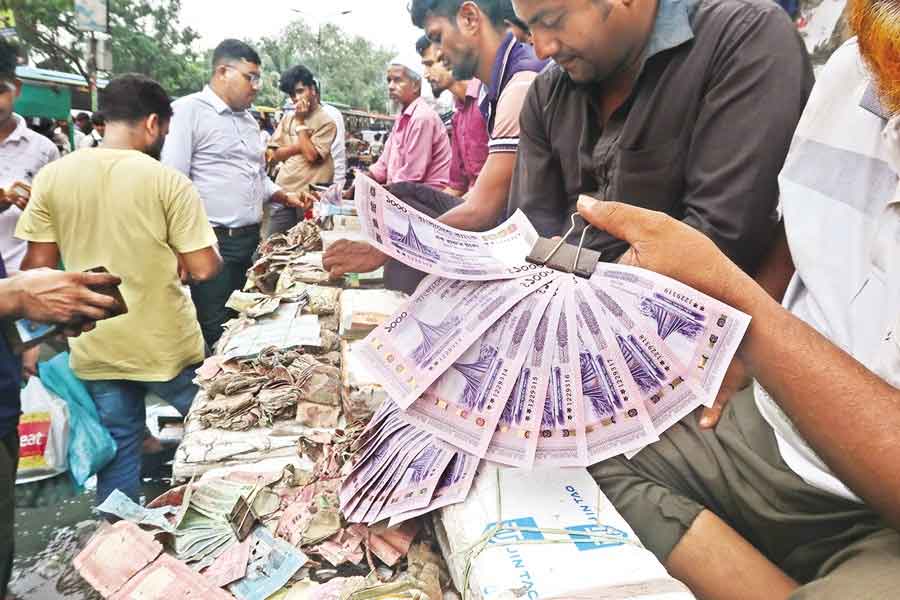
The festive spirit of Eid-ul-Fitr has been dampened for many as the central bank’s decision to halt the supply of new banknotes has forced citizens to pay up to a 40 percent premium on the black market.
The lack of official distribution has left footpath vendors in areas like Gulistan and Motijheel as the only source of crisp bills, which are in high demand during Eid, when many elders traditionally give money to younger people, especially children and youth.
Buyers are paying an extra Tk 400 for Tk 1,000 worth of Tk 10 notes, effectively raising the price of each note to Tk 14.
The crisis stems from a series of leadership changes and policy reversals at Bangladesh Bank.
Under former Bangladesh Bank (BB) governor Abdur Rouf Talukder, the long-standing practice of direct exchange at the central bank was shifted to commercial banks.
By 2024, 84 bank branches were designated for this service.
Following the 2024 mass uprising, the interim government halted the distribution of notes featuring Bangabandhu Sheikh Mujibur Rahman.
The central bank began preparing new designs featuring July Uprising motifs.
After the formation of the BNP government and the appointment of a new governor on Feb 25, the decision to release the July Memory notes for this Eid was scrapped.
Despite the official ban on public distribution, the BB issued an internal circular allowing its own officers and staff to withdraw new notes ranging from Tk 18,500 to Tk 183,000.
These internal allocations include denominations of Tk 10, 20, 50, 100, 500, and 1,000.
While the public remains barred, some commercial banks have reportedly released older-designed new notes into the market under pressure from their own employees, further feeding the informal supply chain on the streets.
In Motijheel, vendors are demanding an extra Tk 500 for a Tk 2,000 bundle of Tk 20 notes, and Tk 300 extra for the same amount in Tk 50 or Tk 100 notes.
"I used to get new notes through friends at the bank, but this year they have nothing," said Nazmul Islam, a frustrated buyer.
"Paying Tk 1,400 for Tk 1,000 is unthinkable. I’ve decided not to buy new banknotes in bundles. I'll just take a few loose pieces for the kids," he said.
Ferdous Khan, heading home to Barishal, echoed the sentiment: "The kids look forward to new notes, but with my income down, I can’t justify paying Tk 400 extra per bundle. I’m just taking ten pieces of Tk 20 notes so I can at least say I brought something."
Trading in the national currency for a fee or profit is a punishable offence under Bangladeshi law.
Despite this, the open trade of new banknotes continues year-round in areas like Sadarghat, Mirpur, and Farmgate, peaking sharply during the Eid season while authorities largely turn a blind eye.