

Published :
Updated :
 For all latest news, follow The Financial Express Google News channel.
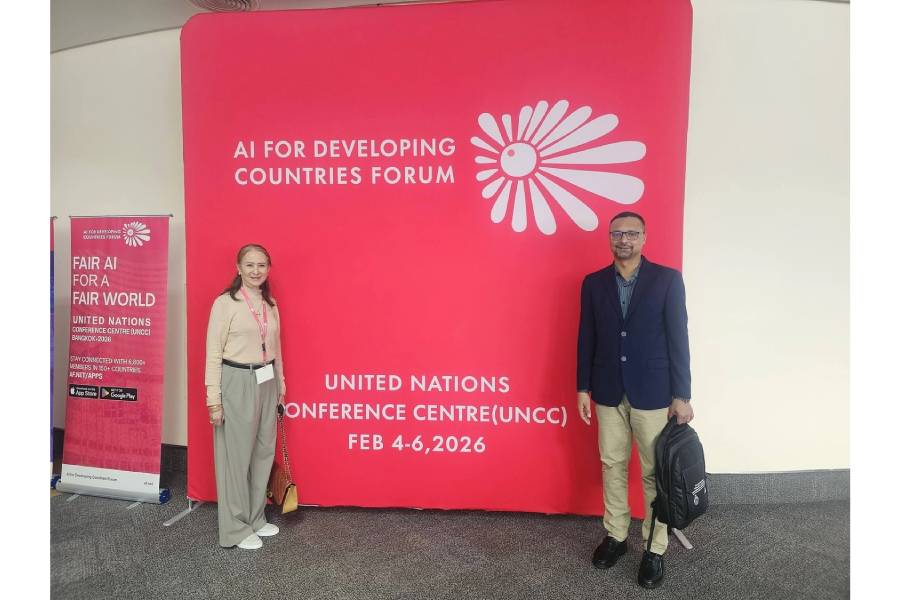
The American International University-Bangladesh (AIUB) participated in the AI for Developing Countries Forum (AIFOD) Winter Summit, held at the United Nations Conference Centre (UNCC) in Bangkok, Thailand, from February 4–6, 2026.
AIUB was represented at this prestigious global forum by Dr. Carmen Z. Lamagna, Member of the Board of Trustees and Former Vice Chancellor of AIUB, and Prof. Dr. Dip Nandi, Associate Dean, Faculty of Science and Technology, AIUB, according to a press release.
Their participation reflected AIUB’s strong and continuous engagement in global conversations on responsible, inclusive, and sustainable artificial intelligence, in alignment with the United Nations Sustainable Development Goals (SDGs).
The AI for Developing Countries Forum (AIFOD) was established to create fair and equitable opportunities for access to artificial intelligence.
The forum brings together policymakers, academics, technologists, and development practitioners from across the world to design AI solutions that respond to local needs, rather than relying on standardized global models.
The Bangkok summit focused on how developing nations can move beyond being merely data suppliers and technology consumers to becoming true architects of their own digital future.
The panel session titled “How Can Developing Countries Build AI That’s Truly Ours?” was moderated by Prof. Dr. Dip Nandi.
In his role as moderator, Prof. Nandi led a critical global discussion on the widening AI divide, where high-income nations—representing only 17% of the world’s population—currently control nearly 87% of existing AI models.
On the sidelines of the summit, Dr. Carmen Z. Lamagna and Prof. Dr. Dip Nandi held a formal meeting with the founders of AIFOD.
The discussion focused on establishing strong academic collaborations aimed at bridging the gap between theoretical AI research and real-world applications in developing nations.
Drawing from practical experience in Bangladesh, Dr. Lamagna highlighted how AI can contribute to sustainability when it is developed around local contexts rather than imported as a ready-made solution.
She shared a practical example from a university campus serving approximately 15,000 students, where AI technology is used to predict short-term energy demand alongside solar energy production, enabling more efficient and sustainable energy management.
AIUB’s active participation in the AIFOD Winter Summit reinforces the university’s commitment to global leadership in technology, research, and innovation, as well as its dedication to contributing meaningfully to the future of ethical and inclusive artificial intelligence for developing societies.